
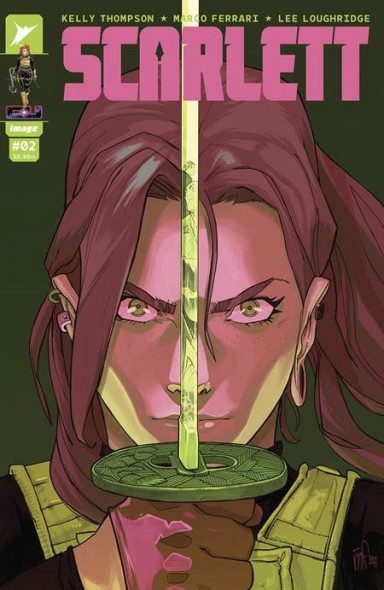
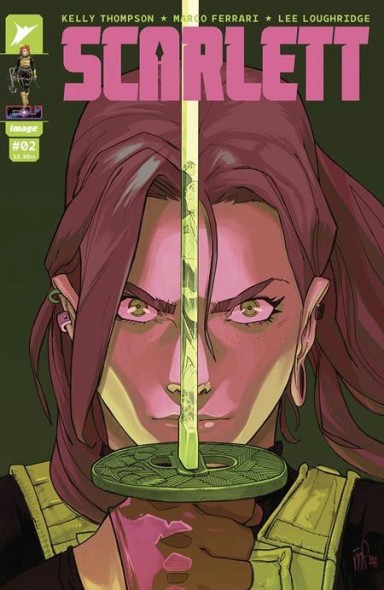
A Stunning Artistic Showcase: Reviewing ‘Scarlett’ #2
by Austin Gorton
Overview
Scarlett #2 continues the series’ strong start by serving as a showcase for the talents of artist Marco Ferrari, who excels at both the action and thematic storytelling.
Overall
9/10Scarlett #2 is a strong follow-up to the series’ inaugural issue. It continues to showcase the strong grasp writer Kelly Thompson has on Scarlett’s characterization, using the plot as a vehicle to showcase her skills, determination, and motivations.
But even more so than the previous issue, this second chapter is a showcase for artist Marco Ferrari, who continues to prove adept at both the martial arts and super spy elements of the story.
This is especially true of the first dozen or so pages. While hardly silent — there are still narrative captions written from Scarlett’s perspective and a few snippets of dialogue — it is nevertheless a stretch in which the burden of storytelling falls squarely on Ferrari’s shoulders.
He proves up to the challenge. Awakened tied to a chair after being knocked out by Storm Shadow in the closing page of the previous issue, the first half of this installment showcases first Scarlett’s escape from bondage, and then a series of fights that ultimately prove to be an audition of sorts for Storm Shadow and the Hard Master.

Ferrari ably controls the pacing of the ensuing fight scenes via panel layouts, slowing down the action with fewer, longer panels on one page and speeding it up via smaller, more numerous panels on the next. On one page, divided into four long rectangular panels, he positions Scarlett in each panel such that she never appears in full in any one panel. It creates the impression of dynamic action, of a character moving so fast the “camera” can’t even fully catch her full figure.
Ferrari also plays with perspective throughout the fight, shifting from action depicted from Scarlett’s point-of-view to action from her opponents’ point-of-view. This culminates in the climax of the fight, in which it’s revealed that the wall Scarlett has had her back against is actually a mirror, with Storm Shadow watching on the other side. From that point on, the ensuing action is shown entirely from Storm Shadow’s “opposite” perspective, until he reveals himself to Scarlett and she crosses the threshold to his side – literally and metaphorically.
Thus “mirrored perspective” is a recurring theme throughout Scarlett #2. Just as the fight scene is depicted from two opposite sides, and serves as a vehicle to transition Scarlett from Arashikage foe to Arashikage ally, this issue is, structurally, the mirror of issue #1. Where that issue starts off as a spy story before shifting into a martial arts one, Scarlett #2 starts off as a martial arts story before transitioning back into a super spy adventure, as Scarlett sets out on the mission given to her by the Hard Master to prove her worth to the clan.
This mirrored perspective continues all the way through to the final page of the issue, which concludes with Scarlett leaping into action down a long shaft, but is depicted such that readers are looking up at her as she falls. Scarlett is a character forced to move between worlds — military, espionage, ninja — and this is illustrated by Ferrari as much as by the beats of the plot.

The end result is an issue which succeeds in terms of furthering Scarlett’s characterization, the immediate plot of the miniseries, and this new take on the GI Joe mythos. But more than anything, Scarlett #2 succeeds as a vehicle for artist Marco Ferrari, both for the way he renders the action scenes in a kinetic and engaging manner and the way his work supports the characterization and thematic elements of the issue.
Scarlett is an accomplished and driven woman, fighting her way across multiple worlds to meet her goals. The success here is that words aren’t needed to make that clear.
