
Snap Into Marvel! — Will Gwenpool Break The Meta?
by Austin Gorton
Real Name: Gwendolyn “Gwen” Poole
First Comic Book Appearance: Deadpool’s Secret Secret Wars #2 variant cover (June 2015)
First Full Comic Book Appearance: Howard the Duck (vol. 6) #1 (November 2015)
Powers: Fourth Dimensional awareness that she is a comic book character, one who possesses vast knowledge of the Marvel Universe by having read a bunch of Marvel comics in her home universe. Over time, she has displayed the ability to interact directly with the medium of her stories, manipulating dialogue bubbles, pushing characters into the gutters between panels, etc. She has also been trained in weapons and hand-to-hand combat by Batroc the Leaper.
Comic Book Chronicles
Gwenpool has one of the oddest real-life origins of any Marvel Comics character.
So, once upon a time, there was a character named Gwen Stacy. She was Spider-Man’s girlfriend for a while, and then was killed by the Green Goblin in a foundational Spider-Man story. Many years later, Rob Liefeld and Fabian Nicieza created a character named Deadpool. Initially little more than a thin pastiche on the kind of anti-hero mercenary characters that were exceedingly popular at the time, Deadpool evolved into a character known for talking a lot, cracking a lot of jokes, and possessing a vague awareness of his existence as a comic book character.
Many years after that, the “Spider-Verse” storyline introduced a whole bunch of alternate Spider-Men from across the multiverse. One of them was an alternate Gwen Stacy who, instead of dying, became a Spider-Man in her own right. Technically named “Ghost Spider“, she came to be referred to colloquially as Spider-Gwen (a version of this character appears in the Spider-Verse animated films, which were inspired by the earlier “Spider-Verse” comics).

Not long after that, due to the increasing popularity of Spider-Gwen, Marvel released a wave of variant covers across their comics featuring mashups of Gwen Stacy and the title character of each comic. Thus was Gwenpool — an amalgamation of Gwen Stacy/Spider-Gwen and Deadpool — born on a variant cover to an issue of a Deadpool comic, At that point, she existed only as that image. Yet despite that, driven by the combined popularity of Spider-Gwen and Deadpool, she became popular herself, especially amongst the cosplay crowd. Seeing this, editor Jordan D. White commissioned the creation of a Gwenpool character in a comic book story.
Pointedly (and humorously, probably unintentionally so), due to the state of film rights for various Marvel characters at the time, Gwenpool the comic book character (as opposed to Gwenpool the Gwen Stacy version of Deadpool on an alt Gwen Stacy-themed variant cover) couldn’t actually be connected to either of her dual inspirations. She’s not the daughter of Deadpool or Gwen Stacy from another reality or anything like that. She’s a fully independent character who just happens to kind of look like Deadpool and have a name that is a portmanteau of Gwen Stacy and Deadpool.

That said, her knowledge of the Marvel Universe as a creation of comic book stories and her place within it as a character is certainly in keeping with Deadpool’s modern day fourth-wall breaking schtick, even if the character doesn’t have any direct connection to Deadpool in her backstory. That schtick has led her to cross paths with a wide variety of characters in various limited series and one-shots since her introduction. She’s hung out with or battled everyone from Batroc to MODOK to Ms. Marvel.
She’s been a member of a version of the West Coast Avengers (which is where Marvel Snap stalwart Jeff the Land Shark first appeared, becoming Gwenpool’s pet/companion for a time). She used her “powers” to retroactively make herself a mutant, allowing her access to Krakoa and an opportunity to hang out with the X-Men. And perhaps most notable of all, she’s now gotten herself made the Season Pass card of a Deadpool-centric Marvel Snap season despite being legally unrelated to Deadpool as a character in any way.
Fit & Finish

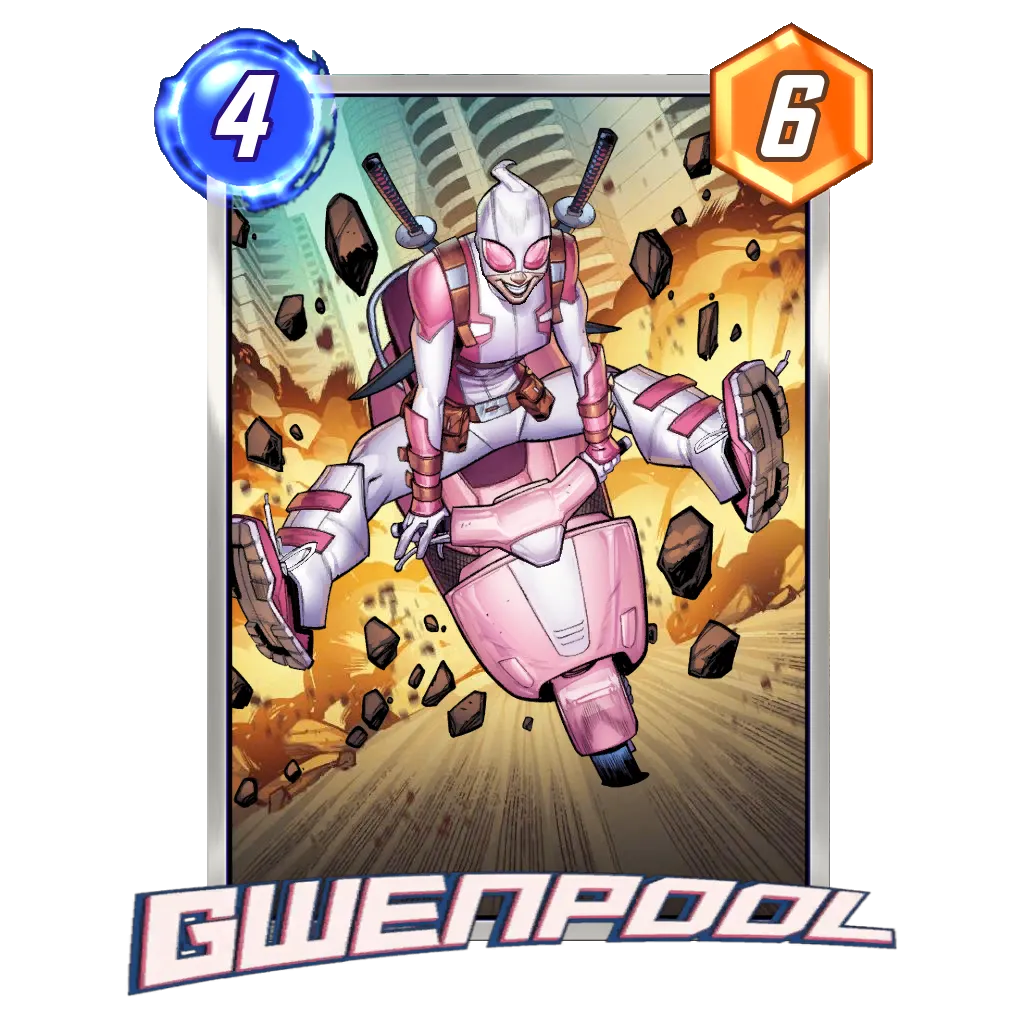
Having not yet appeared in the MCU or any other major multimedia endeavors (which makes the careful circumstances of her backstory to that end all the more hilarious), and being a relatively recent character with a less rich history of costume changes and artistic interpretations, Gwenpool appears on her Marvel Snap mostly as she does in her comics. That is to say, in a pink-and-white but purely coincidental riff on Deadpool’s look.
Form & Function
I will admit, I’m a bit lost as to how Gwenpool’s Marvel Snap ability connects to her comic book abilities. It almost seems like Hydra Bob’s ability — moving to a new location any time either player snaps — would be more appropriate. It would represent the card breaking the fourth wall of the game, so to speak, by being affected by the actions of the player. Yet that would be a terrible ability to saddle the season pass card with, so whatever the reason may be, it’s good Gwenpool has a more intriguing and potentially effective, if somewhat generic, ability.
Granting three random cards in your hand +2 power on reveal makes her a bit like a mini, more targeted Phastos, or Iron Heart but you know which cards get boosted before they’re played, she has six power in her own right instead of zero, and is most effective when played on curve. In the right deck, this ability could be huge. If you’re able to play all three cards she buffs, it effectively makes her a 4/12, which is bigger than Cull Obsidian or the old Sentry at the same cost. And that’s before factoring in cards that get an extra benefit from that buff — Sebastian Shaw, Brood, Black Panther — and cards that boost the effect itself, like Wong, GrandMaster or Absorbing Man.
Obviously, this means that even though every deck could benefit from an extra 6 power spread across three cards, not every deck will benefit enough to justify giving a slot to Gwenpool (in the same way Iron Heart doesn’t appear in every deck). The fact that she has to be played as soon as possible to gain maximum value is a limitation (drawing her on turn 6, for example, just makes her a 4/6). This will likely hold the card back from being a meta-dominating or meta-shifting one, making her more like Gilgamesh than, say, Hope. A good but not great card that has a place in the meta but isn’t ever-present. Honestly, that’s not a bad spot for a season pass card to fall into.
Seasons Past & Present

Looking back on the previous “Celestials Finest” season, here’s how I would rank the new cards:
This seems like a particularly strong season. None of these cards are bad. Even Makkari, as the “worst” of the bunch, provides value and has a spot in Surfer deck if nothing else. It’s just not a card that had the same impact as the others this season. Thena helped drive the nerfs to Professor X and Angela, and remains a key piece in any deck that wants to get ahead early.
Gilgamesh revived an entire archetype, giving Zoo decks the final turn punch it had been lacking. Arishem may well end up the most impactful card of the season, helping boost Loki and Evo decks (and making Darkhawk a key counter card) while also simply injecting a new element of fun into the game. Like Gilgamesh with the Zoo archetype, Sersi helped raise the power of Junk decks, while adding an Arishem-like sparkle of RNG fun to matches. Even if Phastos isn’t the must-play card he looked to be before the season started, he has his utility, especially as a tool in Arishem decks.
All in all, three meta-transforming cards, two solid additions, and one perfectly fine card makes for a pretty successful season. Now let’s speculate on how the “Maximum Effort” season stacks up?

Here’s my pre-launch, pre-play rankings of the next batch of cards:
- Copycat
- Ajax
- Gwenpool (Season Pass)
- Cassandra Nova
- Hydra Bob
On paper, this seems like a weaker season than the previous one. But there’s a lot of unknowns tied to the state of the meta that will likely make or break some of these cards. Copycat seems like the clear winner, largely because her ability to steal the text of your opponent’s deck occurs when she’s drawn, not played.
This means you gain a useful piece of knowledge about your opponent’s deck, you deny them the same ability, AND you get to choose whether or not to use it yourself (if it’s an ability that would be detrimental to your game plan). Copycat should thus be a boon to Mill decks, and find plenty of play elsewhere (that said, if Arishem continues to be dominant, that makes Mill a tough deck to play, and cards are useful anywhere but critical nowhere can struggle).
Similarly, Ajax could be a huge card in Junk/Toxic decks and a useful one in Evo/Lockdown decks. Or he could just cause a surge in Luke Cage play that quickly renders him irrelevant (look how fast Darkhawk become a must-play card in any deck looking to standup to Arishem). If Ajax can stave off/counter Cage effectively, he’ll be great.
Cassandra Nova’s value will all come down to the state of the meta. Played on curve against a regular deck, she’s a 3/7 (plus the points taken off whatever cards get played against you), which isn’t bad but isn’t great. Against Arishem, she becomes an obnoxious 3/19. Will Arishem be present in the meta enough to justify throwing her into decks as a counter? The answer to that will likely make or break the card.
Hydra Bob is the clear loser of the season, a watered down Silk who turns the Snap mechanic against you. The one caveat here is that the card seems designed to prosper in the new Deadpool’s Diner game mode, where there will be more opportunities to snap, making Bob a possibly insane Kraven booster in that format. Again, only time will tell.
On paper, that makes for one or two potentially significant cards, one or two okay cards, and one outright dud. This game is always surprising, but as it stands right now, it looks like “Maximum Effort” will suffer in comparison to “Celestials Finest”

