
Film Review: ‘Kinds Of Kindness’ Is Kind Of Callous
by Koom Kankesan
Summary
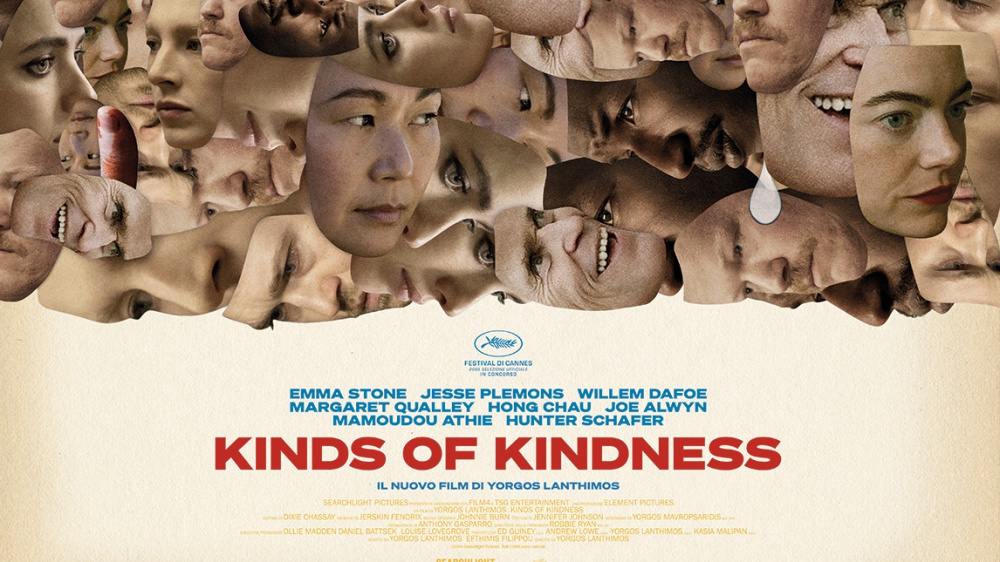
Kinds of Kindness, the new film by Yorgos Lanthimos, is a triptych of short stories. Jesse Plemons, Emma Stone, Willem Dafoe, Hong Chau, and Mamadou Athie play different roles in the three stories.

Yorgos Lanthimos‘ new film, Kinds of Kindness, stars three of the actors we saw in the director’s recent Poor Things: Emma Stone, Willem Dafoe, and Margaret Qualley. The significant additions to the ensemble are Jesse Plemons — who in some ways is more prominent than Stone — and Mamadou Athie and Hong Chau, whom we see in less prominent roles. All of the aforementioned actors play multiple roles because this is an omnibus film comprised of three different and distinct stories that may or may not be set in the same fictional world.
The first story involves a master/servant relationship between the characters played by Dafoe and Plemons. When Plemons refuses to kill someone at Dafoe’s behest, Dafoe ends his relationship with Plemons, throwing the latter’s life into turmoil. The second story features Plemons as a police officer whose wife, played by Stone, has gone missing. Once she returns, she doesn’t seem to be the same person. The final story sees Stone and Plemons as part of a cult run by Dafoe as a character who seems somewhat based on L. Ron Hubbard. All of these stories feature relationships that are beyond the edges of normalized social behaviour. Given the recent allegations surrounding Neil Gaiman and the horrific abuses of power that happened in the Nexium cult, it was hard to watch this film and not think of the truly horrible ways in which people seek literal, debauched, and pernicious power over others in personal relationships and the ways in which some people give it to them.

Lanthimos wrote this film with Efthimis Filippou, who co-wrote other films with Lanthimos: Dogtooth (2009), Alps (2011), The Lobster (2015), and The Killing of a Sacred Deer (2017). If people have seen any of these films, they will be familiar with the detached, cynical, very dry, and almost cruel way in which the pacing and scenes unfold. If not for the absurdist humour, there would be little warmth in them. By contrast, the films by Lanthimos that Tony McNamara contributed writing to are much more alive and vital — The Favourite (2018) and Poor Things (2023). Their humour and satire are much more in-your-face and over-the-top. The last two are my favourite Lanthimos films by far. Since they feature Stone prominently — and since she seems to have formed a close partnership with Lanthimos producing what I’d argue is the strongest work of her career — I expected this new film to have the same wild, lively streak but was disappointed.
The film received middling reviews upon release. Comparisons to The Favourite and Poor Things aside, it’s not a bad film. But since it dispenses with the liveliness and humour of the director’s previous films, it is bereft of the charm and wit that made those last two so unexpected and original. Once again, it’s not a bad film — it’s well made and the performances are quite strong. Stone has become an outstanding actor in her own right and Plemons and Dafoe deliver on their capabilities. Lanthimos is obviously as talented as any other filmmaker working in art cinema; his use of camera movements, editing, pacing, framing, and storytelling are quite measured and refined. However, he’s not ultimately interested in only being a classy producer of art cinema. His violent streak of absurdist, jarring humour and actions beyond the pale of normal human conduct constantly upend the sublime filmmaking, as do the occasional and abrupt switches to black-and-white or the use of jump cuts and editing that serve to discombobulate the viewer’s feelings.

For most viewers, the lack of a cohesive take away from this film and Lanthimos’ inability to focus on ‘normal’ relationships (plus his need to continually shock and disturb) will make this an ultimately forgettable omnibus film. The key problem with the format: people are always forced to weigh one part against the others and the work as a whole may come off as uneven or unsatisfying. For me, the first of the stories was my favourite as that was the one which most entranced me. Shorter stories also mean we don’t have as much time to attach ourselves to the characters although that’s no excuse in Lanthimos’ case as he clearly doesn’t want us to attach ourselves too much. It also seems to be another intentional perversion on his part to use ‘kindness’ in the title as there is so little of it on display in this film (or his films in general) and I suppose that’s the point. His worldview allows for little genuine kindness or compassion to exist, especially in romantic/sexual relationships between people, although there is much suffering and sadness. What this bodes for the relationship between his movies and his viewers is anyone’s guess in these times.