
Characterization In The Buffyverse — ‘Angel’ Season 1, Episode 19
by Benjamin Hall
This is part of a bi-weekly series concerning the characterization of Buffyverse characters. The first installment in this series can be found here. Arguably the best place to begin reading this series is at the beginning, but that is up to each reader. As a reminder this column will cover major and some minor characters from the shows Buffy The Vampire Slayer (1997-2003) and Angel (1999-2004). Other Buffyverse media, such as the graphic novel Spike: Into The Light (2014) are not pertinent to this series. Also there will be no referencing real world events that have direct relation to either show in this bi-weekly series.
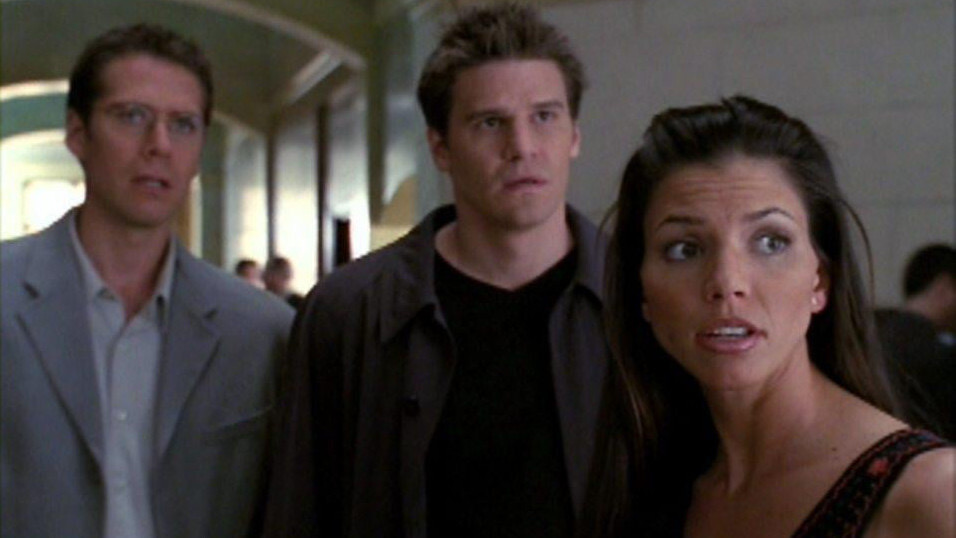
This week: Angel (David Boreanaz) attempts to help rogue slayer Faith (Eliza Dushku). Meanwhile, Wesley Wyndham-Pryce (Alexis Denisof) comes to a crossroads regarding morality.

(Warning of spoilers from this point on!)
(Trigger warning for mentions of substance abuse and torture)
Angel acts possessive when Faith mentions his ex, Buffy Summers (Sarah Michelle Gellar). It is almost as though he is still in a relationship with her and isn’t dealing with other possible love interests at times (Season 1, Episode 17, “Eternity”). Also, he behaves as both a mentor and a defender-type parental figure to Faith. He helps her find a redemptive path even though it starts with time in prison. The latter aspect is more analogous than anything and is very much a reaction to Buffy acting like another kind of parental figure. Then there is the “standard action hero role” he plays out in most episodes of this show.
Weatherby (Jeff Ricketts), Collins (Alastair Duncan), and Smith (Kevin Owers) are the Watchers’ Council’s wet works team. Other than seeking vengeance against Faith for their failure to capture her in the past, their only other major element of characterization is, apparently, knowing Wesley from his days as a Watcher (Buffy The Vampire Slayer Season 4, Episode 16, “Who Are You?”).
Wesley goes majorly “grimdark” for the first time when he talks about Faith like she is a rapid animal needing to be put down. This is obviously a reaction to both Faith torturing him and having his boss, Angel, take care of her. The behavior is both negative and a sign of his future growth into a tragic character. Also, there is no sign of him being a gag character here. Lastly, Wesley shows a good head for strategy with how he handles the Watchers’ Council goons.
Buffy arguably has no real reason to be in this episode. Her motivation is revenge against Faith, which she initially masks with concern for Angel. Due to this, she first comes across as a jealous ex upon finding Angel comforting Faith. This jealousy and urge for revenge play out as she acts and talks like an abusive parent to Faith. She is also, apparently, revising history in her head by ignoring Angel victimizing her when she says that Faith is the only one to do so to her in the past (Buffy The Vampire Slayer Season 2, Episode 14, “Innocence”). Finally, her speaking on the newness of her relationship and yet saying she truly knows Riley Finn (Marc Blucas) seems to be paradoxical. One cannot truly know and trust someone if a relationship of any kind is new.
Cordelia Chase (Charisma Carpenter) displays intelligence by leaving the premises while Faith is there. She also is smart in getting Angel to unwittingly sign an agreement to her vacation with pay during this time.
Detective Kate Lockley (Elisabeth Röhm) is arguably an idiot by chasing the supernatural and openly admitting it to Detective Kendrick (Adam Vernier). Her inclusion here is mainly to provide an update on her status and for an actual character to arrest Faith.
Faith, meanwhile, is at her most vulnerable at the beginning of this episode — at least emotionally — and in regards to her various appearances across both shows. As for the fantasy sequences involving her, they seem to be suggesting mental health issues. While possessing Buffy’s body, Faith also exhibits this type of fantasizing. However, there is no continuation of this past troubling mindset following this episode. Yet, it is doubtful prison is the cure for this and obviously it is not in Faith’s future appearances. Lastly, her violent past becomes a drug withdrawal analogy and she therefore acts like a detoxing addict.
Lilah Morgan (Stephanie Romanov), Lee Mercer (Thomas Burr), and Lindsey McDonald (Christian Kane) do not get any growth in this episode. The most one can take from the trio is exposition in relation to either the episode or Wolfram & Hart.
Detective Kendrick really only exists to give exposition about Lockley’s current status and help fill out the population of this universe.
The cast of characters have a debatable amount of characterization. This is mostly because a lot of character beats are ones viewers see in past Buffy episodes (Buffy The Vampire Slayer Season 3, Episodes 14 and 15, “Bad Girls” and “Consequences”). Also, with the exception of certain moments, the only growth that occurs is for the provision of analogies and resolution. Though there is a nice attempt with the addiction-versus-killing analogy, it feels like there is no true success when it comes to applying it to Faith. On the other hand, it works just fine for Angel due via his curse and the little willpower he displays being the only deterrents to his killing again. Clearly, this episode attempts more with the characters than it can deliver.

