
Declan Shalvey Talks Skynet, Time, And ‘The Terminator’
by Erik Amaya

It is a simple, but resilient premise. A war between humans and machines will be decided not by any conventional tactics at their disposal, but by sending agents to a seemingly random day in 1984. For the machines, it is a chance to kill the leader of the human resistance before he’s even conceived. And for the resistance, it is a the fulfillment of fate … even if there is no fate but what we make for ourselves. Forty years ago, The Terminator took sci-fi fans to the tech-noir world of director James Cameron and introduced one of the genre’s most induring icons: the T-800. The film catapulted the young filmmaker, known for making Roger Corman b-movies look good, into the next big name in movies after Steven Spielberg and George Lucas. It also unleashed millions of speculative “what if” thought experiments for its audience.
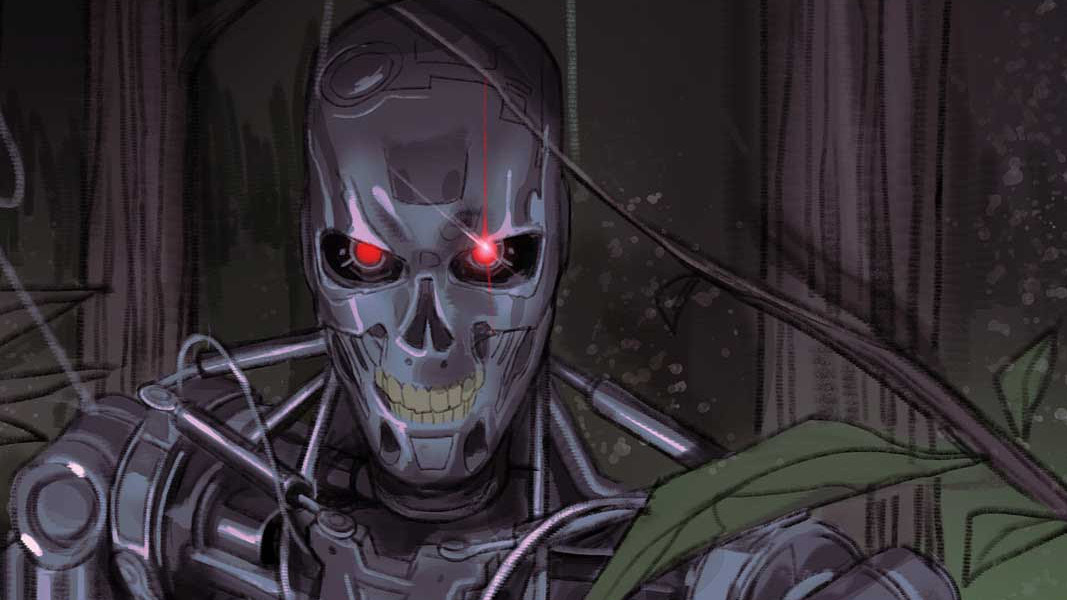
Some of those potential story prompts form the basis of Dynamite’s upcoming The Terminator comic book series. Writer Declan Shalvey and artist Luke Sparrow are teaming up to tell tales of the machines’ other objectives across time. And like their master computer system, Skynet, Shalvey has a plan for the series, as he told our own Erik Amaya. Read on to learn more about its format, xx, and more:
Erik Amaya: What is your earliest memory of The Terminator? Was it something you discovered via its long life on television?
Declan Shalvey: My first memory of seeing anything Terminator was T2 [Terminator 2: Judgement Day] … I was in a school play and while the previous acts were on, the school played a movie. I would have been too scared to see it otherwise, but the whole class was watching it so I had no choice. I have a very strong memory of seeing all those human skulls getting crushed under the weight of the T-800’s foot. It was both terrifying and awe inspiring.
If you’ll forgive my use of the Dark Horse comics series title, “secondary objectives” always feels like the most exciting way to do a Terminator story without endangering Sarah Connor or John again. How quickly did you know this was the path you wanted to take?
Shalvey: The licence has certain restrictions, and in those restrictions, I often find more interesting choices. Not that we couldn’t use those characters, but I felt it was a vein often tapped, where there was other places we could go without tapping that vein dry, so to speak. It also feels like a very machine-like, logical strategy for machine intelligence.
And how soon after that did you know this format allowed you to push the timeline back further than 1984?
Shalvey: Pretty much immediately! Images of a T-800 in very alien environments came to me quick and fast — and, again, puts the machine in scenarios we haven’t seen before, on top of environments we want to see it in. Of course, the question now is how far past 1984 do we want to go…?

For as much as you can say, when and where is the first story set?
Shalvey: It’s set all over, as for the most part each issue takes place in a different time. Issue One is primarily set in the post Judgement Day 2000s, actually, but also in the early ’80s. The reasons for which, you’ll have to read the story. We will be going back in time, but that doesn’t mean it’ll always be before The War With the Machines. I can reveal within the arc, we’ll also be in the final days of the Vietnam War.
You’ve said most of the stories plotted so far are done-in-one. Is it surprisingly freeing to have a new cast of characters each issue or has there been a point where you felt a recurring character would be helpful?
Shalvey: A recurring character sure would be helpful, but for me the recurring character is the T-800. So yes, there’s a challenge in setting up new characters and scenarios, but I think the advantage of this book is that every reader will know what The Terminator is, so we don’t need to explain the whole concept in every issue. Once a murder robot appears, we all understand what happens next. We run.
Does the change in setting nearly every issue give Luke Sparrow the challenge he’s looking for, too?
Shalvey: Luke drew a story for me in my upcoming Old Dog Operations anthology where there was a lot of location hopping, and I was really impressed with the attention to detail he gave those locations. There was some great period-specific stuff in there too, which is what made me think of working with him on this. He has an excellent eye for detail that will really deliver on establishing each time period and as you suggest, I’m sure that’s a challenge that will really show him rise to the occasion. He also draws an excellent T-800 by the way, which is not easy!

Is it possible to keep the tech noir feel if sliding into, say, the 1970s or other eras with a wildly different aesthetic? Or is part of the challenge to bring The Terminator into those eras and tones?
Shalvey: I think with a distinct artist like Luke and colourist in Colin Craker, we are delivering a visually concise book. My goal is to make a licenced book that feels like a creator owned one, that has a strong identity. Yes it’ll pass through different moments in time, but it’s not going to have an aesthetic shift from issue to issue. The ‘voice’ will be consistent.
From Skynet’s standpoint, did Judgement Day still occur in 1997 or does it continue to push into the 21st century as the time war rages on?
Shalvey: It’s original timeline for Judgement Day, so I’m sorry to say there was a nuclear war about 20 years ago.
Will Skynet have an opportunity to be a character in the series, or will the focus remain squarely on the objective, their help from the future, and the Terminator tasked with clearing them off the board?
Shalvey: More the latter but as the series progresses we will be able to peer into Skynet more, so keep reading to see that.
And I don’t think I can end this interview without asking this: is there no fate but what we make for ourselves?
Shalvey: Is that not still fate…?
The Terminator #1 arrives in stores this October.
