
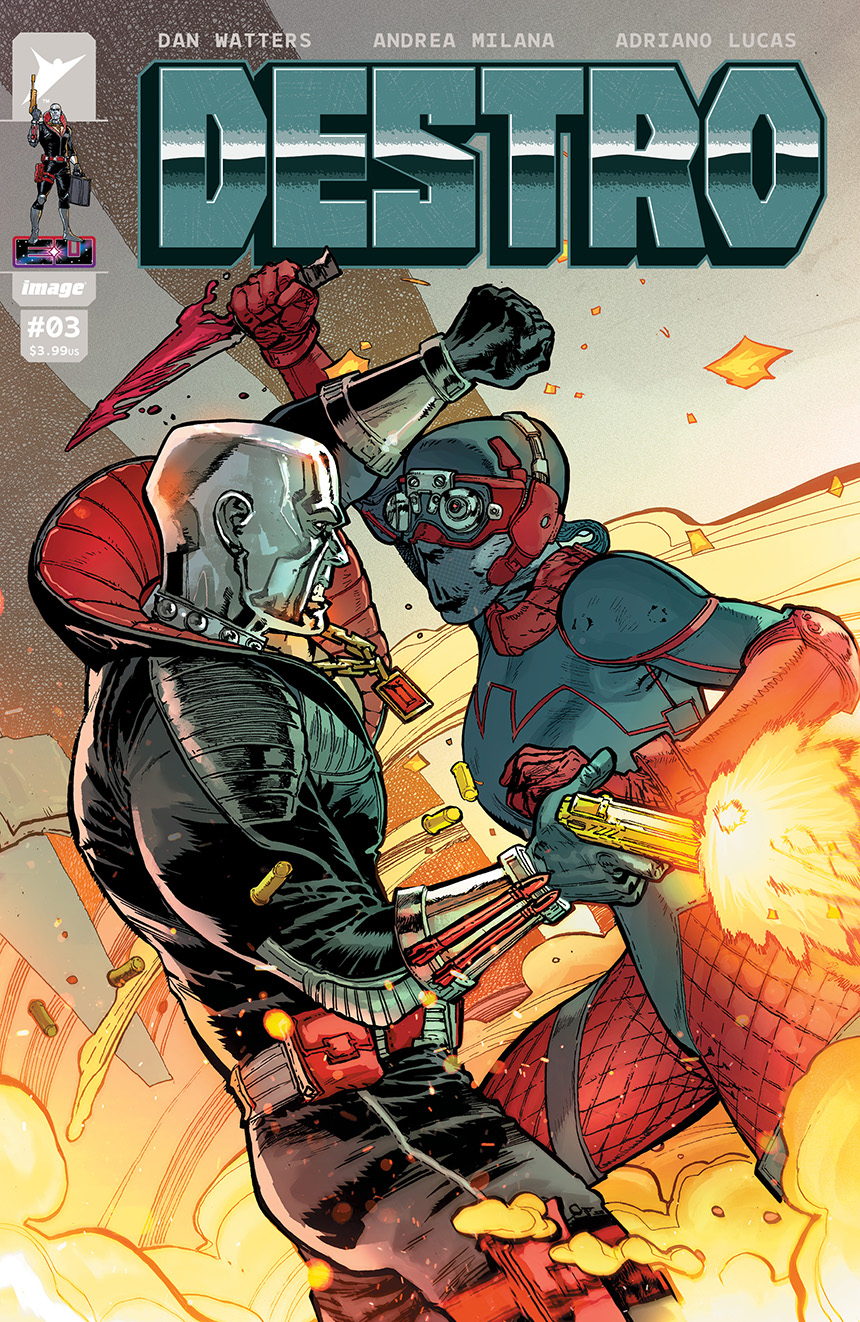
‘Destro’ #3 Review: How Destro Got His Groove Back
by Austin Gorton
Overview
The paradox at the heart of Destro #3 – Destro reclaims his power by giving it up – electrifies the issue, elevating an otherwise straightforward action-orientated story.
Overall
8/10Throughout the first two issues of Image Comics’ Destro, the titular character has been fighting to turn back a tide that threatens to knock him from his place of power, ignorant of the fact that it’s a fight he’s already lost. Destro #3 represents his most direct efforts to reclaim his own narrative, in ways both obvious and unexpected. This leads to another strong issue which, somewhat paradoxically, is less complex than the previous ones, but which more firmly puts Destro at the center of the action.

Like Scarlett #3, Destro #3 is largely an all-out action issue. The comes in the form of Destro’s fight with Chameleon, the assassin sent to kill him in the cliffhanger to the previous issue. Set against the snowy backdrop of the Scottish Highlands outside Destro’s ancestral tomb, artist Andrea Milana and colorist Adriano Lucas do an impressive job of keeping the action clear.
Chameleon and Destro pop against the white backgrounds, but the background space is more than just nondescript white. The figures move through it with purpose, and their physical proximity to each other is always clear. Writer Dan Watters also establishes a striking contrast between the two characters, with Destro offering up all of the issue’s dialogue for the first six pages. He comes across as a complete chatterbox next to the silent Chameleon. It’s only when their fight draws the pair in close to each other, and Chameleon is forced to concede she’s lost the upper hand, that she breaks her silence by calling in reinforcements (and with the seal broken, proceeds to pepper Destro with snark).
Not only does this underscore how in control of the situation Destro is despite the penetration of his sanctum, it introduces the idea of another faction in the battle between Destro and the Crimson Twins. Chameleon relays an order to “Overkill” (a name familiar to GI Joe fans), suggesting it is not Xamot and Tomax who hired her. This sentiment is furthered by a cutaway to Mercer and Scrap Iron, investigating the drones which attacked the weapons fair in issue #1, as they realize the tech had to have come from someone other than MARS or Extensive Enterprises.

This broadening of the conflict continues in the closing pages of Destro #3. After managing to escape from Chameleon and the drone attack, it’s revealed that Destro has turned himself over to US authorities in the form of General Flagg. While on the surface, this seems to be a total ceding of his power, an acceleration of the arc he’s unknowingly been on since the start of the series, it actually represents Destro working to strengthen his own position.
Recognizing that there are other players involved, and that his own organization is likely comprised (the only way for Chameleon to have known where to find him when he went to his ancestors tomb to hide out), Destro widens the conflict even further, looping in the proto-GI Joe, but on his own terms. And because he’s an arms dealer, and the US government happens to buy a lot of arms, he knows this is a situation he can control.
This is echoed in the story he tells Flagg about the origins of his metal mask. Originally a punishment for his 17th century ancestor who sold weapons to both sides of the English Civil War — he couldn’t simply be killed, as the weapons he provided were still needed — the people of Clan Destro have turned this intended mask of shame into a symbol of pride. In much the same way, Destro #3 concludes with Destro seemingly at his weakest — alone, on the run for his life, in the hands of a nominal enemy.
Yet he is also exactly where he wants to be, after sloughing off attack after attack and coming out the other side intact. Destro has reclaimed his narrative, taken setbacks and made them strengths, just as his ancestors took an punishment meant to shame and made it a symbol of their power.

Will it be enough to forestall or change his ultimate fate? Assuming the Energon Universe follows a similar trajectory as past Joe stories, unlikely. Destro is seemingly destined to find himself in a role where he’s constantly vying for an absolute power that remains just out of reach. But that tension is what has made this such an entertaining series. And the paradox in Destro #3, of Destro finding himself the most in control of the situation that has consumed him by isolating himself entirely from his allies, resources, and even ceding his freedom, that Destro has reclaimed his power by giving it up, is what makes it such an entertaining issue.
