
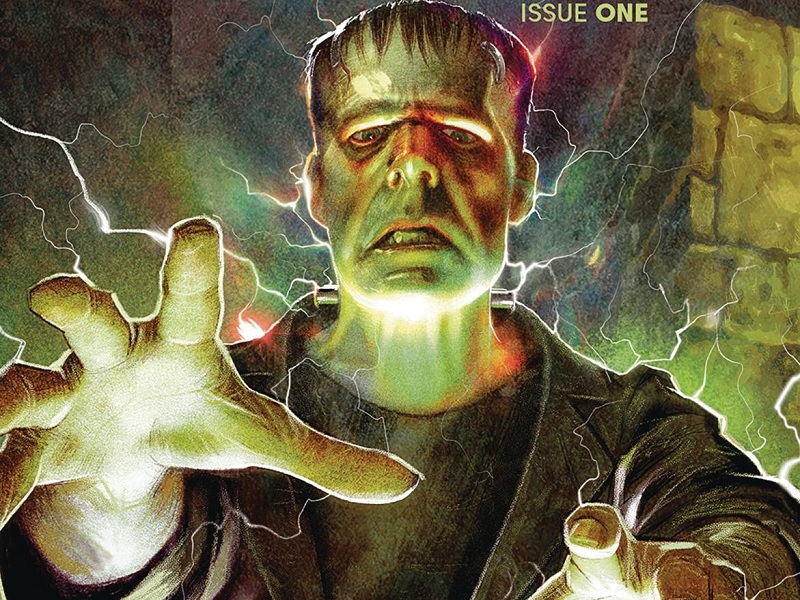
Talking ‘Universal Monsters: Frankenstein’ With Creator Michael Walsh
by Rachel Bellwoar
It’s easy to forget how Henry Frankenstein procured the body parts to make his monster. There’s one person who will never forget, though, and it’s through their eyes that writer and artist Michael Walsh reimagines James Whale‘s film adaptation of Mary Shelley‘s novel for comics with Universal Monsters: Frankenstein. With colors by Toni Marie Griffin and letters by Becca Carey, find out what Walsh had to say about the miniseries below:

Rachel Bellwoar: I love your cover for the first issue of Universal Monsters: Frankenstein, which incorporates daisies from one of the most iconic scenes in the original movie. What made you want to callback to that scene with your cover?
Michael Walsh: I wanted to do something simple but still integrate imagery that many viewers of the 1931 film consider iconic and important to the character. I also wanted to play with the juxtaposition of nature and technology.
Bellwoar: Do you remember when or how old you were when you first watched Universal’s Frankenstein starring Boris Karloff?
Walsh: As a kid, I was terrified of horror movies and media. Once I hit high school, I developed an intense love and obsession with the genre. I did a deep dive into all the essential films. I would have been roughly fifteen the first time I saw it.

Bellwoar: One of the biggest changes you make with this series is to tell the story from a child’s perspective. Where did that idea come from?
Walsh: There was a slew of reasons to make this choice. Shifting the perspective away from Doctor Frankenstein allows us to see him from a very different perspective. We also have a heightened sense of unpredictability because there are new characters whose fates are not determined in the original film. I also wanted to add some heart and connection to the monster in a new way.
Bellwoar: Different adaptations of Frankenstein have emphasized the aggressiveness versus the gentleness of the monster. Was there a direction you wanted to lean towards more here?
Walsh: To me, the true horror in the Frankenstein story does not come from the monster but from all the humans who surround it, facilitate its creation, and shape it into a killer. The Frankenstein story leans into tragedy and philosophy as much as it does Horror, and I really wanted to play with those elements alongside a touch of body horror.

Bellwoar: If anything Henry Frankenstein is the one who looks monstrous. Was that a deliberate choice in your character design, to show how he’s becoming less human?
Walsh: Totally! Glad you picked up on that. Especially in the first issue, where he is seen from a child’s perspective. He’s almost mad with power and completely twisted up in his own ambition. I play a lot with his arc and the way other people see him throughout the series.
Bellwoar: Why did you decide to associate the monster more with blue instead of green?
Walsh: I did a bit of both throughout the series. Toni-Marie Griffin (the colorist) and I love to play with how light sources affect how we see colour. We endeavoured to create various moods through the comic using drastic, sometimes grotesque, palette changes.
Bellwoar: Thanks for agreeing to this interview, Michael!
Universal Monsters: Frankenstein #1 goes on sale August 28th from Skybound.
