
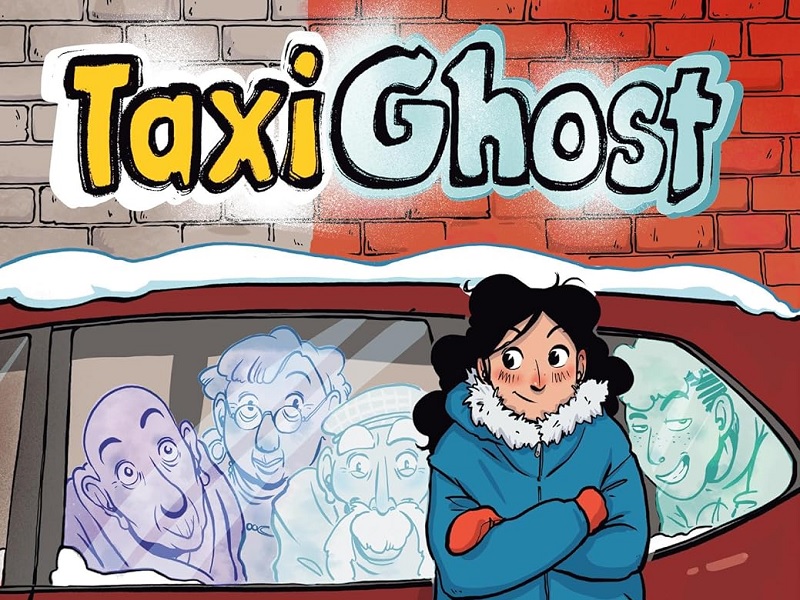
An Interview With ‘Taxi Ghost’ Creator Sophie Escabasse
by Rachel Bellwoar
Apparently, being a medium runs in the family, but this is the first Adèle’s hearing about it — and what a way to find out! In Sophie Escabasse‘s latest graphic novel, Taxi Ghost, Adèle may be new to seeing ghosts but the ghosts aren’t wasting any time. Will she be able to help them or, like her Gran, will she find being a medium more trouble than it’s worth? With colors by Kiwi Byrd, find out what Escabasse had to say about Adèle and setting the story in Montreal below:

Rachel Bellwoar: Adèle discovers she’s a medium on the same day she gets her first period. While learning ghosts are real could’ve easily overshadowed that event, what made you want to make sure that rite of passage was acknowledged?
Sophie Escabasse: That was indeed something I wanted to bring light on because I feel like we aren’t seeing it often enough. It is slowly changing but periods are still somehow a “complicated” topic for a lot of people. It is still a matter that is whispered about secretively one on one, when really let’s just talk about it!
I thought it could be interesting to show a group of women of different ages and backgrounds throwing a casual party around a table of sweets to celebrate one of them having their first period. I wanted that scene to feel warm and natural, and even if at times Adele feels embarrassed about the attention, she’s also comforted by hearing everyone’s experience and being able to share her own feelings. I’d love for period parties to become a trend!
Bellwoar: Similarly, one of the first ghosts Adèle gets to know is Ambroise at the library. While it might have been tempting to tiptoe around Ambroise being the same age as Adèle, why did you decide to address that head-on?
Escabasse: People of close age connect more easily, and for Adele to be on board with her new found power and for her to consider putting herself out there and help ghosts, I needed her to befriend one. Ambroise’s jokes and teasing attitude make the relationship almost normal, Adele isn’t spooked by him, she’s curious. I voluntarily didn’t linger on Ambroise’s death, choosing instead to show how lively and eager he is to keep doing things he loves.

Bellwoar: Getting around the city is no easy task for the ghosts in Taxi Ghost. Why did you decide to have public transportation still be an issue for ghosts, instead of having them fly like Casper?
Escabasse: I had the idea for Taxi Ghost back when I was still living in Brooklyn but it’s moving to Montreal and experiencing what it was to live with snow on the ground several months per year that really helped me shape the story.
I wanted ghosts to still face some physical inconvenience. They’re still here, they’re still tethered to the world somehow and snow is a reminder of that. It was also the perfect narrative element, letting me mingle ghosts and livings.
Bellwoar: Montreal is like another character in the story. Are there any details you’re especially proud of that the average reader might not notice but a native from Montreal would appreciate?
Escabasse: Every street my characters are passing, the neighborhoods, the cafe, the library, the forgotten pavilion, all these places are real and I’m sure Montrealer can locate them. I loved finding the spots where my story would take place, it was a lot of exploring and drawing around.
To find a setup for the blue goose depanneur I searched realtor’s websites until I found a bodega with an apartment on top, that was effectively for sale. I researched in real life, the place where my fictional characters would live, haha!
Of course I redesigned the interior and renamed it but if you’re observant and willing, you could find it. The facade isn’t blue though!

Bellwoar: Is there any significance to the ghosts being different colors?
Escabasse: There isn’t. I wanted the ghosts to be all kinds of colors and shimmering lights. The afterlife isn’t defined by colors.
Bellwoar: Adèle figures out how to navigate talking to ghosts in public pretty fast but that doesn’t mean she doesn’t have a few slip-ups. Was it fun getting to show strangers’ reactions?
Escabasse: It totally was. I imagined a lot of backstage little scenes and anecdotes when I was putting the story together. It was a lot of fun.
Also, I had a sort of imaginary friend when I was a kid so I have a fondness for people talking to themselves.

Bellwoar: Meanwhile, being the only person in the room who can’t see or hear ghosts is never an enviable position, but Adèle’s sister, Helen, handles it pretty well considering. How important is it to have a character who can provide an outsider’s perspective on Adèle’s new powers?
Escabasse: Most of all Helen is a big sister that Adele looks up to. She counter balances the disgust and complete rejection of anything ghost related that their Granny has, which is important. The fact that Helen wanted the gift and is eager to know more about it helped Adele accept her new condition.
Also, Helen is much older than Adele, she had time to make peace with the idea that she doesn’t have the family gift but that doesn’t mean her curiosity on the matter was ever satiated. She sees it as a chance to have her little sister growing into a medium.
Bellwoar: Ghosts have always been known to effect the living emotionally, but not so much physically. Where did the idea to have some ghosts be able to touch things originate?
Escabasse: We’ve all heard spooky campfire stories or saw movies showing ghosts-like characters affecting the solid world.
I was 10 years old when the movie Ghost came out, and for some reason I remember very vividly the scene in the subway when the older ghost played by Vincent Schiavelli showed Sam (Patrick Swayze) how to move a beer cap. The struggle of Sam to do the same… I guess maybe it originated there.
Bellwoar: Thanks for agreeing to this interview, Sophie!
Taxi Ghost is on sale now from Random House Graphic.

