
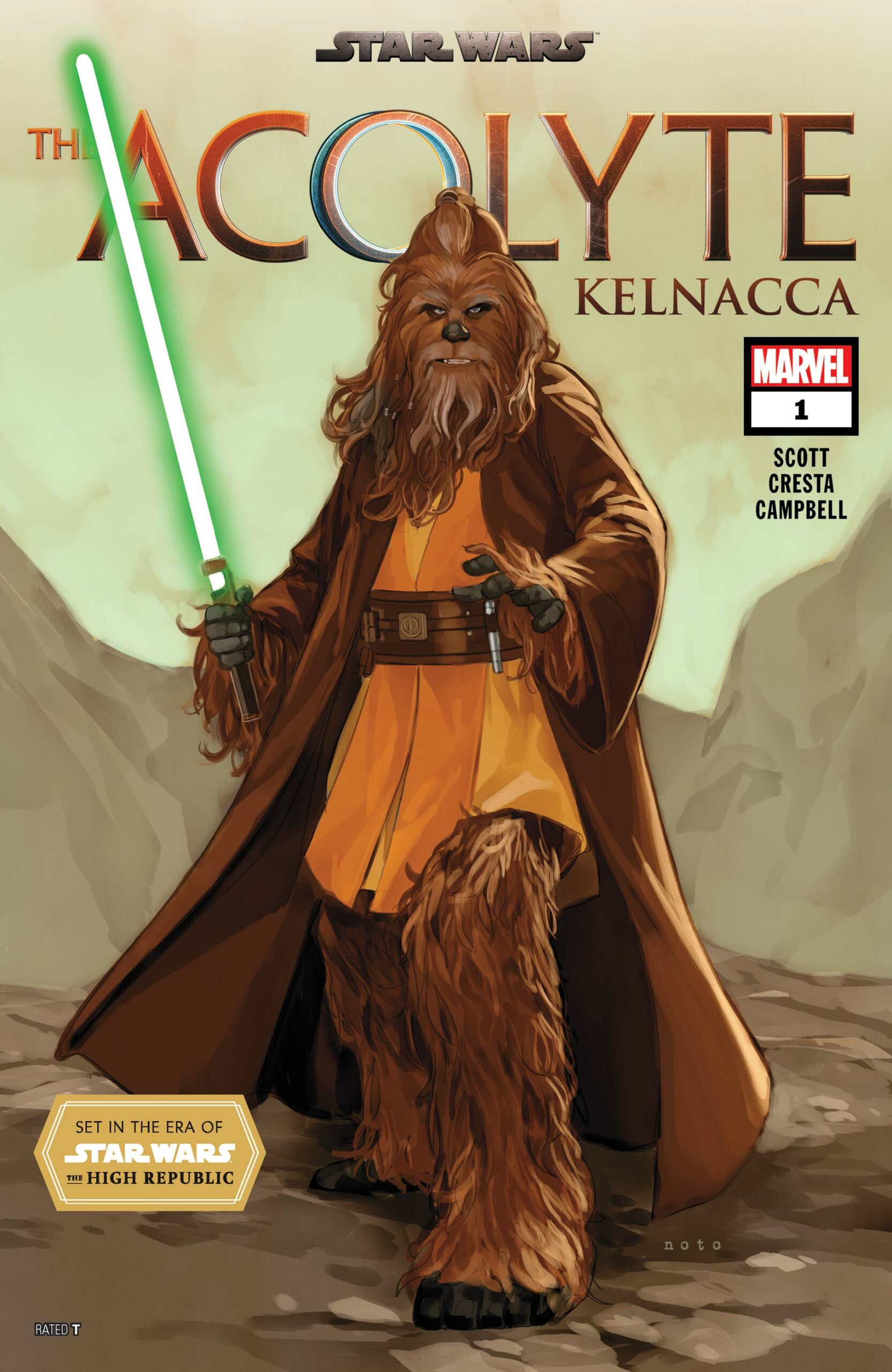
Review: ‘Star Wars: The Acolyte — Kelnacca’ #1 Is Effective But Arrives Too Late
by Austin Gorton
Overview
Despite the title character speaking only in growls & grunts, Star Wars: The Acolyte – Kelnacca #1 succeeds at making the Wookiee Jedi feel like a richer, more realized character. Yet coming long after the series its tying into has left the zeitgeist, it struggles to answer the question of, “why now?”
Overall
6/10The timing of this issue is curious. Of course, it’s unlikely that anyone could have anticipated it would be released relatively soon after Disney canceled (or declined to renew, whichever you prefer) The Acolyte, the streaming series the issue ostensibly ties into. But even if that series remained in limbo, its fate uncertain, the timing would still be odd, coming as it does many weeks after the series wrapped.
What’s the point of releasing a tie-in to something that has already passed out of the zeitgeist? Neither the TV show nor the comic is going to benefit from any of the synergy this is clearly trying to tap into. Of course, none of that should have any bearing on the quality of the comic itself, and Star Wars: The Acolyte — Kelnacca #1 is, for the most part, a competent and entertaining one. But it’s not so good that it manages to fully overwhelm concerns regarding the circumstances of its release.

Intended to offer some backstory on Kelnacca, one of the more visually-compelling (he’s a big Wookiee Jedi!) characters from The Acolyte, the aptly-named Kelnacca #1 manages to be about its title character without making him the story’s protagonist. Instead, it employs a narrative device in which the main character is a Jedi named Yarzion who, on his deathbed, tells his Padawan, Ordea ,about Yarzion’s own master, Kelnacca.
It’s a smart move on the part of writer Cavan Scott, as it allowed Yarzion to effectively speak for Kelnacca. This prevents Scott from having to resort to a clunky device like throwing brackets around Kelnacca’s English dialogue with a footnote saying, “translated from Shyriiwook” or lean too heavily on the artist to depict an otherwise-silent Kelnacca’s thoughts and feelings. Instead, Kelnacca speaks merely a few grunts of dialogue, but by the end of the issue, readers still have a clear understanding of the character.

Which is not to discredit the efforts of artist Marika Cresta, who does an admirable job with a difficult task. Making a character expressive without the use of dialogue or first person captions is no mean feat, but Cresta pulls it off in Kelnacca #1. Whether through the tilt of his head, the placement in a panel, or a raised eyebrow, it’s also clear what Kelnacca is trying to say to Yarzion or others even as his dialogue is extremely limited. Cresta also gets the opportunity to showcase Kelnacca’s surprising (for his size) agility, something highlighted occasionally in The Acolyte, and rises to the occasion.
By constructing the issue as a survey of Yarzion’s time with Kelnacca, Scott also prevents the story from getting bogged down in ultimately-ephemeral storytelling details. There’s no time spent establishing a villain that’ll never appear again, or introducing a MacGuffin to drive the plot. Rather, by presenting a sequence of jumps from one event to another, the details of which are largely irrelevant, the issue is a more effective illustration of who Kelnacca is which, ultimately, is the point of the comic.

Still, as admirable a job as Scott, Cresta, colorist Jim Campbell and letterer Ariana Maher do with Kelnacca #1, it’s hard to read the issue independent of the circumstances surrounding its release. For being as effective an introduction to its title character as it is — clearing the relatively high bar set by the challenges of its main character not speaking English (or Basic, if you prefer) — it’s hard not to also wonder…so what?
The Acolyte ended weeks ago; even if more seasons were confirmed to be coming, this comic would have been even better coming out before the series began, giving readers a glimpse at an important but still relatively minor character in the series. This far after the fact, the success of the comic feels more like a tease than an achievement.


