
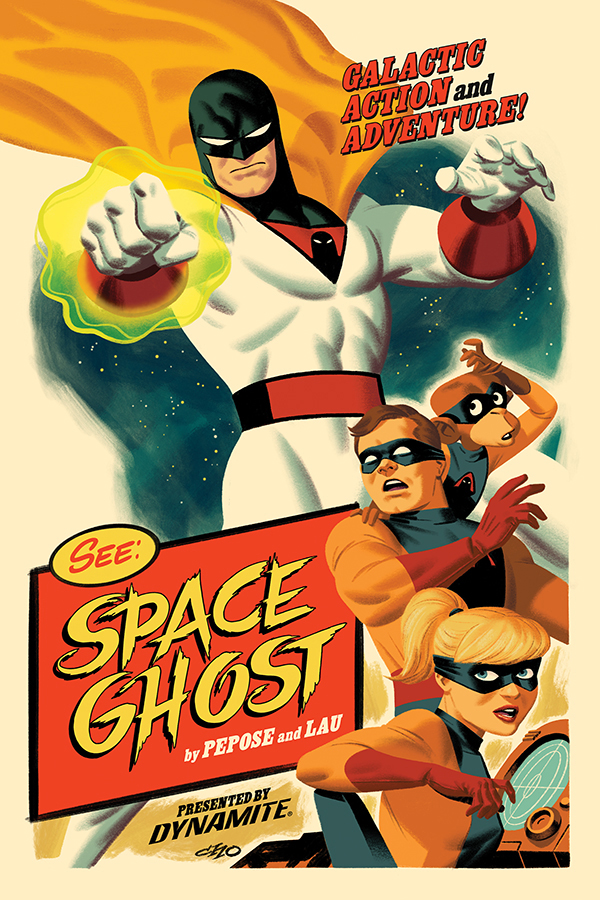
Talking ‘Space Ghost’ With Writer David Pepose
by Tony Thornley
If you know Space Ghost you probably know him best from Space Ghost: Coast to Coast, his Adult Swim talks show. However, the character originated in the 1960s as a space bound superhero, almost a cosmic Batman from famed producers Hanna-Barbera.

As part of Dynamite Entertainment’s publishing deal with Warner Bros. Discovery, several classic Hanna-Barbera characters are now in comics form. The first was Space Ghost, whose series debuted in May from David Pepose, writer of Spencer & Locke, Scout’s Honor, The O.Z., Savage Avengers and The Punisher.
With the series’ fifth issue out this week, we sat down with David to talk about the journey the series has been on.
Tony Thornley: So David, I feel like Space Ghost is in a weird space (pardon the pun). He’s close to a household name, but for a parody of him. How did that affect your approach to the character?
David Pepose: I feel like Space Ghost has always been a product of his time — back in the ‘60s, he was created to ride the wave of Adam West’s Batman. In the ‘80s, Space Ghost returned in Space Stars, standing shoulder-to-shoulder with the Super-Friends. And of course, Space Ghost: Coast to Coast captured the irony of the MTV generation and basically defined a generation’s sense of humor — meanwhile, the 2005 miniseries by Joe Kelly and Ariel Olivetti tapped into the same kind of dark origin that would launch Batman Begins into the zeitgeist.
By all that I mean, Space Ghost is a character who is incredibly flexible in terms of tone and narrative, just a concept that historically has always lended itself well to reinvention — and given that it’s been a generation since Space Ghost’s last standalone comic, this felt like the perfect opportunity to distill him and his supporting cast down to their essentials. While there are plenty of people who might know Space Ghost from the ‘60s, ‘80s, or Coast to Coast, there’s a whole demographic of readers who are discovering the character for the first time, thanks to those amazing iconic and timeless Alex Toth designs. So it really feels like a homecoming to me of a cult classic character who has long deserved his time in the spotlight.

Tony: I’m one of many readers who doesn’t know the deal with Space Ghost’s more straightforward stories. What did you do to prepare for that challenge?
David: Honestly, I just mainlined the source material — beyond the episodes of Coast to Coast that I grew up with, I rewatched every episode of the original ‘60s run, the ‘80s revival, and every comic I could get my hands on. Space Ghost is a character that has such a rich mythology to him, largely due to the genius of Alex Toth — and the bones of that worldbuilding still feel strong and powerful over a half-century later. There’s nothing wrong with Space Ghost as a character — if anything, I think he has all the ingredients to be such a compelling and exciting hero. So it’s been about honoring the source material as much as possible, while figuring out the best way to connect those disparate threads — and beyond that, trusting our readers that they’ll fall in love with Space Ghost and his universe the same way fans have across multiple generations.
Tony: What element of the character’s canon have you most enjoyed updating and modernizing?
David: I think it’s just digging deeper into all of the characters themselves. The relationship between Space Ghost, Jan and Jace has been really fun to explore, and giving new twists to all those iconic villains has been a treat. Space Ghost himself has a fun backstory that we’ve teased a bit in the series, and that past will come back to haunt him in a big way in some upcoming issues.

Tony: There’s something weirdly formulaic in the set-up of the character: the core hero, a few sidekicks and an animal mascot. It’s especially common in Hanna-Barbera concepts. How have you found yourself working with that trope? Do you feel it better to lean in or try to subvert it?
David: Looking back at the original cartoon, I think Space Ghost and his sidekicks — Jan, Jace, and their pet monkey Blip — was actually ahead of its time. When Batman first introduced Robin, sales skyrocketed because young boys could see themselves as Batman’s sidekick. But Toth and Hanna-Barbera took that a step further — young boys could see themselves as Jace, but young girls could also join the action and excitement as they saw themselves through Jan. And back in the Silver Age, it was a known tactic that adding monkeys to a book would often result in a sales bump, so why not add that edge with Blip?
But I think beyond the marketing elements, Space Ghost having a group of sidekicks is what sets him apart. You can tell Batman stories without Robin, and it still feels organic — I’d argue that you cannot tell a true Space Ghost story without including the twins or Blip. It’s like trying to make a banana split without the banana. And exploring Space Ghost’s ongoing relationship with the twins has been the emotional heart of our entire series — it didn’t take much tweaking to give these characters complimentary tragedies, but I think that’s what makes this series engaging to readers. Watching Space Ghost, Jan, and Jace slowly begin to trust and embrace one another not just as crime-fighters, but as found family, that’s what gives this series its flavor.
It helps that I also love writing Jan and Jace — to reference Jurassic Park for a second, I see them as the Tim and Lex to Space Ghost’s grumpy Doctor Grant — but we’re seeing this series through their eyes just as much as Space Ghost. I’ve always seen Space Ghost as not just a story of cosmic adventure, but also a coming-of-age story.

Tony: You’ve got a great art team working with you in Jonathan Lau and Andrew Dalhouse. What has been your favorite page that they’ve delivered so far?
David: Boy, that is tough. I love the way that Jonathan has reimagined all of Space Ghost and his villains — his preliminary reveals of Space Ghost, Zorak, The Widow, and Creature King are among my favorite images of the series. He does excellent action, as well — the sequence in Issue #2 where Space Ghost races to punch out an asteroid field might be one of my single favorite pages that I’ve ever been involved in. His fight with Space Ghost versus Titanor in Issue #4 was another highlight. Honestly, I’ve been so lucky to work with Jonathan and Andrew — they elevate the material on every page, and they really inspire me to keep bringing my A-game for every script.
Tony: Jan and Jace have largely been co-leads in the stories so far, with Space Ghost himself being a bit more aloof and in the background in comparison. Why are the kids important to you as point of view characters?
David: We already saw a pretty in-depth solo origin story for Space Ghost back in the 2005 run with Joe Kelly and Ariel Olivetti, so I wanted to make sure we weren’t retreading old ground here — instead, I see our new series as more of an ensemble book, one that’s all about following the evolution of all three of our leads.
Space Ghost does start off as this fearsome figure lurking in the shadows, and having the kids be the point-of-view characters from the outset becomes a great way to explore that world. But as we’ve seen with each new issue, Jan and Jace really force Space Ghost to reckon with that long-lost humanity he’s buried away since the deaths of his own family. It’s easy to put on this pose of a monster — literally what Space Ghost has been doing from the outset, calling himself a “ghost” in his first appearance in our series — but it’s a lot harder to keep that up when you’ve got an audience of these bright and impressionable kids.
I also think having Jan and Jace appear as co-leads gives the book a unique flavor — we can shift the spotlight across our various characters from issue to issue. Sometimes it’s Space Ghost saving the day, like when he goes head-to-head with Zorak’s machine-enforcer Titanor; sometimes it’s Jan or Jace coming in the clutch. Just wait until you read our Blip-centric issue against the Creature King coming out in November!

Tony: The best known antagonists of Space Ghost are of course his sidekicks from Coast to Coast, Brak and Zorak. He has a fairly expansive rogue’s gallery though. What’s been your favorite part of exploring that larger antagonistic group? Do you have a favorite so far?
David: The villains are one of my favorite parts of Space Ghost as a property — he’s got a rogue’s gallery that I think is every bit as iconic as Batman, Spider-Man, or The Flash. I think a lot of that heavy lifting comes from Alex Toth’s designs, which lended so much personality to these villains, even when they only had a limited amount of screen time to flesh them out.
So for me, it was about returning to the source material, rewatching those original episodes and figuring out what stood out to me about each villain. Zorak being this creepy praying mantis, for example — how do we lean on that inherently alien way of looking at things? Or Brak having more blue-collar aspirations, being more of a bandit than a world conqueror — what if we made him and his brother Sisto a pair of corrupt cops? Every villain has their own unique flavor that stood out to me, so it was a matter of zeroing in on those core characteristics and then figuring out a twist to really make them pop.
As far as favorite villains go, that’s another tough one… it really is a whole squad of bangers! Zorak is super-fun, just because he’s the guy that can even frighten Space Ghost… the Widow also snuck up on me, she wound up being really fun to write, particularly her dynamic with Jan. And wait until you see Metallus — he might be my favorite of the bunch so far. He’s got history with Space Ghost that we’ll see play out in the months to come.

Tony: With issue #5 just out, what’s the biggest tease you want to leave with us readers?
David: Not everybody makes it out in one piece — and if you thought dealing with Zorak was harrowing, wait until you see the aftermath…
Tony: What has been your favorite part of working on the character and series to date?
David: Watching this found family come to trust and love one another. These kids make Space Ghost a better person — and Space Ghost inspires Jan and Jace to be heroes and defenders of the innocent in their own right. They’ll do anything to protect each other from the worst that the galaxy has to offer — and they’ll need to rely on each other for the ever-increasing threats coming down the line. This is a story about complimentary tragedies, but more importantly, it’s how we heal and move beyond those tragedies. Space Ghost is really a hopeful, optimistic story, and getting to put these characters on such an exciting and emotional trajectory really is one of the most thrilling projects of my whole career.