Life Is Like A Hurricane: Talking ‘DuckTales’ With Brandon Montclare
by Tony Thornley
Disney’s DuckTales is one of the most popular franchises in pop culture. It’s a series that gets trotted out in discussion after discussion, whether it’s favorite 1980s cartoons, best theme songs or most successful reboot. The franchise, based on Disney’s long-running Ducks comics, has maintained popularity in a way that few others like it have been able to.

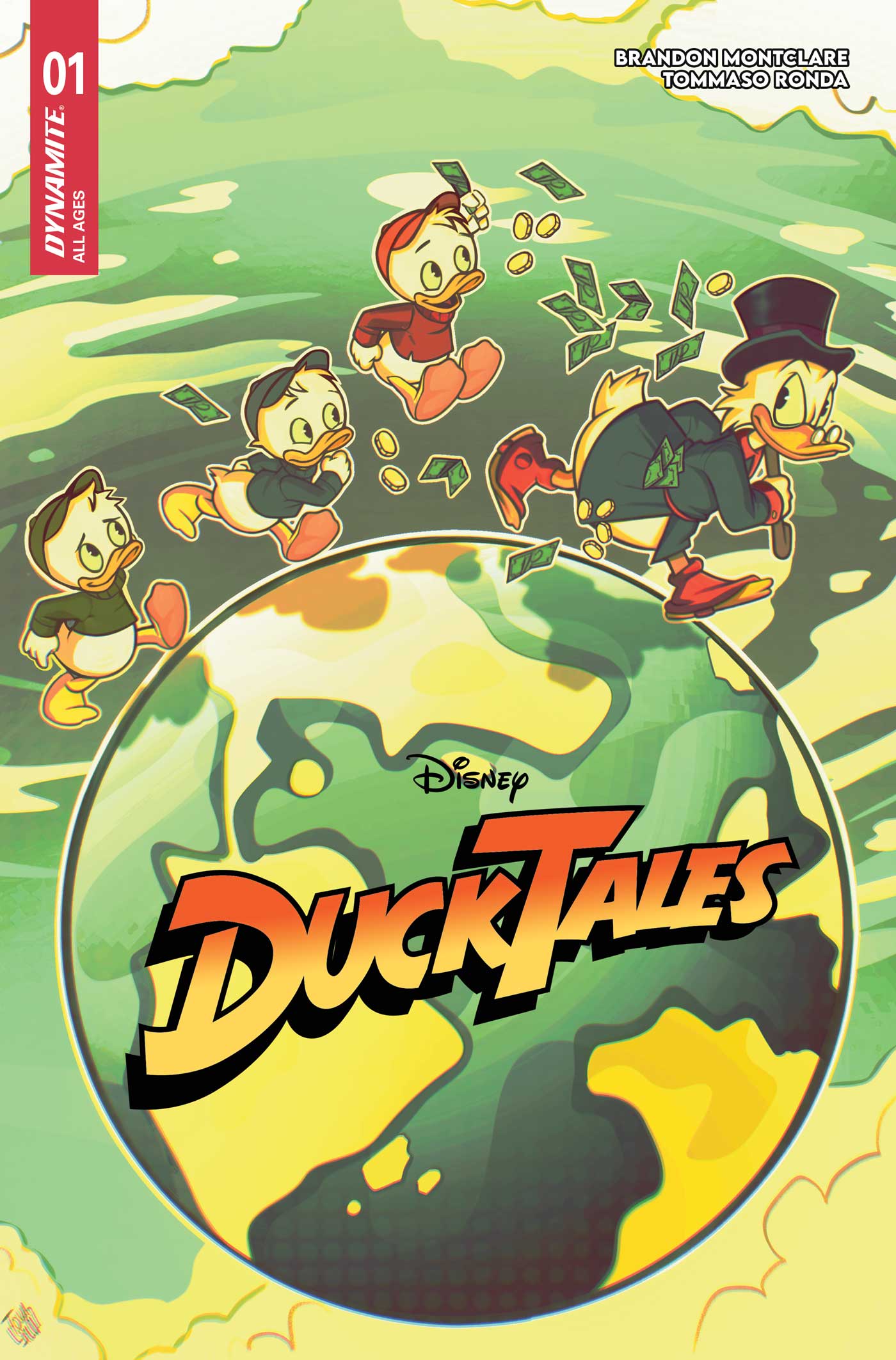
Naturally, that makes it a perfect candidate for a new series alongside Dynamite Entertainment’s other Disney titles. On November 6th, DuckTales debuts from writer Brandon Montclare and artist Tommaso Ronda. We got to sit down with Montclare to talk about the series, his history and inspiration, and what he hopes to add to the Ducks’ long legacy.

Tony Thornley: Hi Brandon, thanks for sitting down with me! I’m thrilled to chat about your upcoming run on DuckTales. I know I’m excited because the Disney Ducks are some of my favorites in comics. It goes back to me to when I’d visit my grandma, and she’d always have Ducks comics- Donald and Scrooge both. What’s your history with the franchise and DuckTales In particular?
Brandon Montclare: I am more aware of it now than when I was watching DuckTales as a kid.
I never grew out of stuff like cartoons (obviously), but when DuckTales came out I was getting a little older. In my mind, that is! I think I thought, at twelve, that the stuff for me was Masters of the Universe… or something awesome like Inhumanoids (does anyone remember that?). I could watch (and watch again) DuckTales, but that theme song was cringe. But with all due respect (sorry, He-Man; respect, Flint Dille, but apologies): DuckTales holds up better than just about anything from the 80s. Due in no small part to its being inspired by Raiders of the Lost Ark. And, as I would later learn, the two very famous creators of Indiana Jones were inspired by Uncle Scrooge.

But I should be fair: G.I. Joe or Robotech: Next Generation meant a whole lot to me at the time, and made me who I am as a creator. As did the comics that wound up in the quarter bin. And as a creator —or even as that intense kind of fan that’s destined to become a creator — you can’t escape Carl Barks. Skipping Barks is like being a playwright who’s only read a few of Shakespeare’s plays. And once you eyeball the Carl Barks Uncle $crooge stories, you instantly know why he’s so important. I was in my 20s when I first read it. And at some point after that … and that would be after the original publication … I read the award-winning Don Rosa stories.
What’s important is that by the time Dynamite called, I was ready!

Tony: The Duck adventures that inspired DuckTales have a rich legacy in comics, from the Barks classics, to the more modern Rosa stories, to European comics still being published today. How do you plan to honor and add to that legacy?
Brandon: I am well aware of the legacy. That Nate Cosby, and the whole of Dynamite, thinks I’m their best guy for this book is flattering and exciting. At the same time, under the shadow of that legacy you can’t help but be humble.
But that being said: any character(s) with whom I’m lucky enough to work, I bring my A-game. I don’t know artist Tommaso Ronda personally and we’ve only just begun this project and there’s an ocean and a language barrier and, and, and… but you can tell just by looking at his first page (and there’s a sweet four preview pages out there!) that he’s bringing his A-game too. You know because the book can’t possibly look any better!
Barks and Rosa are cartoonists. I don’t draw. If I was in a room of artists, I’d say I write on DuckTales; Tommaso Ronda draws Uncle $crooge. Savvy? I’ll come through on the stories… on the moments… on the nostalgia… on the surprises… but one of the ways I honor the legacy of Barks and Rosa is to script something that plays to an artist’s strength. But, luckily, that’s something a good comics writer always does.
Tony: Now from what we’ve seen, your series is based on the classic DuckTales cartoon from the ’80s, rather than the more recent reboot. Is that a choice you made, or were you asked to use the classic series?
Brandon: The plan was always to do a book set in the 1987 continuity. That being said: that’s the story I would choose to tell if it were 100% up to me! So it’s a perfect fit. Not only is it the series I grew up on, but the 1987 cartoon itself takes a lot from the classic Carl Barks stories — so we get to have that iconic legacy very much in the ‘feel’ of the new book.

Tony: Are you going to take any of the notable changes from the reboot — such as the more assertive Webby, the nephews’ distinct personalities and Donald’s increased presence — and include them here?
Brandon: I think there’s a lot of cool stuff in the reboot. While they made some radical changes, the motivation for those changes wasn’t bonkers; it makes sense, if you aim to put a new spin on it. That being said: I think there’s something very appealing as a storyteller (and I should emphasize storytellers, with Tommaso Ronda) with the identical tripletness of Huey, Dewey, and Louie. You can do a whole lot in the dialogue by having the three boys bounce words off each other. And you can do a whole lot moving them around the page in this kind of contained sequence of 1-2-3. I’ll risk a pun: ducks-in-a-row! Tommaso and I very much take advantage of what’s really a storytelling gimmick … but the best tricks-of-the-trade endure for a reason. Anyway … it’s too abstract to talk about: you’ll have to see it!
Tony: From the solicitations, it sounds like the series will be somewhat episodic with serialized elements. Is that the case? How does that enhance your storytelling?
Brandon: In my experience and observations, comics that are going to wind up in the hands of kids have a bit more success when they’re a big story vs a collection of 5 or 6 unrelated tales. That’s just that audience’s preference (but, again, certainly not absolute). So trade paperbacks are tricky. Because any single issue, no matter how much creators write-for-the-trade, must work as a complete story. But that’s not really an obstacle, because we (or at least I) already do it that way. Every story has a beginning, where you establish what’s up; and if you’re doing that correctly, that status quo is you’re your hero is anteing up. Every story has a middle, which is the fun stuff; the conflict. Every story has an end, where the conflict is resolved; and if you’re doing that right, it establishes a new status quo. So that cycle can repeat forever. But you can deconstruct the same way. Every chapter (which for a monthly comic IS the monthly comic) should have a beginning, middle, and end. So should every scene. And if you’re doing it right (in my opinion), so should every page (and yes, even single panel splash pages).

Anyway … that’s too high-falutin’ and going down a rabbit hole. The shorter version is you need a balance between emphasizing the single issue and the eventual collected edition. For DuckTales, the balance leans more toward each issue working alone — but with enough of an arc that they all go together to form a big story over the first five issues. And that being said: there will be stories in the run that are totally standalone, but the trick (I think) for those is to make them feel like special occasions.
Tony: Obviously, the series is going to be centered on the McDuck household, as that’s the core of the series. Duckburg has such a rich cast of characters though — both good and bad. Who are some of your favorites?
Brandon: In the first few issues of our new DuckTales, Duckburg is a character. “Four Corners of Your World,” our opening arc, finds Huey, Dewey, and Louie finding out all the secrets of their hometown. We focus on Scrooge and the boys, and the world-outside-your-window. You don’t need to journey half way around the globe to find treasure. And, not to put too fine a point on it, one of the greatest treasures you can find is yourself. So in the beginning we spend a lot of time with the ‘core four.’ But just about everyone will be sprinkled in … a bit in the background … and a few important flashbacks feature the iconic villains. Later issues will showcase the supporting cast in real time, and in really cool stories!

Tony: Without spoiling anything, was there anyone that became a favorite after you wrote them?
Brandon: Flintheart Glomgold. Not for any spoilery reason. Generally: I think broken-mirror characters are cool. Man-Bat, Venom. Reverse Flash. Spock with a beard, of course. So Glomgold was off to a good start. But one of the first decisions I had to make on DuckTales was Scrooge McDuck’s voice. You can put accents on a page — and I mean literally in how you write words — but even if you pull it off it can be a distraction to the reader. The classic Duck comics don’t attempt any written accent, however. Likewise: I think everyone ‘hears’ the cartoon Scrooge when they read his balloon — especially if you got the correct style of word choice. But early on I was tempted — maybe just by the challenge of it — to transpose that nutso-sounding Glaswegian onto the page.
Back in the day I was the assistant editor on All Star Superman for DC Comics — with its All-Scottish team. I didn’t have too many conversations with writer Grant Morrison, and he spoke whisper-like, so it was already not easy to make out. Colorist Jamie Grant was in Glasgow too, but from Edinburgh — where they speak closer to the Queen’s English. Artist Frank Quitely was also perfectly understandable when we spoke on the phone … but if he was ever interrupted … like someone in the background would ask him something … I’d overhear what sounded like an animal ripping up cardboard with its teeth instead of English. He was, by his own admission, always on his ‘best behavior’ when speaking to people from America. But more than all this: Frank Quitely was also a fan of Scottish newspaper cartoonist Dudley D. Watkins. On his recommendation, I got my hands on some of his work. Brilliant stuff. But since I’m already making a short story, long … all of that material is ‘written’ in goofy Glasgow accents. His titles, for example: The Broons (“The Browns”); Oor Wullie (“Our Willie”).
So … I couldn’t use this for Scrooge. It’s not practical. But in honor of my early gig in comics, the great Dudley D. Watkins, and the greater Frank Quitely: when you see — or should I say ‘hear’ — Glomgold, hold onto your kilts!

Tony: I can’t wait! Glomgold is already one of my favorites, and I can’t wait to see that.
Who was your favorite character going into the series?
Brandon: I’d just be being contrary if I didn’t say the main man: Uncle Scrooge!
Tony: Has any of the core cast stood out and become a favorite?
Brandon: Magica De Spell. Mainly for the visuals. As much as I like to write her, I want to see all the cool visuals Tommaso Ronda can bring to the page. She’s a stunning design: femme fatale and witch and … duck! But, again, just a Ditko-esque power set that can be so fruitful.

Tony: Thank you Brandon! I can’t wait to read it!
DuckTales #1 is available for pre-order now, and will be on comics shelves November 6, 2024.

