
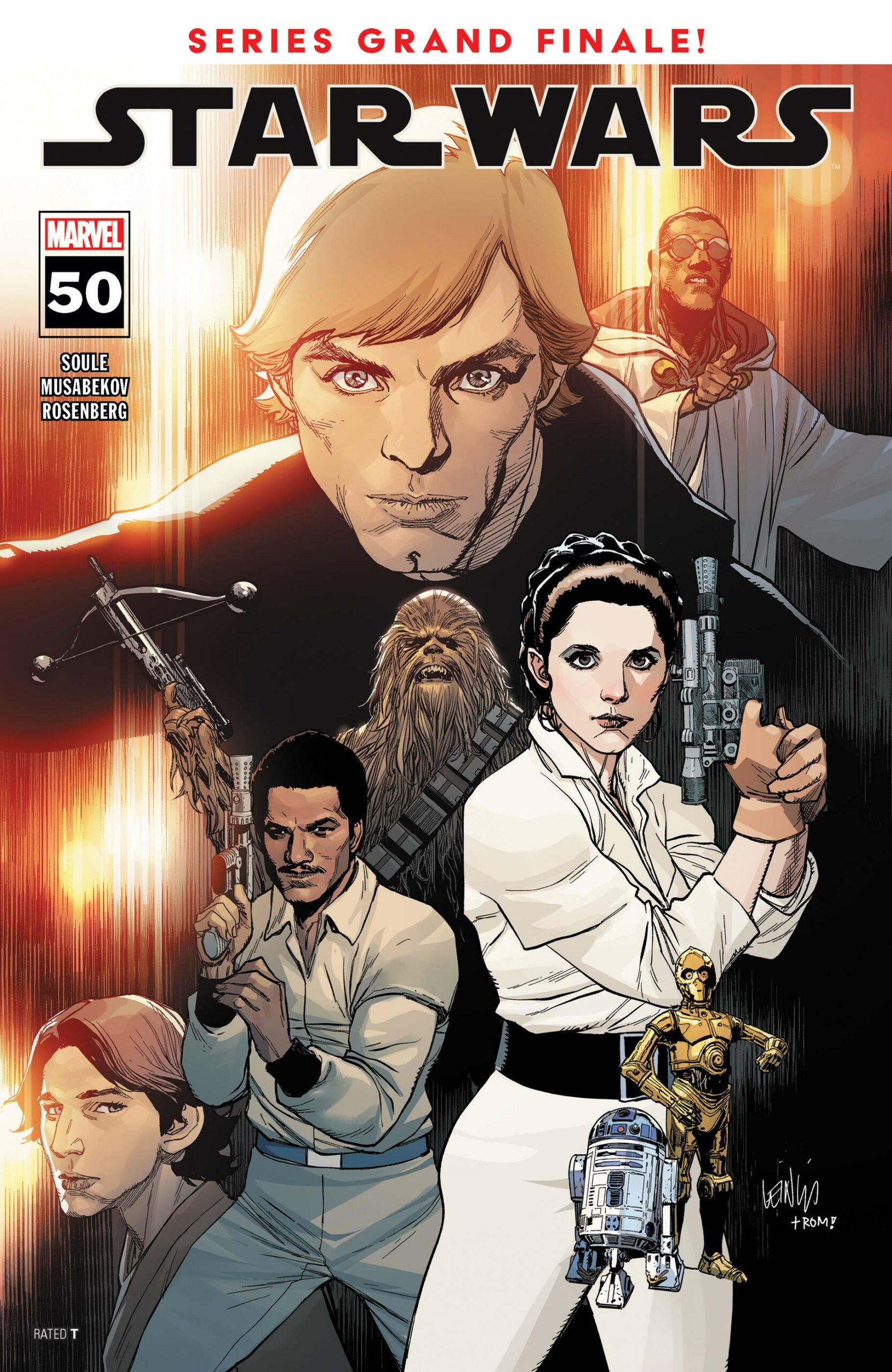
Not The Ending It Needs, But An Ending That’ll Do: Reviewing ‘Star Wars’ #50
by Austin Gorton
Overview
Opting for a thematic resolution rather than a plot-based one, Star Wars #50 isn’t a soaring climax of the era that lead directly into Return of the Jedi. The resulting story-as-parable in the series’ present day is at least good enough for what it is, and far more effective than the future-set framing sequence surrounding it.
Overall
6/10It became clear well before Star Wars #50 that, while this iteration of the series was coming to a end, it would not be coming to a soaring plot-based climax leading into the events of Return of the Jedi. There would be no dramatization of the Bothans stealing the plans for the second Death Star, or word getting around around about the Battle of Taanab that earned Lando his commission, or closing pages of the final issue that would show Lando infiltrating Jabba’s palace, Leia acquiring the Boussh disguise, and Luke assembling the parts to build his new lightsaber.
In hindsight, the closest we got on that score was the Trial of Lando Calrissian, which at least completed Lando’s arc from reluctant to steadfast Rebel. It’s hard not to feel disappointed by any of that (as well as the lack of any of the series-specific plots/characters factoring into the finale — remember the Pathfinders, Shara Bey, Lobot…), but also, it’s hard to pin that disappointment on this issue, as those were all decisions made before its inception.
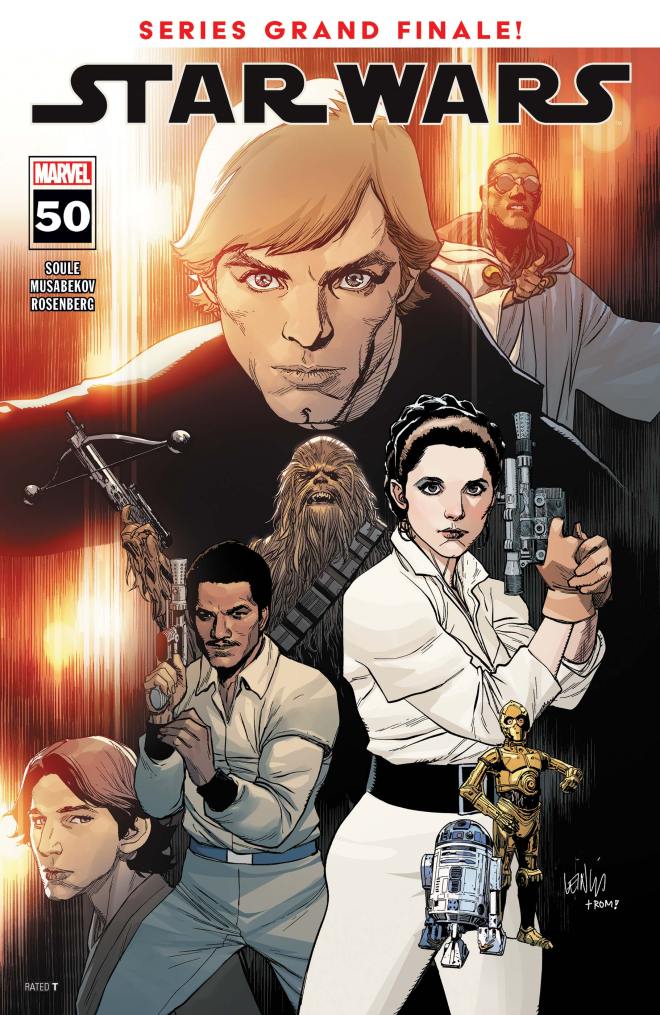
Since it can’t really provide a satisfying narrative climax in one issue, instead, Star Wars #50 provides a thematic one. It attempts to say something larger about the themes of Star Wars while giving each of its main characters a moment in the spotlight and also stretching out to encompass a broader swath of the Star Wars timeline than the immediate pre-RotJ period. Ultimately, it is more successful at accomplishing some of those missions than others.
Plot-wise, the issue consists of a story being told by an older Luke to his young nephew and apprentice, a pre-Kylo Ren Ben Solo, about an adventure Ben’s mom and extended family participated in shortly before rescuing his dad from Jabba the Hutt. Toggling between this “future” and the immediate pre-Jedi “present”, it involves Luke and his friends returning to the planet of Gazian, where Luke communes with the memory of a dead Jedi to learn about a MacGuffin that will allow them to kill the Emperor.

What follows is a quest to get the device, then to figure out how to use it, and then, when the cost of using it becomes clear, figuring out how to stop it. It all culminates in the moral of the story, which older Luke imparts to Ben, that you shouldn’t become evil to defeat evil.
This is underscored by the Jedi Luke “meets” on Gazian, a High Republic Era Knight who fell to the Dark Side trying to find a way to defeat a powerful enemy (ie he turned evil to fight evil), as well as by chapter titles taken from the dialogue in the initial Death Star firing sequence (equating the actions of the Rebels here with the most overtly-evil act of the Empire). As Star Wars lessons go, “don’t fight evil with evil” is certainly in keeping with the morality of the franchise. Squint, and you can even see how Luke learning this lesson right before his confrontation with Vader and the Emperor aboard the second Death Star informs his actions there.
In the course of the quest, writer Charles Soule gives each member of the main cast a moment in the spotlight (with Leia — who headlined the previous two-parter — getting the least to do). Even Chewbacca, so often relegated to background/supporting roles due to his inability to speak English/Basic, gets a chance to shine. As everyone else argues the merits of activating the device, Chewbacca takes action, then delivers an impassioned monologue, translated by Threepio, chronicling the plight of Wookiees under the Empire as a rationale. It’s a powerful moment in an otherwise string set of sequences that effectively highlight the main cast.

Less effective is the framing sequence itself. Other than making it easier for Soule to underscore the moral of the story (by having Luke directly state it to Ben), it’s not clear what it’s adding to the story. Presumably, the idea is to make the issue “bigger”, make it not just a send-off to the post-Empire Strikes Back, pre-Jedi era of this series but something that speaks more broadly to the larger swath of, at least the Skywalker Saga. But it’s really only concerning itself with two eras. There’s nothing about Anakin or the Prequel Era (or even present day-Vader) to truly make this a “arc of history” kind of story.
The Jedi on Gazian is from the High Republic Era, but that feels more like a nod to Soule’s large involvement in the crafting of that’s era’s stories than a strong thematic connection. Maybe the framing sequence is meant to be a tease, of sorts, to the next step in Star Wars comic publishing, which is poised to move into the post-Jedi Sequel Era for the first time. Whatever the reason, as intriguing as it is to see a pre-fall Ben interacting with Luke, it takes away from the story more than it adds to it
All in all, Star Wars #50 isn’t a bad issue for what it is, a reiteration of the themes important to the mythos and a vehicle to send-off the specific iterations of Luke, Leia, Lando and Chewie just before the events of Return of the Jedi. Would something that synched up more directly with the opening of Jedi, or that wove the various lingering plot threads and supporting characters of this volume into the climax, be better? Probably. But once the fact that the issue isn’t really trying to do that is accepted, it’s doing what it does well enough to be successful, even if it’s hard to say it stands as a satisfying climax to this era of Star Wars comics.

