
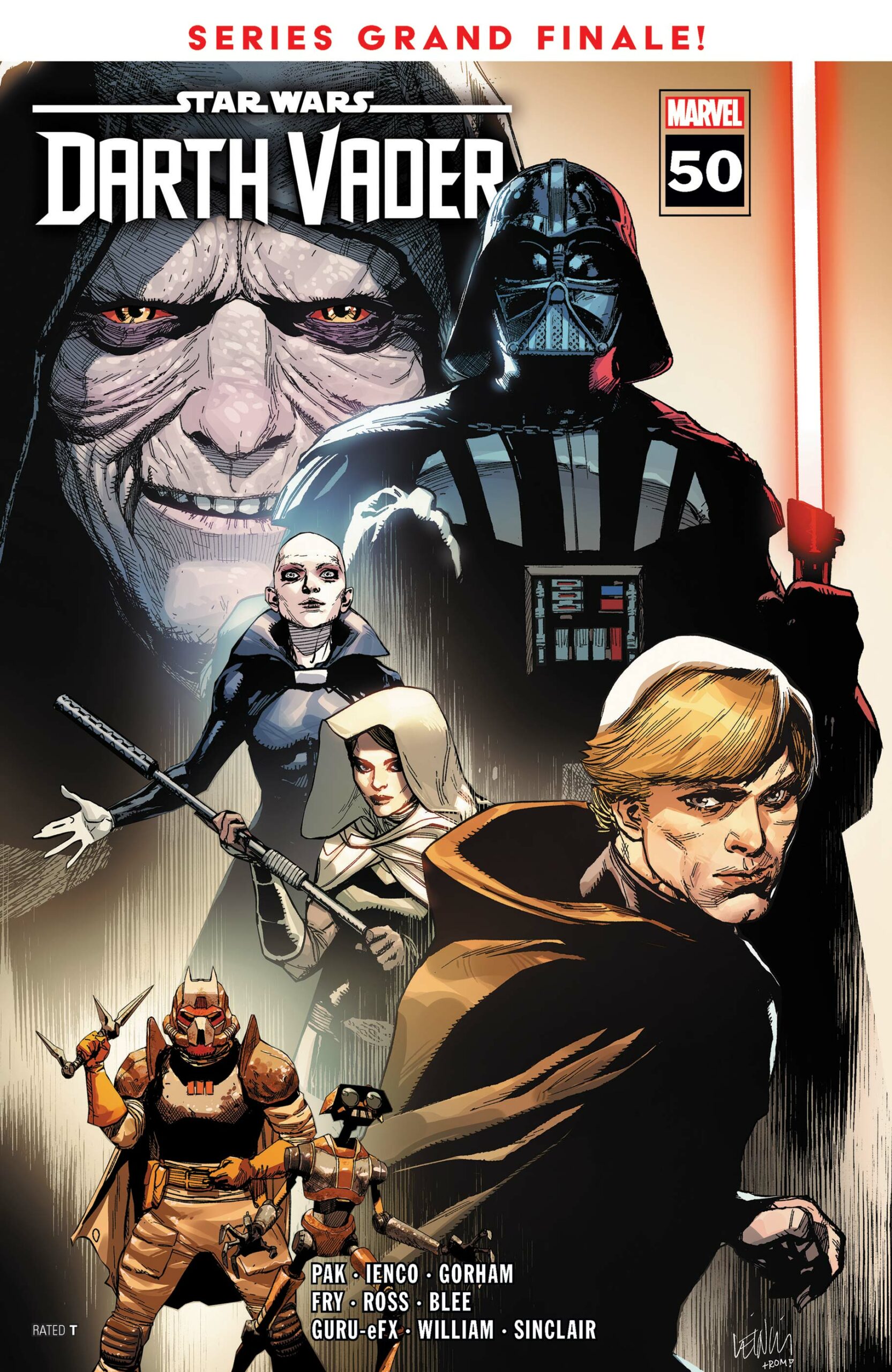
Vader Is a Sad Boy As His Series Concludes: Reviewing ‘Darth Vader’ #50
by Austin Gorton
Overview
Darth Vader #50 is more a conclusion to the “Schism Imperial” arc than a proper series finale – and the finale notes it hits leave the title character in a dour if understandable position.
Overall
5/10Whereas Star Wars concluded with a sweeping statement of thematic intent, Darth Vader #50 marks a more plot-focused and perfunctory conclusion to the latest (and as of this writing, last) series starring the saga’s preeminent villain. The end result is a disappointment. It concludes the plot du jour effectively enough and leaves the character in the appropriate place for the Return of the Jedi to pick him up. But in doing so, it adds to the feeling that this isn’t the intended end for the book, and ends in a dour, depressing manner for its title character.
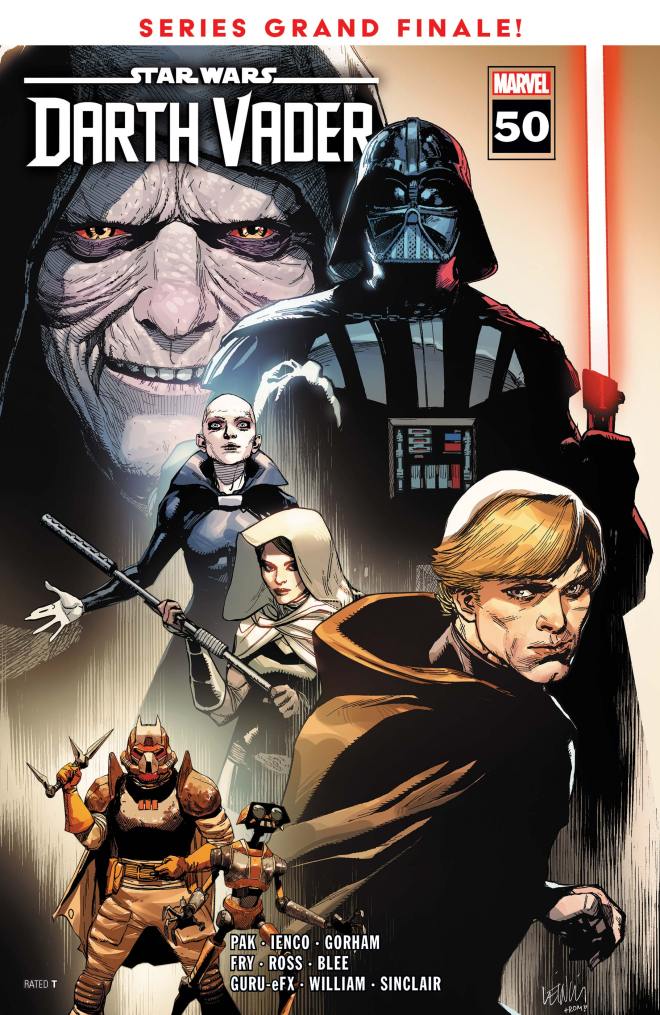
The main thrust of the story taking place on Caranthanax B concludes in the first section of the issue. With the Schism Imperial collapsing, the loose alliance of Vader and the Rebel MAR Corps turn the tide, allowing Luke to leave the planet safely. Vader then powers himself up using the Kyber weapons and energy taken from Tauntaza’s planet-killing death machine to face down the Emperor, legions of Stormtroopers, the Sith Eternal, and a couple of Summa-Verminoths for good measure. Writer Greg Pak does his best to sell the action — which artist Raffaele Ienco ably if unexcitingly depicts as, essentially, Vader blasting big bolts of energy at everything — as a battle for Vader’s soul as much as anything, intercutting the sequences with flashes to key moments from Vader’s past. This builds to a crescendo in which it seems Vader has blasted apart the Emperor (looking not unlike what Rey eventually does in Rise of Skywalker). Of course, this turns out to be an illusion generated by the Emperor to prove, once and for all, only he is capable of handling the kind of power fueled by the Sith’s fear and hatred. In the end, the spark of good in Vader sensed by Sabé — and, later, Luke — is what keeps Vader from defeating the Emperor once and for all. And so the all things ends with Vader thoroughly cowed, kneeling before the Emperor, his loyal servant once more.
While this effectively sets the stage for the events of Jedi, with Luke igniting that spark of good that defeated Vader here into something that will prompt Vader to finally turn on the Emperor, it’s hard not to feel like this is a downer ending. Vader is not heroic but he is the protagonist of this series, and this conclusion feels akin to ending a Superman series with Lex Luthor triumphant. It makes narrative sense in context, but the moment of triumph for the hero of the book comes elsewhere, which results in this being a less satisfying conclusion.

From there, Darth Vader #50 features a trio of, essentially, epilogues, which attempt to wrap up some of the lingering plot and character arcs of the series. These all work a bit better than the “main” story, in part because they don’t center Vader as the protagonist (though he does appear, fully cowed, in two of them). They also all add to the feeling that the series is being rushed to its conclusion, as they feature characters or arcs that could very easily have been converted story arcs in their own right. That said, each one comes with something to recommend.

More time with Ochi of Bestoon (especially after getting sidelined for much of the last few series’ arcs) is always appreciated. Sabé seeking out Leia to, essentially, test her as a worthy successor to Padme, makes for a nice if rushed conclusion to Sabé’s arc in the series. And the story wrapping up the fate of Kitser and Wald (who have effectively become the Tag & Bing of the back half of this series) is sweet, as the duo return to Tatooine, free their enslaved childhood friends, and reminisce about the long-gone Anakin, with its closing pages once more underscoring the sad state in which the series is leaving Vader.
Darth Vader #50 is ultimately a perfectly adequate conclusion to what was already one of the series’ more cluttered and lackluster arcs. The epilogues get an A for intent, but they can’t do enough to make it feel like a satisfying conclusion to the series on the whole. It’s rarely good to end a book with its title character at their lowest ebb, which is exactly what this issue does. While that sets the stage nicely for Vader’s ultimate (if short-lived) victory in Return of the Jedi, it does little to lift up this issue.