
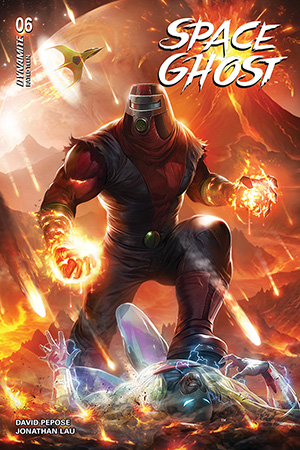
‘Space Ghost’ #6 Review: Everything Is On Fire In And It Looks So Good!
by Austin Gorton
Overview
Backed by some stellar color work, Space Ghost #6 effectively uses its villain-of-the-issue plot as a vehicle for exploring the fallout from Jace’s actions in the previous issue.
Overall
8/10Following in the wake of the previous issue’s events, Space Ghost #6 is all about family. Of course, this is comics, so “family” is, in one case, an interplanetary Space Batman and his wards and the other is a fallen scientist whose “children” are lava monsters. But by leaning into Jace’s encounter with Zorak and centering it in the narrative even as it moves on to another “villain of the week”, the issue both feels part of a larger whole while also advancing the characters.
(Spoilers Follow)

Given that story involves an issue-long fight with Moltar, colorist Andrew Dalhouse deserves a shoutout. Nearly every page is awash in various reds and warms, but Dalhouse renders them with enough subtle gradients and shades that the action never gets confusing. Having the title character clad in white certainly helps. Dalhouse uses that to his advantage, with pops of cool-white from Space Ghost serving as a counterbalance to the warm fires of Moltar. The visual contrast is also underscored by the elemental cannon — basically a freeze ray — Team Space Ghost uses against the villain. The hot/cold dynamic is supported by the different color palettes, the icy blasts of the cannon both overwhelming Moltar’s flames in-story as well as visually by the end of the issue.

Writer David Pepose deploys a flashback structure for the issue’s story, opening the Space Ghost/Moltar fight in media res before cutting back to before it begins, with both sequences narrated by Jace via his journal entries. They are an effective way of giving voice to Jace’s perspective and to setting up the twist of the issue. But the shifting timelines feel a little unnecessary, with the transitions between them getting muddled occasionally. The twist — essentially that Space Ghost isn’t mad at Jace for his reaction to seemingly killing Zorak, as Jace thinks, but rather that he’s mad at himself for putting Jace in that situation — is much more effective.

It both speaks to Jace’s character and believably underscores his age. Of course a kid is going to think he’s done something wrong when the authority figure in his life shuts him out after something he’s done. It also speaks to Space Ghost’s character, and its development over the preceding issues. An earlier version of this character probably would have been mad that Jace couldn’t just shake off killing someone who was so clearly a threat to many, many people. But the edges have been sanded off a bit, with Jan and Jace softening Space Ghost during their time with him. His own response to the events of the preceding issue make that clear. In the end, Space Ghost #6 is an affirmation of the bond between Space Ghost, Jan, and Jace following the most significant threat to that bond yet.


