
Fans Of Literature And British History Will Like Alan Moore’s ‘The Great When’
by Koom Kankesan

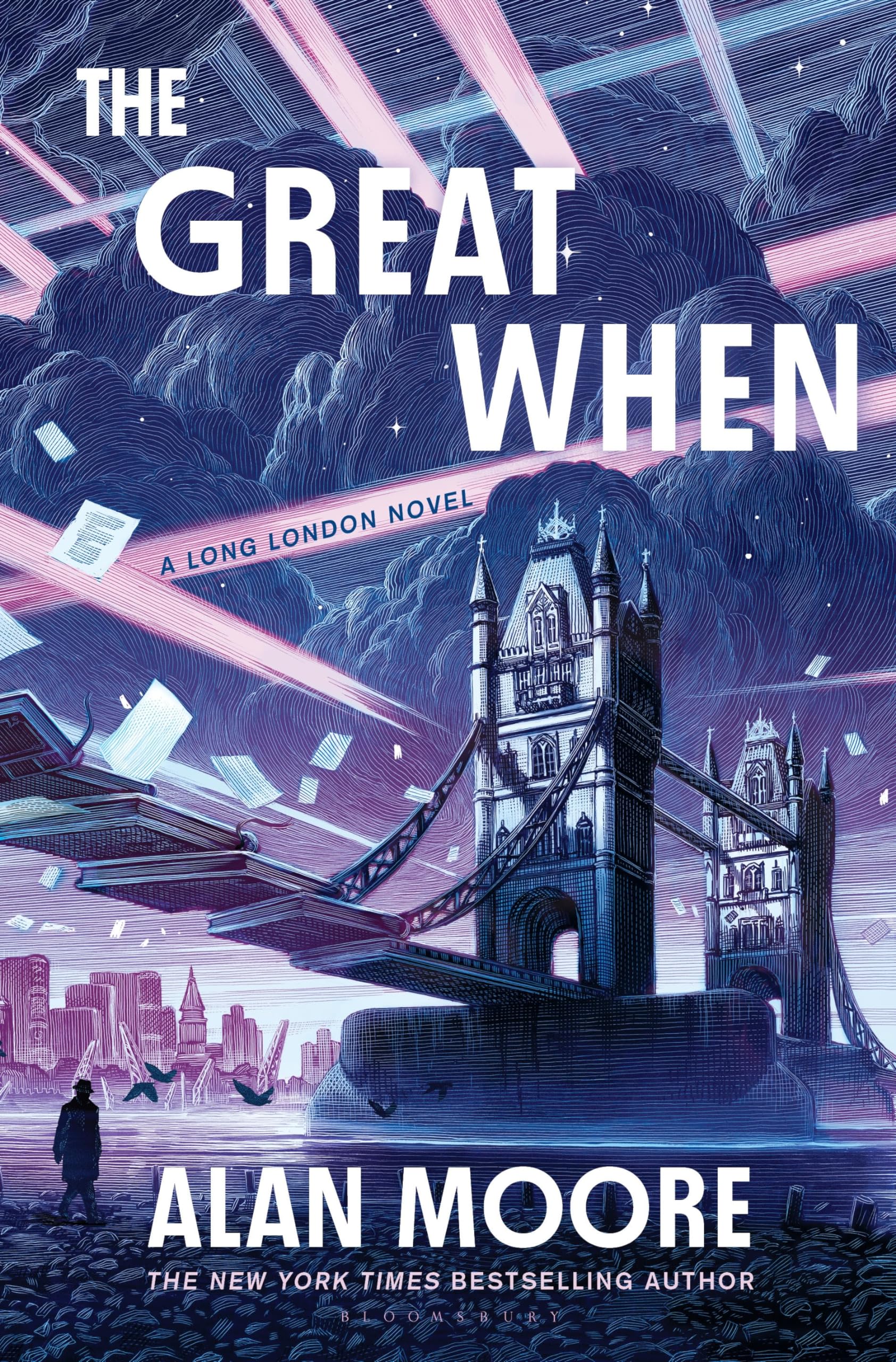
The Great When, Alan Moore’s new novel and the first in a quintet called the Long London series, is perhaps what people may expect and perhaps not. If people have been reading Moore’s fiction in the latter phase of his career (Jerusalem, Illuminations), they will be familiar with his baroque style favouring long descriptions, less beholden to plot and momentum than early works. Those who want Moore to write like he did when he wrote superhero comics probably shouldn’t pick this up. On the other hand, if you’re a fan of literature and English history (like I am!), you may quite like it. It feels like a shift in Moore’s writing happened around the time of The Black Dossier which, though a League of Extraordinary Gentlemen episode, felt nothing like the League stories before it. Since then, in one form or another, Moore’s focused on tackling worlds of ideal forms that exist contiguously to our own — mystical dimensions formed of ideas that can be accessed by adepts, and Long London is no exception.
Set in a 1949 London trying to recover from the Blitz during WW II, the novel’s protagonist is Dennis Knuckleyard, an impoverished eighteen year old living and working in a bookshop run by “Coffin” Ada (one of the meaner characters to inhabit Moore’s oeuvre, her nickname is well deserved). Much of the first half of the book revolves around Knuckleyard being saddled with a book that should not exist in reality (a book that is referred to in the fiction of Arthur Machen’s short story “N”), and his journeys into “Long London” — a symbolist dreamworld which artistic and historic figures have access to but also end up in. There are portals into it from “Short London” (the London of “reality” which most people know). A book from within fiction — and therefore imagination — cannot exist in Short London and will have dire consequences if Dennis does not return the item.
Moore describes episodes within Long London all in italics — vertiginous prose, a never ending stream of poetry and images, dazzling with associative, spiritual, and symbolist meaning. I didn’t always understand what I was “seeing” or supposed to see in the scenes in Long London and wondered whether this might be because in the past, Moore has worked with artists to make these transcendent worlds appear to readers; they can be seen rendered by Kevin O’Neill in The League or J. H. Williams and Mick Gray in Promethea. Both Jerusalem and What We Can Know About Thunderman offered transcendent worlds purely through prose, but these seemed less dissociative. Those who sorely miss Moore’s adventurers can pretend that the colourful and larger than life historical figures who populate his new novel (Prince Monolulu, Austin Osman Spare, “Iron” Jack Neave, and villain Jack “Spot” Comer) are stand-ins.
Truth be told, I like the fictional storyline and its characters better outside of their interactions with the transcendent world. Dennis Knuckleyard and his frustrated adventures with romance as well as romanticism, his friends and comrades, and a subplot which harbours resonances with From Hell (spoilers stop me from revealing more) are quite gripping. At just over three hundred pages, this is not a long work by Moore-ish standards and it definitely feels like he’s laying the groundwork for something much more vast — i.e. a gloss of British history throughout the latter half of the twentieth century — but there are going to be passages less interested people will just not be able to brave through. I like that this first installment establishes Knuckleyard as a writer-to-be and, if I’m not mistaken, this might be the first time that Moore is fashioning a literary writer as his central protagonist (the one in Providence was a would-be writer but in this, as in so many other things, Robert Black fell short of his aims) so perhaps we will get some of Moore’s own feelings about his practical trade emerging in the slipstream. In time, I think this series will only diverge more from Moore’s comics work, becoming its own thing.
Speaking of literature and writing, the final chapter is an absolute tour-de-force, even if I don’t understand every nuance of it. Its poetry and feeling stands with the best of Moore’s work. I know that this will not be incentive enough for many people — with each passing year, it saddens me that there are less and less friends I can discuss Moore’s latest projects with. Moore seems to favour making the beginnings of his works a challenge, as if he’s intellectually carding the people who wish to enter his establishment. So, to end off, here are a few of my favourite quotes, picked for no reason except they exhibit how beautiful and evocative the writing can be and Moore’s facility for detail and delineating a character:
“Finishing his stout, confirming his next-day appointment at Wynne Road and shaking everybody’s hand, Dennis picked up his bag and exited Elephant and Castle before etiquette demanded that he get a round in and stand everyone a drink. Being the conscientious type, this didn’t make him feel particularly good, but, then, since he was relatively broke, it didn’t press upon his conscience any further than the second or third lamppost. The overcast hour it took to reach Spitalfields – across Tower Bridge, as an immense weight of black water crashed invisible below – had not one star, the sky emptied of promise rim to rim.” (p.122)
“‘This new Britannia’s looking good, but where I think we’re going to have a problem is in letting old Britannia go. It’s clear the empire’s had its chips, with India ready to abandon ship, but what’s the betting that we’ll try to hang on to our status as a grand and world power, up there with Russia and the Yanks, despite the fact we’re in debt to our eyeballs? We can have the decent country we’ve been guaranteed, or we can keep up the illusion that we’re still a great one, but I can’t see that we’ll have the money to do both. And knowing us, we’ll probably decide that destitution’s not too bad, so long as you can dress it up in a Union Jack waistcoat.’ ” (p. 298)
“At this age, the career arc stands revealed as a V-2 parabola, its many questions now reduced to time and place of impact. Functions of the body once as unremarkable as waking in the morning are made hard-fought victories and thus a cause for celebration, like, for instance, waking in the morning. Every day, the future seems a shorter street, just as the lists of gone acquaintances and things that won’t be done again seem longer. Even though this outcome is the one that everybody, surely, was expecting, it appears to always come as a surprise, like snow in February, or long nights in October.” (p.307)
