
‘Huckleberry Finn’ Reimagined: Talking ‘Big Jim And The White Boy’ With David F. Walker And Marcus Kwame Anderson
by Rachel Bellwoar
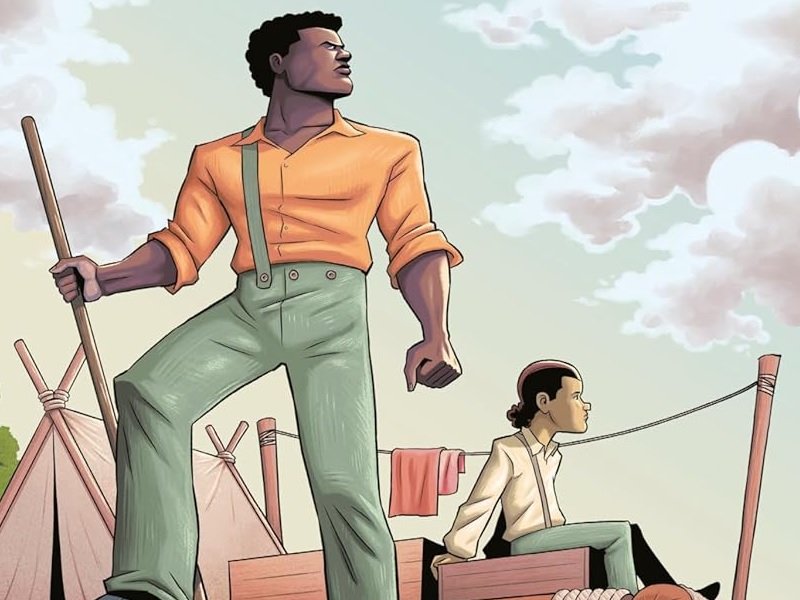
In The Adventures of Huckleberry Finn, Jim was a character in Huckleberry Finn’s story. Now, in writer David F. Walker and artist/letterer Marcus Kwame Anderson‘s graphic novel re-imagining of Mark Twain‘s American novel, Jim gets to be the narrator and tell his version of events. With colors by Isabell Struble, Big Jim and the White Boy is on sale now and here’s what Walker and Anderson had to share about it:

Rachel Bellwoar: When did you first start toying with the idea of reimagining Huckleberry Finn as a graphic novel centered around the character of Jim and did you run into any copyright issues?
David F. Walker: The idea started really taking shape about ten years ago – maybe a little more than that. Back then it wasn’t a graphic novel, and it was something I returned to every now and then, but for the most part it languished. While Marcus Kwame Anderson and I were working on The Black Panther Party for Ten Speed, the idea of re-imagining Huckleberry Finn and telling the story for Jim’s perspective popped up in a conversation, and from there things really began to move forward. For whatever reason, it never occurred to me to do it as a graphic novel, which I suspect is why it languished for a long time – I wasn’t thinking about the project in the right way.
Marcus Kwame Anderson: David had been kicking the idea around for years before our publisher, Ten Speed Press presented the idea of re-imagining a classic work of fiction. It was the perfect opportunity to explore his re-imagining in graphic novel form. Thankfully he insisted that I was the right person to tell this story with him. I’m not aware of any copyright issues.
Bellwoar: Big Jim and the White Boy begins by showing how Mark Twain wrote for Jim versus how Jim actually spoke. It’s not just the dialogue that’s different between these two scenes, though. How important was it to you to show how dialogue can effects how a person is perceived or imagined, especially in a written medium?
Walker: Part of my issue with Twain’s portrayal of Jim has always been how the character talked. So much has been written about Twain’s use of realistic dialects, but for me, Jim always sounded like a character from a minstrel show, and that’s the problem with a lot of Black characters portrayed a popular media, especially during the 1800s and into the 1900s – they all sound ignorant and infantile. I knew from the very beginning that one of the big differences between our Jim and the Jim portrayed by Twain was going to be how he spoke. I never wanted our readers to struggle with what Jim was saying, and more important, I never wanted them questioning his intelligence.
Anderson: Dialogue is extremely important, along with what a character is and isn’t allowed to say with their voice. There were issues in how Jim’s dialogue was written in the original story, but there was a larger issue in how little access we had to his thoughts and motivations. Jim’s interiority was largely unexplored in Twain’s book. We wanted to represent Jim in a more dignified manner, and we aimed to make him a more complete and complex character overall.

Bellwoar: It’s not immediately clear who Jim is telling his story to, or that he’s not alone. Why did you decide to take your time revealing his audience?
Anderson: In our early discussions we knew that we wanted this to be a layered story. I love David’s choice to take time in revealing the larger connections between characters. I enjoy this type of storytelling as a reader. The surprises keep coming page after page and it rewards your patience.
Walker: I like layered stories. I like stories that ask the reader to pay attention and participate by studying what’s going on. I wanted the reader to get to know Jim, then Huck, then the other characters. I wanted the relationships to open up and bloom, like a flower, as opposed to dumping everything on the reader all at once.
Bellwoar: Did you always want to have this story play out across multiple timelines, so we not only get to hear from Jim directly but we also get to see how his descendants keep his legacy alive?
Walker: More or less that was the plan. Some things changed along the way. Very early on, the college professor was just a college professor, and not related to Jim. But I quickly realized that having them connected made the story more compelling and much stronger. In fact, I only wrote two or three pages of the professor before I realized that she needed to be related to Jim. Once that decision was made, the story began to take shape with a greater sense of clarity.
Anderson: Telling the story across multiple timelines and from multiple points of view was part of the plan very early on. As David wrote, the idea of tying these timelines directly to Jim’s descendants just made sense. It allowed us to speak on the importance of keeping one’s family legacy alive, and to articulate the connections between the enslaved and their descendants. As an artist, I loved the multigenerational aspect of our story. I had a lot of fun drawing and creating generations of family members, each with their own distinctions and similarities.
Bellwoar: We literally get to see Jim and Huck age, too. What was it like getting to follow their relationship over a much longer period of time?
Anderson: I loved drawing Old Jim and Huck! It was a fun challenge to take their younger designs and imagine how they would age. Who would they be after all of their trials and adventures? We deal with a lot of serious subject matter in our story, and the interactions between these two bickering old friends allowed us to inject some humor into the story.
Walker: It was a challenge in many ways, because I wanted to make sure that over the course of the story we get a sense of how long they have known each other. People talk to each other differently as time marches on – their familiarity evolves. And it was important that we show these two characters evolving and growing together, and that required a lot of thought and planning. Marcus and I talked about these things a lot, as it was important to us to know where Jim and Huck were in their relationship at any given time.

Bellwoar: It’s amazing how much history you can go without ever hearing about. It wasn’t until this graphic novel, for example, that I learned about the Border War in Missouri and Kansas. What was the research process like on Big Jim?
Walker: I love research. It is my favorite form of procrastination. I’m also a bit of a history junkie, and I love reading about all kinds of things. I knew a little about the Border Wars, and John Brown’s actions in the Kansas Territories, and it was important to me that Jim (and Huck) find themselves caught up in what was happening in the Missouri area both before the Civil War, and during. Twain never addressed any of that in his book, setting [it] before the real hostilities broke out. But I knew that the tension and conflict would be part of our story, so I gathered a ton of books on Missouri and Kansas and the Border Wars, as well as books on the history of slavery in Missouri.
Anderson: David researched widely and tirelessly, and so much of that research was in the script. I also did my own extensive research to get an idea of how to visually represent this world. Photography was very limited before the civil war, so I had to rely on written descriptions in many cases. I also did quite a bit of research on how 19th century weapons worked, which helped with our action scenes.

Bellwoar: Adventures of Huckleberry Finn is a book that’s no stranger to being banned. What would say to those who think it should be removed from schools?
Walker: I don’t believe in banning books. I believe in teaching and helping people think critically. Removing books from schools and libraries is not a solution to better understanding of anything, it is merely closing your eyes and hoping that monster in the room doesn’t see you. Schools are meant to educate – to teach us how to see and understand the monsters and the things that scare us, or the things we don’t fully understand. School is not a place to hide from the things that make us uncomfortable, it is where we are supposed to grow, learn, and make the world a better place, and not cower in fear of the things that offend us or force us to see the truth.
Anderson: I don’t think that Adventures of Huckleberry Finn should be banned, but I think educators have a responsibility to put it into context when teaching it. The aspects of the original book that have made it controversial also provide opportunity for discussion and critical analysis. I recommend that educators teach Adventures of Huckleberry Finn alongside Big Jim and The White Boy, allowing students to compare and contrast the two stories.
Bellwoar: Thanks for agreeing to this interview, David and Marcus!
Big Jim and the White Boy: An American Classic Reimagined is on sale now from Ten Speed Graphic.