
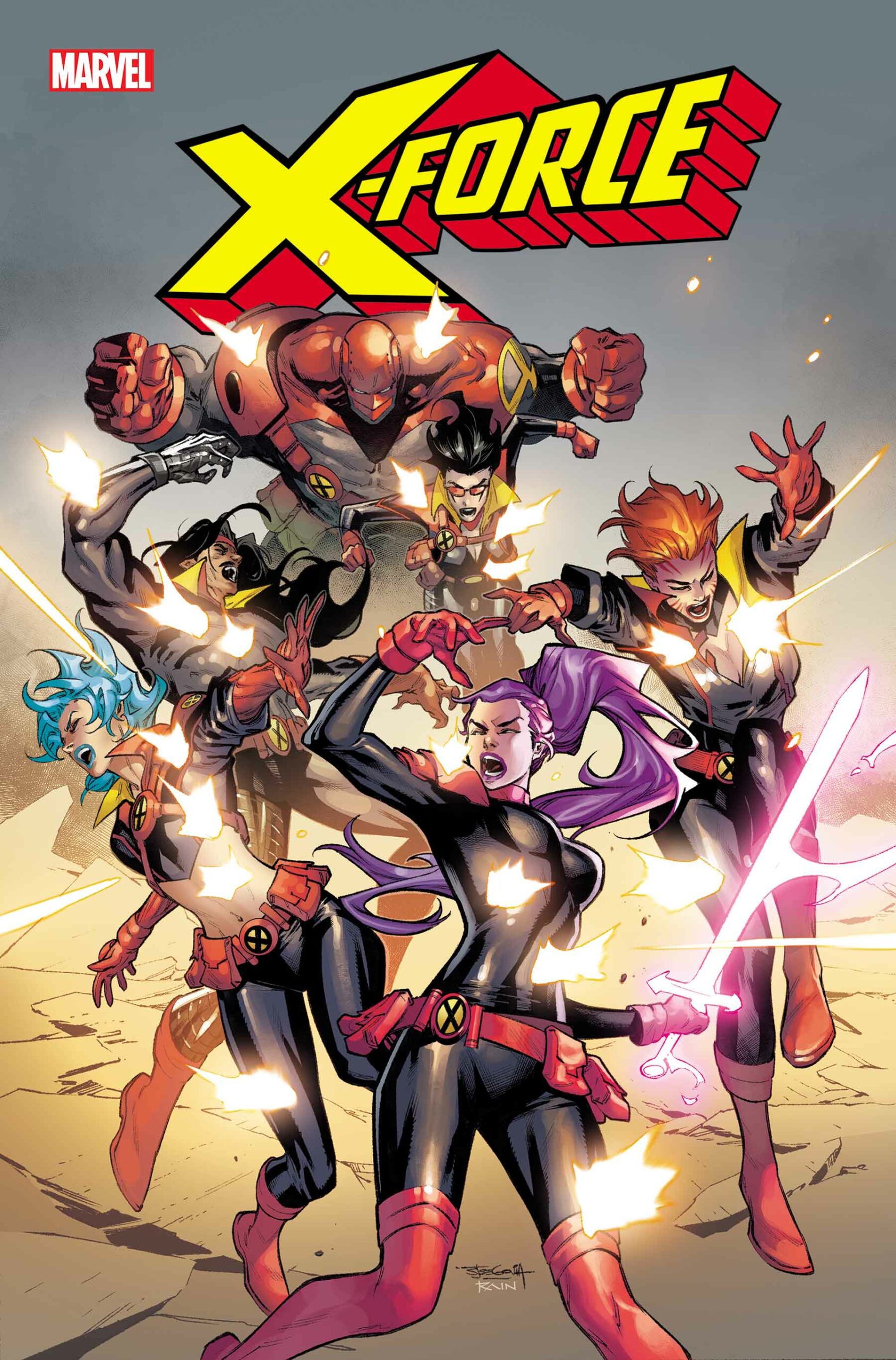
‘X-Force’ #5 Builds To A Frustrating And Regressive Conclusion — Review
by Austin Gorton
Summary
X-Force #5 addresses some of the series’ structural flaws (and looks nice), but is ultimately undercut by a climax that both regressive and unearned.
Overall
4/10Throughout much of X-Force #5, there are signs of the series growing into its own, and improving as a result. Flaws remain, but there’s a confidence to it that suggests the book is heading in the right direction. Then the issue runs headlong into its conclusion, and a particular storytelling decision drops the book right back into “what are we even doing here?” territory.

First, the good stuff (or at least, the better stuff). After a pair of largely standalone issues (still operating within the larger context of the series’ overarching plot), the previous two issues and X-Force #5 are chapters in a multi-part adventure. Issue #3 introduced old Avengers baddie Nuklo as the villain du jour; last issue expanded his threat to a global scale and brought in an alternate reality team of Avengers. Here, that immediate plot concludes as the combined X-Force and alternate Avengers team-up to take on Nuklo and the multiversal threat Forge’s Analog device is screaming about.
This all gives the story some much needed structure and, in not having to spend pages setting up a new threat, more room for character interactions and development. This issue also continues to look great, thanks to the continued work of artist Marcus To, who is adept at handling both the big action set pieces and the quieter moments, and isn’t overwhelmed by the exceptionally large cast in this issue (featuring two different superhero teams).
On the other hand, in a series that is still struggling to establish its core cast beyond Forge and Sage, there are entirely too many characters in X-Force #5. While it ultimately falls on X-Force to save the day (more on that below), the lead up to that involves a lot of random alternate reality characters whizzing around doing stuff, at a time when the bulk of this book’s cast are still little more than one-note characters: Captain Britain doesn’t trust Forge, Askani is along for the ride cuz of Captain Britain, Surge just wants to help people, Tank is mysterious. The fifth issue of a new series when 4/6 of the cast are still struggling to establish themselves is not the time to drop in a guest appearance from a whole team of alternate characters.

*Warning: Spoilers Follow*
Which, in turn, makes the climax of the issue all the more troubling. Nearly every issue since the first has featured running (occasionally repeated) dialogue from Sage’s internal monologue, presented as narrative captions, sharing her thoughts in the moments immediately after someone has died. This issue reveals that person to be Surge, who dies in the course of defeating Nuklo.
It’s a heroic death, to be sure, and given it promptly leads to Sage quitting the team, it seems unlikely the fallout from the death is likely to be breezed past in the regular churn of monthly storytelling. Writer Geoffrey Thorne also deserves credit for writing around Forge’s power and establishing contextually why Surge had to die and Forge couldn’t just build something to prevent it.
But at the same time, it just feels like a waste of a character. Coming this early in the book’s run, it reads a bit like the slaughter of the first batch of X-Factor operatives in X-Factor #1, a way to say, “hey, now that mutant resurrection is off the table, death matters again!” Except it didn’t really matter before the Krakoa Era, and it likely won’t now: then and now, any character death can be undone by a writer who wants to do it. It also doesn’t feel great that Surge, whose most (…only…) consistent characterization in this series has been “the one who is there to do good” on a micro level (vs. Forge’s vague macro level “save the world” mission) and the character with the least amount of publishing history (outside of Tank, the token mystery character) is the one to die in the series’ inaugural story arc.
Maybe Thorne will use her death to further define this iteration of X-Force, that it’s the place for characters who are not like Surge, who are more willing to sacrifice the few for the many. But for now, it just reads like the climax of the story needed someone to die, so the character who would be missed by the fewest fans and had less “edgy” morality than the rest of the team drew the short straw.

There’s still potential here — Surge’s death might lead to significant developments in the mission of the characters or the themes of the series, or serve as a catalyst to finally explore the characterization of the remaining team members more deeply. At the moment, however, the big takeaway from X-Force #5 is that it serves as a reminder that killing characters for a cheap “shock” moment is back on the table.
