
Their Fathers’ Shadows — Reviewing ‘Star Trek: Sons Of Star Trek’
by Scott Redmond
Overview
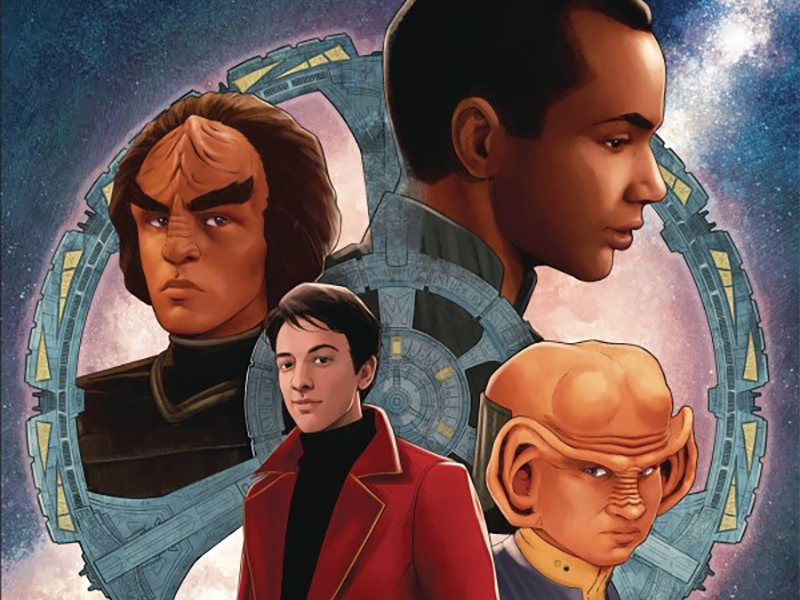
Star Trek: Sons of Star Trek is a an emotional journey through the legacy of Trek, both in and out of the universe, creating a powerfully rich miniseries. Big heavy yet light visuals bring such bold and superb life to a story which tackles the sci-fi and personal exploration with expert care.
Overall
9/10For decades, the characters of Star Trek have sought out new life, met new civilizations, and always done it boldly. Sometimes though, the bold place that one must go starts with a look deep inside of oneself.
On the other hand, maybe that discovery comes from a Q-powered trip to an alternate universe. Tomato, potato really.

Legacy characters of all shapes and sizes unite for Star Trek: Sons of Star Trek, one of the latest tales in IDW Publishing’s bold new Trek line. The tale of sons is set adrift by Morgan Hampton, Angel Hernandez, Nick Filardi, and Clayton Cowles.
Dipping into alternative universes is nothing new for the characters that inhabit the world of Star Trek. Having a god-like being or some cosmic anomalies fling a person or their whole crew into this situation is far more common than most beings in the universe would like. Being the children of prominent movers and shakers in the galactic realm, it’s actually surprising that this is a first for the trio of characters we’re following.
Father & son relationships are something that Hampton does well, as evidenced by his recent Cyborg series for DC Comics (which I thoroughly loved). It carries over here three-fold, since we have three sons dealing with things related to their fathers and futures. Actually, four sons and fathers if we count Q Junior and Q in the mix.
Yet it maintains the wacky but powerful beats that make Trek what it has been for all these decades.

Hampton taps into each of their pasts, struggles, and family connections when placing the characters on the board in respect to their desires about a return home. It makes perfect sense for Jake and Alexander to be on far opposite sides of the board, with Nog hovering in the middle. Jake’s connection with his father and others is strong, and while he isn’t sure what his personal path might be he wants to go back there. Alexander, on the other hand, has a horrible relationship with his mostly absentee father and took part in a murderous cult and has plenty of blood on his hands.
This might be the best Alexander focused story that has ever come out of Star Trek.
That’s a bold declaration, seeing as there have been so few stories that even gave the young Klingon and Human son of Worf a focus. It’s a statement that I stand wholeheartedly behind though.

A story like this gives room to play with a wide variety of toys, from every avenue of Trek. From the departed but never-forgotten Jadzia Dax to the recently introduced Liam Shaw (Star Trek: Picard) and Mariner Beckett (Star Trek: Lower Decks) to even stalwart supporting characters like Alyssa Ogawa (Star Trek: The Next Generation). Hell, even the Deep Space Nine barfly Morn and the controversial Tuvix have a part to play in the whole story. Not to mention a very similar yet vastly different Gul turned Captain Dukat.
Like others who are working on the current Trek books at IDW, Hernandez hits that perfect spot of characters who feel familiar without being carbon copies of the actors. Just close enough that we’re like “Oh yeah that is Jake/Nog/etc” without thinking too hard about seeing their actors on the page.
So much depth and detail is apparent in the work that Hernandez brings to the page. Emotions are crystal clear with the facial expressions and body language being spot on. Each action sequence crackles with energy and feels almost impossibly bigger than the pages, ready to burst right into reality. At the same time, when it benefits the story all that detail is pulled back on to really focus on a singular element or to set the stage (in some of the more crowded panels).
This move takes nothing away from the story, only makes it stronger because it keeps things streamlined until it all bursts forward again.

Great weight comes from the artwork and also the colors that Filardi is bringing to the party. Each ship and space has its own feeling. The Theseus is far brighter and more hopeful, while DS9 is still as dark and heavy as it always was on the show, thanks to all that dour Cardassian architecture and styling.
One thing that really sticks out to me in the various Trek books lately is the choice to have different lighting and filters throughout the main ships. On a show we get why the lights would be the same through almost every space, because of limitations but also ease for shooting. Comics don’t have those limitations, and it makes so much sense that different areas of the ship have their own visual aesthetic. Sure, it’s not really a space military-esque program sort of concern, but it’s just a fun visual and makes these ships feel more lived in and unique.
Most of the vibrancy is left to the uniforms, letting those blues, golds, and reds pop, especially under the far brighter settings on the different starships we see. Overall, the balance of light and dark is spot on and makes sure the vibes are felt.

Character focused pieces generally mean that characters have a lot more to say, unless it’s those more stoic characters.
There is a lot for Cowles to do here, which is no different from the other Trek work he’s been putting in. Plenty of character captions that are colorful and unique, and ways to spice up the dialogue. Shifted fonts, big explosions of color and size, SFX that are just as vibrant and loud as the uniforms. It all really makes sure we are right there with the characters, hearing their voices perfectly in our heads.
Star Trek: Sons Of Star Trek is now available from IDW Publishing.
