
Snap Into Marvel: Star Brand Introduces The New Universe To ‘Marvel Snap’
by Austin Gorton
Real Name: Vnn
First Appearance: Marvel Legacy #1 (September 2017)
Powers & Abilities: The Starbrand imbues its bearers with god-like strength, durability, and near-immortality, along with the ability to generate intense energy blasts and fly; with enough time and willpower, the user can reshape the power as they see fit.

Comic Book Chronicles
The concept of the Starbrand — a planetary defense mechanism of cosmic origin that imbues its wearer with considerable power — comes from the New Universe, the brainchild of former Marvel Editor-in-Chief Jim Shooter. As part of Marvel’s celebration of their 25th anniversary in 1986 (dating back to the launch of Fantastic Four #1 in 1961, though the company’s existence predates that), the New Universe was a sort of proto-Ultimate Universe. But rather than present refreshed takes on existing characters, the intent was to introduce new characters living in a “world outside your window” (i.e. the real world) which is changed in the wake of the “White Event”, heralding the creation of super-powered beings or “paranormals.” An added twist: the stories would unfold in real time — the month which passed between issues in “our” world also passed for the characters in theirs.

The New Universe never quite caught on, due to a variety of factors including budget cuts preventing Shooter from putting top-tier talent on the various books; some creative misunderstandings of the core concept and storytelling goals of the endeavor; and internal political struggles involving Shooter (who would leave Marvel before the New Universe fully ran its course). But as with most things in comics, it had its fans, and over time, various elements from its stories worked there way into later tales set in the “main” universe. Notable amongst those elements is the Starbrand, which writer Mark Gruenwald (who worked on some of the New Universe) brought into his Quasar series; he even built a crossover around it in 1994.
A different take on the New Universe was launched in 2007 as newuniversal, celebrating the original’s 20th anniversary. In 2013, writer Jonathan Hickman tapped several elements of the New Universe, including the Starbrand, for his Avengers run. From there, the concept of a character with the name Star Brand wielding the Starbrand became a semi-regular fixture in the Marvel Universe and Avengers titles, including during writer Jason Aaron‘s run on the main book. Which brings us to the inspiration for Marvel Snap’s Star Brand card.

A primitive human living on Earth circa 1,000,000 BC, Vnn and his lover, Brrk, were attacked by Deviants (ancient enemies of the Eternals). While Brrk died during the attack, Vnn survived after discovering the corpse of a dinosaur that had possessed the Starbrand. Taking its power for himself, Vnn managed to defeat the Deviants.
Unlike other wielders of the Starbrand, however, absorbing its power transformed Vnn into a hulking, monstrous behemoth. Shortly thereafter, he came across the Prehistoric Avengers and joined their number. With each of the Prehistoric Avengers loosely approximating a more contemporary superhero, Star Brand is basically the Prehistoric Avengers’ Hulk, a being of massive power with a monstrous form, filled with rage over the death of Brrk.
Fit & Finish

Without a huge back catalog of stories to his name nor multimedia appearances, Star Brand’s initial variants are all just different takes on the main look — but it’s always nice to see a new Alex Horley variant. That said, it’d be great if we got an old school 1986 New Universe version of the character as a variant some day.
Form & Function

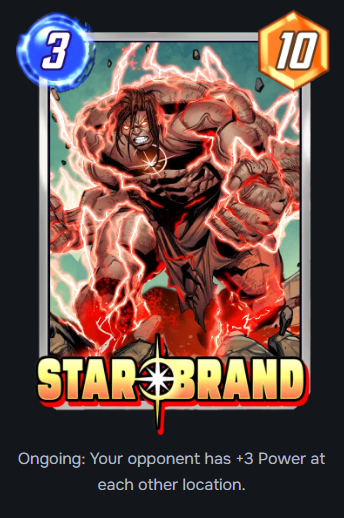
Positioned as the Hulk of the Prehistoric Avengers, Star Brand appropriately fits into the wider Marvel Snap Hulk “family” of big power cards like She-Hulk and Skaar. Star Brand’s downside — giving your opponent +3 power in the locations Star Brand is not — is presumably a cute way to represent the risk associated with having a Hulk on a team. They’re powerful, but their uncontrollable nature means that power comes with a cost that, if not accounted for, can cause more harm than good.

