
Previously On X-Men: “X-Manhunt” Makes The Best Issue Yet of X-Force
by Austin Gorton
This week, “X-Manhunt” marches on, but turns in maybe it’s best showing yet in the process, in X-Force #9 and Exceptional X-Men #7, while more is revealed about Liminal in Magik #3, Cable does that “fight a virus by fighting metaphors in his mind” thing in Cable: Love & Chrome #3, and a lot of 1990s stuff is new again in Deadpool & Wolverine #3.
X-Force #9 by Geoffrey Thorne & Marcus To

Picking up on last issue’s cliffhanger and tying in with the “X-Manhunt” crossover, Sage answers Professor Xavier’s call for help while X-Force continues to battle La Diabla.
- Artist Marcus To has been the best thing about this book, so its nice to have him back after a couple issues away.

- Sage/Tessa is called “Teresia” a few times this issue; this is her real name (Teresia Karišiknear) as established obliquely in the previous issue. as I can tell, this is the first/only time that name has been used. Similarly, the idea, largely being introduced by Geoffrey Thorne, that Sage is more like a literal computer than previously suggested, “upgrading” her versions (she says she is “Teresia v10.6” now) is established here. She also tells Xavier she is using Tessa again, except for when she’s working (then it’s still Sage). All of this seems like Thorne addressing the inconsistency in her presentation and usage of names here vs. in the previous iteration of the series.
- The list of teleporters in Sage’s database include Lila Cheney (last seen in the Dazzler mini) Manifold (late of X-Men Red), John Wraith (thereby explaining his sudden appearance to rescue Xavier at the end of X-Factor #8), Spider-Man anti-hero Solo (who starred in a 2017 miniseries co-written by Thorne), and Silver Age villain/former X-Force member Vanisher aka Telford Porter, the man with the best real name in comics.
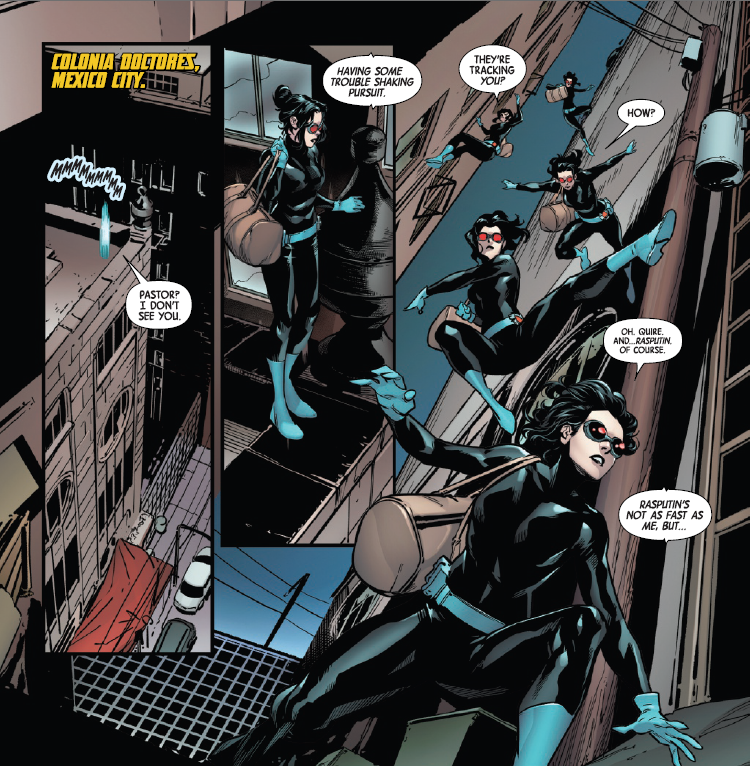
- Wraith is referred to by Sage as “pastor”, a nod to his status as a priest. He was killed in 2010’s Wolverine #1, and presumably resurrected (off-panel) during the Krakoa Era.
- Sage apparently has safehouses stashed around the country; here, she raids “Vault 204” for equipment before meeting Wraith at a different safehouse in Mexico City. I believe this is new information, but is consistent with Sage’s methodical mindset and history in black ops.
- Sage being, seemingly, the one character to in this crossover to drop everything and help Xavier unquestioningly is also largely consistent with the character’s background; the two share a history that dates to before the formation of the X-Men, and Sage has done shifty/difficult things for Xavier before (like working deep undercover as Sebastian Shaw’s aide for all those years).
- The big Krakoan Egg Xavier has been touting around turns out to contain Lilandra, his space bird empress wife/Xandra baby momma, who died in War of Kings #4. Sage makes a point about Krakoan resurrection only being meant for mutants but allowing for Xavier having done this for myself, but this overlooks the fact that resurrection was extended to non-mutants as a PR move in the wake of the AXE crossover.

- One has to assume Xavier is “hatching” Lilandra now in order to get her back on the Shi’ar throne, thereby eliminating the threat to Xandra. Maybe we’re also headed for another period of “Professor X hangs out with the Shi’ar”, a tried and true method of taking him off the narrative board.
- Meanwhile, the rest of actual X-Force (Sage technically quit the team a few issues ago) continues to fight La Diabla and her team (Presumably Fake Colossus and the monstrous Rampage), whom she dubs “The Solution”, in setup for the series’ final issue.
In most cases, “X-Manhunt” has proven to be more of a detriment to the ongoing narratives being disrupted by the crossover, but here, it actually elevates the issue, highlighting Sage’s bond with Xavier while relegating the repetitive fight with La Diabla to the B-plot.
Psylocke #5 by Alyssa Wong & Vincenzo Carratu w/Moisés Hidalgo

Psylocke’s confrontation with the Taxonomist comes to a head!
- Included in the Taxonomist’s “Psylocke exhibit” are replicas of her Outback Era armor (which this Psylocke technically never wore) and her long term “bathing suit” costume.
- When the Taxonomist tells Psylocke he’s had his condition since birth, she suggests this means he can’t be a mutant, the implication being mutants don’t manifest their powers til adolescence. That notion has been inconsistently depicted through the years however, with mutants like Nightcrawler being born with obvious signs of their mutant nature.
- Peter David also once tried to retcon this as a sub-spieces of mutant he dubbed a Killcrop in his Madrox-led X-Factor run. It has been largely ignored since.
- One of the visual signifiers of this series has been frequent deployment of the De Luca Effect, in which the artist draws the same character multiple times in different positions across an otherwise static panel to imply movement. Psylocke #5 has another example of it.

- A montage of Psylocke’s emotional highlights including her fighting Betsy Braddock circa X-Men (vol. 2) #20, the moment she revealed she was infected with the Legacy Virus, and the death of, I believe, Matsu’o Tsurayaba in X-Men (vol. 2) #32, and a shot of her in the current X-Men book.
- Greycrow has regrown his arm he lost, which seems like a more aggressive depiction of his healing factor than usual.
A pretty by-the-book conclusion to the series’ first story arc, but a reasonably entertaining one.
Exceptional X-Men #7 by Eve L. Ewing & Carmen Carnero

Axo is drawn deeper into the web of Veritas while “X-Manhunt” does a drive-by.
- The montage of Emma Frost’s past lovers on page 3 include Namor (established during the 00s’ Utopia/”Dark Reign” era), Tony Stark (from Invincible Iron Man), and Cyclops.
- The flashback to the big party on Krakoa is from House of X #6.
- The montage of mutant “safe havens” created and then ultimately destroyed include Utopia, Krakoa, and Genosha, all mutant island nations (whose names end in “A”…) that reached untimely and often violent ends.
- Melee telling Emma that she’s going to defer to Kitty when it comes to phasing stuff is a great line.
- Emma, doing our job for us, explains how Axo isn’t technically a telepath, but rather, a tele-empath.
- Over than Melee (the more socially-conscious of the three), the other kids don’t know who Professor X is when Iceman bursts into the room to announce he’s escaped.

- Melee quotes Fred Hampton (“you can’t build a revolution without education”), the Black Panthers leader who was killed by Chicago police, an event dramatized in the film Judas and the Black Messiah).
- Xenos mentions the recent emergence of adult on-set mutants, a reference to the ongoing plotline in Jed MacKay’s X-Men.
- Mister Sinister — the true identity of Xenos — likely needs little introduction. His arrival on the scene brings the count of former Krakoan Quiet Council members in this series up to three, along with Kitty and Emma.
- Sinister says Axo’s power doesn’t work on him because he lacks emotions, which isn’t really accurate — pride, frustration, pettiness, ambition are all emotions Sinister consistently displays. More likely, it’s Sinister’s relative lack of empathy that makes him resistance to Axo.
- Xenos’ initials — Sheldon Xenos, S & X — when said together sound like “ess ex” or Essex, Mister Sinister’s real name, which is an utterly delightful little detail.
It’s probably a bummer for anyone who buys this just because of the “X-Manhunt” tie-in, but using the crossover for little more than a discussion about the importance of history and a reminder that the loss of Krakoa reverberates into the present and future is a smart example of fitting the crossover into the specific tone of a book and using it to advance the book’s ongoing plot and character developments, rather than grinding them to a halt to do obligatory crossover stuff. But also, dang Carnero is a fantastic artist.
Magik #3 by Ashley Allen & Germàn Peralta

Illyana fights to escape Liminal’s realm before being reunited with an old friend.
- The covers to this series continue to do it a great disservice. I have nothing against cheesecake art and J. Scott Campbell certainly has his fans, but the disparity in visual tone between the Zenoscope-esque “sexy Illyana” covers and the darker, more character driven interior art and storytelling is jarring, and there’s likely people out there who would enjoy the series but haven’t bothered to check it out because they assumed it was just a mindless T&A book based on the covers. (Ed. Note: I picked up the Steve McNiven cover for exactly this reason.)
- Amongst the enemies of Illyana’s past Liminal recreates on page 4 are S’ym, Belasco’s former righthand demon who joined up with Illyana when she overthrew Belasco, and later turned Madelyne Pryor into the Goblin Queen and rebelled against Illyana’s rule of Limbo, kickstarting “Inferno” & N’astirh, S’ym’s former righthand demon who betrayed him (demons, amiright?) and formed an alliance with Madelyne during “Inferno.”
- Cat, the alt-reality Kitty Pryde from the 80s Storm & Illyana miniseries that chronicles Illyana’s childhood in Limbo, gets a callout and footnote, but that series’ Storm appears in one flashback panel without comment as well.
- Liminal’s appearance of being an animated Greco-Roman statute, is the result of some kind of outward shell he’s constructed around himself.

- He also says his power has grown recently thanks to the increase in liminal spaces in the modern world.
- I really like this panel from artist Germàn Peralta, in which Liminal appears to be a genuflecting statute while Illyana takes his throne. Kudos to colorist Arthur Hesli as well, for capturing the glow effect of the Soulsword.

- This issue basically lays out that Liminal’s overall goal, at least for now, is to bascially neg Illyana into ruling his realm by his side.
- After Illyana cuts a deal to escape Liminal’s realm and return to Earth, Cal makes the subtext text by pointing out all she’s really done is trade one prison for another.
- Dani Moonstar, Illyana’s former teammate in the New Mutants, pops up on the last page. Always down to see New Mutants alumni pop up!
- A response to a letter in the debuting letter column mentions that artist Peach Momoko has done work designing demons for the series (Peach Momoko would make for a much more tonally-consistent cover artist for this series as well, instead of just providing the occasional variant).
The first half of Magik #3 gets a little repetitive as Illyana runs through Liminal’s realm slashing at demons and arguing with the villain, but its good to have some forward momentum on the plot and a sense of who Liminal is as a character.
Cable: Love & Chrome #3 by David Pepose & Mike Henderson

Cable fights to overcome the techno-organic virus ravaging his system while Avery launches an attack on the Prime Enclave.
- You don’t see nine panel pages much anymore; Mike Henderson does a fun one in this is issue, depicting three different settings: Avery in the real world, memories of Cable & Avery together, and Cable’s metaphorical battle with the TO virus in his mindscape.
- Both Henderson and writer David Pepose seem like genuine fans of Cable; the 3/4 panel on page 13 when Cable reveals himself toting two comically-massive guns seems like an homage to his 90s style that either creator or both were itching to do.

Pepose is putting in an admirable & workmanlike effort to sell the Cable/Avery relationship at the heart of this issue (and really, the whole series), but it remains difficult to not feel the insularity of this series (and so many other X-books, especially the limited ones); its complete isolation from any previous Cable-specific or larger X-Men plotlines or characters makes it feel like this whole thing will be memory-holed the moment it ends, a passing footnote (at best) on the character’s Wikipedia page, which makes it harder to get invested in the moment.
— Austin Gorton
Deadpool and Wolverine #3 by Ben Percy & Josh Cassara
Benjamin Percy continues to modernize a whole lot of ’90s X-Men concepts as Wade and Logan battle Stryfe.
- After Deadpool was mind-controlled last issue, Wolverine has set them up to try to interrogate and/or deprogram him in Deadwood, South Dakota.
- The tech/psychic programming in Wade’s head is calling itself X-Cutioner. The X-Cutioner was a 1994-debuting anti-mutant bigot and FBI agent named Carl Denti that became a mutant hunter. There have been several X-Cutioners since, but the use of the name seems to be more tied to the 1992 X-Men crossover X-Cutioner’s Song which centered on Stryfe.
- The four page brawl between Deadpool and Wolverine is brutal, bloody and exactly the sort of sequence we should always see in a series starring these two. Also, Cassara is an art god climbing to Olympus.
- Stryfe is riding bone dragons in the sky (if it’s a reference and not just extremely metal, I don’t know it), and raising cowboy zombies infected by a new Legacy Virus. It’s the sort of extreme that this book should always traffic in. The Legacy Virus first appeared in the aforementioned X-Cutioner’s Song and haunted the X-Men for nearly the next decade.
- Maverick is also in the picture here as a third party working for the Office of National Emergency. Maverick has been a part of Wolverine’s black ops history since the beginning of X-Men v2, while O*N*E* became a thorn in the X-Men’s side since the post House of M Decimation.
- Oft-forgotten is that Stryfe is a remarkably powerful psychic, considering he’s a clone of Cable without the techno-organic virus. In this issue, he uses his psychic powers to power the Legacy Virus zombies, and try to find out why Wolverine isn’t brainwashed as well (an ongoing plot of this series).
- Wolverine was apparently deprogrammed thanks to Krakoan resurrection, though that’s not explicit here.

Percy continues to be one of the strongest writers at Marvel. He knows that this series should be brutal, violent and fun. It’s over the top with just the right amount of humor. Cassara continues to do amazing work and we should be considering him one of Marvel’s best right now especially when paired with the Guru-eFx coloring team.
Check out a full review of this issue here.
—Tony Thornley


