
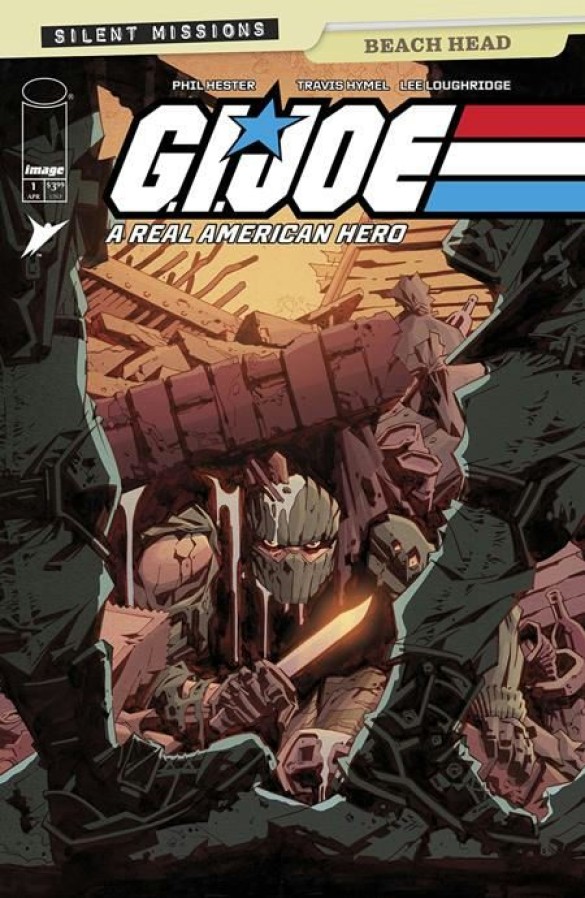
‘G.I. Joe: Beach Head’ #1 and ‘Jinx’ #1 Showcase The Strengths of Silence – Review
by Austin Gorton
Overview
The first two one-shots of Skybound’s “Silent Month” celebration, Beach Head #1 and Jinx #1 each take the conceit of telling a story without any words in different directions, yet in their own ways, both also showcase the strengths of the gimmick by turning into cracking fun comics.
Overall
8/10Though born of experimentation and a deadline crunch, G.I Joe #21 — the famous silent issue — stands as one of the most acclaimed and well-remembered issues of the original Marvel G.I. Joe run. To celebrate it, Skybound is releasing five all new silent issues this month — comics without any dialogue, captions or sound effects — each starring a different member of the G.I. Joe cast.
In keeping with the inspiration, these special one-shots are all part of the “Real American Hero” slice of Skybound’s Joe offerings; that is, the comics that are a direct continuation of Larry Hama‘s original run, and not part of the newer Energon Universe. But narrative continuity is not really the concern of either Beach Head #1 or Jinx #1, the first two “silent” one-shots. Instead, both issues showcase the relative strengths of silent storytelling, albeit in different ways.

Beach Head #1, written and penciled by Phil Hester, features its title character falling out of a helicopter mid-fight with some Cobra goons and landing on the roof of a building in a war-torn, vaguely-Eastern European country. Succumbing to his injuries, Beach Head is taken in my a young boy and his older sister, who must salvage supplies while avoiding the Cobra troops hunting for the Joe. While Hester includes plenty of “home run” artistic moments, especially in his use of negative space, its a suprisingly plot-forward issue.
In that, it showcases how a comic doesn’t need dialogue and captions to tell a complex, captivating story. Even though it’s silent, Hester manages to make Beach Head #1 a compelling read, one as filled with twists and turns and character moments as a “regular” issue of a comic. He does so in part by using layouts to control the pacing, adding in multiple smaller panels when he wants to slow down the action and keep readers from flipping quickly from page to page without any words to read.

Jinx #1, on the other hand, is by design an intense, fast read. Written by Dani with art by Dan Watters, it unfolds in real time: one second of story passes per page. The plot is much more straightforward: Jinx sets a bomb inside some kind of hanger, then has twenty seconds to fight her way past some Cobra troops before the explosion. By taking the opposite approach of Beach Head #1 — using the lack of words to speed up the reading experience rather than slow it down — Jinx #1 illustrates the ability of a silent issue to tell a unique, art-focused story.

It is also much more a direct homage to G.I. Joe #21. Aside from featuring a ninja as its protagonist, it also features a similar palette constructed around distinct colors. In the original, it’s the black/white/red of Snake-Eyes, Storm Shadow, and the red ninjas. Here, it’s the red of Jinx and the Crimson Guardsmen, the purple of the Night Creeper, and the white of the falling snow.

Taken together, Beach Head #1 and Jinx #1 are very different comics. One is a tension-filled slow burn, the other an action-packed thriller that passes, by design, in seconds. Yet in their ways, both showcase the strengths of silent stories. Removing words from a comic don’t have to result in a fast paced, simple story that is over quickly. But removing words from a comic can also make for a brisk, impactful read, one which uses the “silence” to showcase the art even more than usual. Both may ultimately be very different in their approaches, but the end result is the same: entertaining comics in which the lack of words is an asset, not a hindrance.