
Taking Matters Into Your Own Hands — Talking ‘Bronze Faces’ With Co-Writer Shobo
by Rachel Bellwoar
It’s not everyday that the chance to correct a wrong perpetrated against your ancestors falls in your lap. Timi, Gbonka, and Sango know the Benin Bronzes belong in Nigeria. The museums don’t agree, so Bronze Faces is about what happens when they decide to take matters into their own hands. From the writing team of Shobo and Shof, and artist, Alexandre Tefenkgi, here’s what Shobo had to share about the experience:

Rachel Bellwoar: While I’ve read about museums wrongly acquiring artifacts from other cultures, I wasn’t aware of the Benin masks specifically. How did you first come to learn about them?
Shobo: Shof and I grew up in Nigeria, so the Benin Bronzes are part of our cultural heritage. Imagery of the bronzes—especially the Queen Idia mask—is incredibly popular in Nigeria, in no small part because a replica of that mask was used as a symbol for FESTAC ’77, the famous arts festival. We also had a massive wooden replica of the Idia mask hanging on the wall in our living room growing up. For the longest time, I assumed the original was just as large—about three feet tall—only to find out later that the real mask is small enough to be worn on a belt!
Bellwoar: From what I understand, Gbonka, Sango and Timi are all names from Yoruba mythology. Did you always want to incorporate those stories into Bronze Faces?
Shobo: Not initially. The original concept was just about a group of young Nigerians deciding to steal back the Bronzes. The mythic layer was added by Shof. He read my early outline and suggested weaving in the tale of Sango and his two legendary friends to give the story a mythic resonance. Parts of that myth get retold at the end of each issue through stunning full-page illustrations by Osaze Amadasun, who’s from Benin himself. We’re so lucky and grateful that he’s contributing to our story.

Bellwoar: Clothing can be a means of expression for people yet, in Timi’s case, he doesn’t feel like his clothes reflect his personality at all. Did that change how you approached each character’s wardrobe?
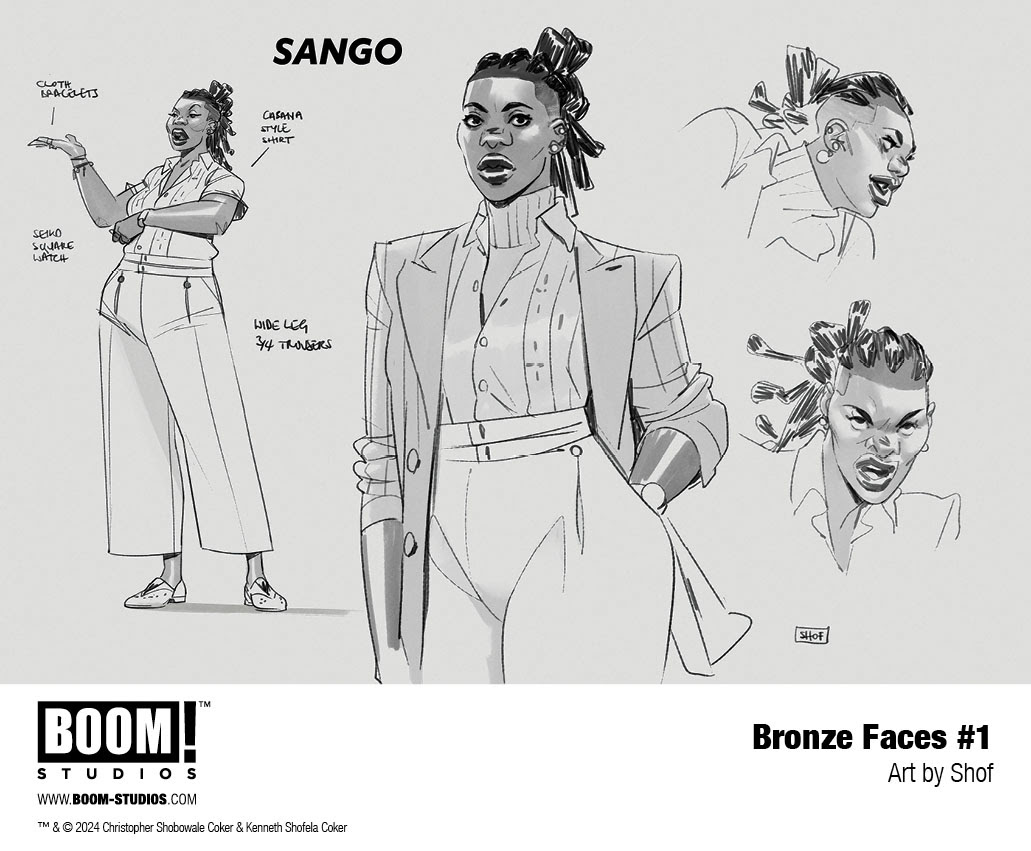
Shobo: Absolutely—clothing is a major form of self-expression. There’s a story being told just through how Sango dresses and how her style evolves throughout the book. Same with Gbonka. Timi’s a bit more complicated. There are two sides to him: the version trying to fit in or mask his discomfort, and the version he eventually becomes by the end. I won’t spoil anything, but yes—how they all dress, and what it symbolizes, is a running thread.
Bellwoar: The first issue goes back and forth in time from the present day in London to fifteen years ago in Nigeria. What was it like getting to show these characters as children and adults?
Shobo: Who we were and what we’ve been through shapes who we become. The story explores whether that past—and the systems and assumptions around it—define our future. The myth of Sango, Timi, and Gbonka ends quite tragically, and toggling between past and present let us explore the depth of their friendship and ask: are we bound to repeat old stories, or can we change them?

Bellwoar: Of the three friends, Gbonka and Sango’s relationship seems the most strained. How was it getting to work out their dynamic and when to share more of their history?
Shobo: Yeah, Timi’s definitely the peacemaker between the two. Gbonka and Sango also share a really deep, complicated bond—and we’ll explore more of that in later issues. Writing their dynamic was actually cathartic. I think a lot of Nigerians or Africans in the diaspora might recognize aspects of themselves in both women—whether it’s feeling “not Nigerian enough” or being underestimated because “you’re from the village.” Telling that story in a way that’s unexpected, even subversive, was freeing. Ultimately, the question is: can such different people still come together for something greater? I feel that’s been a major political and social struggle for Nigeria.

Bellwoar: Were you a fan of heist stories going into this series and what’s been the best part about creating one?
Shobo: I’ve always loved heist stories. I was obsessed with the ‘60s Mission: Impossible show growing up. There’s something so satisfying about a team with wildly different skill sets coming together to pull off the impossible. The best part? It’s all in the craft: pacing, planning, building characters with just enough flavor, making the prize meaningful to each person. With Bronze Faces, the “prize” is personal—it means something different to every character. And that makes the stakes real.
Bellwoar: Thanks for agreeing to this interview, Shobo!
With colors by Lee Loughridge and letters by Hassan Otsmane-Elhaou, the first two issues of Bronze Faces are available now from Boom! Studios. Issue #3 goes on sale May 28th.

