
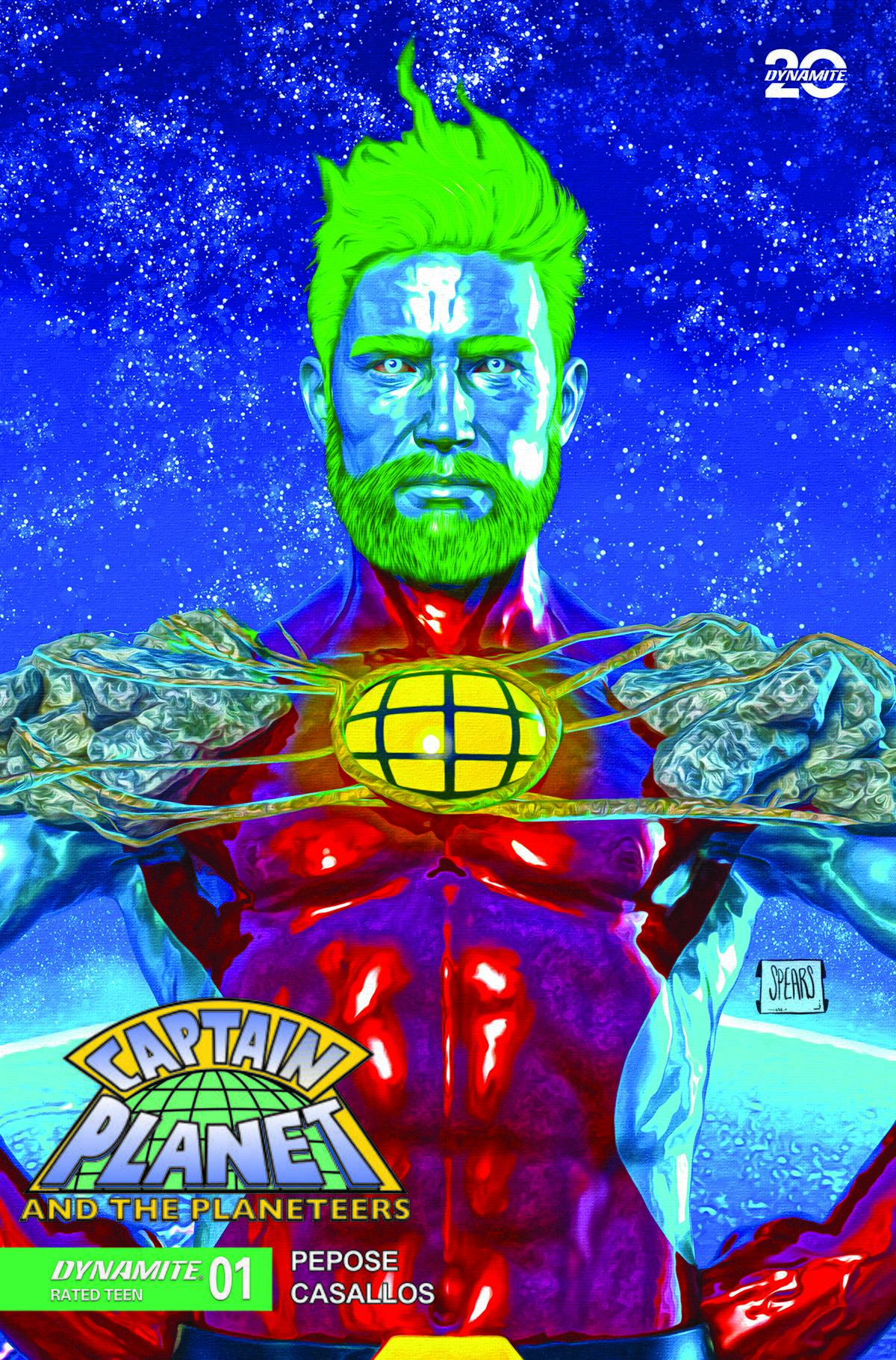
‘Captain Planet’ #1 Succeeds By Following A Familiar Path – Review
by Austin Gorton
Overview
Captain Planet #1 is a successful kickoff to Dynamite and David Pepose’s latest entry in their retro animated milieu, quickly establishing a tone for the series which updates the source material for the comic book medium without sacrificing what makes it appealing.
Overall
8/10With Captain Planet #1, writer David Pepose applies the same formula to the world of Captain Planet that has made his Space Ghost series a success. He takes a fondly-remembered, yet somewhat jokey character and uses standard superhero comic book storytelling techniques to present a straight take on the characters, without taking them too seriously.
As with Space Ghost, the approach to the storytelling engine of Captain Planet — five elemental rings wielded by an international collection of young adults that call forth an eco-friendly gestalt superhero, overseen by a manifestation of Mother Earth as they battle villains with specific schticks and a general disdain for the environment — is somewhere between the lightly-plotted, after-school-special feel of the original animated series and a super-serious, grimdark take on the characters. As with Space Ghost, the end result is an entertaining read.

Much of Captain Planet #1 is setup. In a fun little twist, the issue opens with Captain Planet in action, and goes from there to the assembling of the Planeteers, instead of vice versa. In doing so, it establishes an attack on Gaea (depicted here as a priestess, rather than a literal manifestation of Mother Earth) as the inciting incident that brings together the Planeteers, as Gaea scatters the elemental rings that call forth Captain Planet to prevent them from falling into the villainous hands of her mysterious attacker.
From there, the issue settles in for a series of vignettes which introduce each of the Planeteers, all of whom are recognizable to their animated counterparts but rendered in a way that isn’t “more adult” so much as it is “more suitable to a comic book.”
Russian Linka is punk rocker; South Korean Gi is a scientist. The biggest deviation is Ma-Ti, long the butt of jokes for wielding the seemingly-weak Heart ring, who is introduced using his ring to communicate with a series of predatory animals and setting them upon a group of workers contributing to the deforestation of the rain forest. Of all the updates and tweaks to the characters, it feels the most designed specifically to upend expectations.

Similarly, the visuals of the book are faithful to the source material but updated to take advantage of the change in medium. Artist Eman Casallos‘ Captain Planet is still a guy made of blue crystal, but not having to recreate his look on a cheap animated budget allows for greater detail in his appearance.
Aside from the much-talked-about “Captain Daddy” beard, his Captain Planet has shoulder pads made of rocks, and vines connecting them to his planet emblem, all of which helps make this iteration of the character feel unique to this medium while speaking to his existence as a gestalt being. Casallos also gives Captain Planet a more dynamic suite of abilities than was available to the creators of a kids’ cartoon in the early 90s, such as the ability to use ice, fire and lightning as offensive weapons.

If anything, the most concerning element of Captain Planet #1 is just how much the initial setup established here mirrors that of Pepose’s Space Ghost. Just as that book has Doctor Ibal as an arch-villain orchestrating events in his efforts to get ahold of Blip, this issue concludes with the reveal that “greed is good” villain Lucian (née Looten) Plunder is behind the attack on Gaea that opens the issue, in an effort to retrieve the Planeteer rings for himself. But that’s a minor quibble about what is otherwise a successful effort in taking the first steps towards transposing the animated world of Captain Planet into a comic book.

