
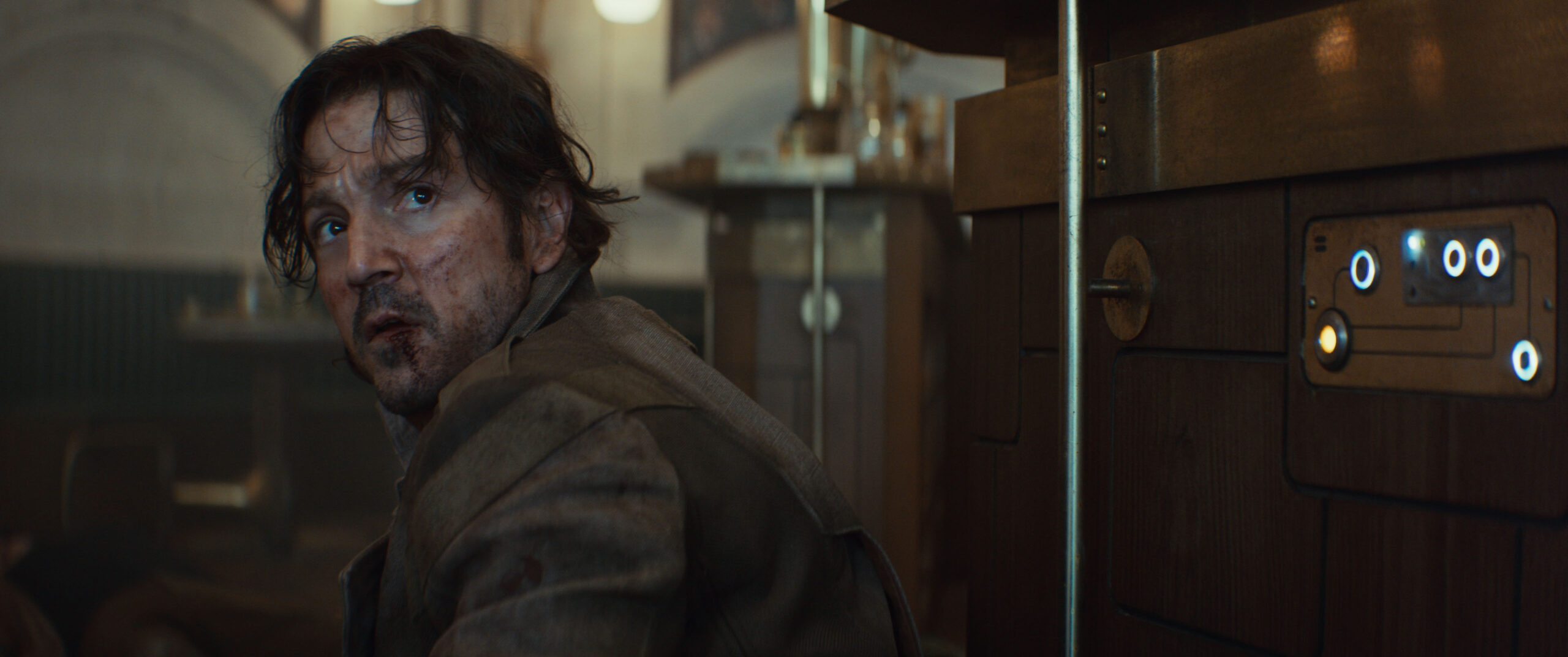
‘Andor’ Episodes 7-9 Are A Masterclass in Tension As The Season Gets Its Big Set Piece
by Austin Gorton
Compared to its first season, Andor Season 2 has struggled a bit in terms of big set pieces.
Outside of Cassian’s (Diego Luna) TIE Avenger escape in the opening minutes of the first episode, there has been little this season to rival the likes of the Aldhani heist or the escape from Narkina 5 or even Maarva’s (Fiona Shaw) funeral procession. According to showrunner Tony Gilroy in a recent Entertainment Weekly interview, this is largely due to the shifting landscape at Disney between seasons; the first season was part of the initial “throw all our money at streaming and watch it soar!” approach to Disney+, while this second season has come about following the return of Bob Iger and a general tightening of the purse strings.
Gilroy has likened the experience to building a half a battleship then being told the war is over and the money is gone. Yet despite those financial limitations, the Ghorman Massacre in episode 8 finally gives this season its big set piece, as the moment to which the season has been building finally arrives when the Empire executes their plan to ravage Ghorman while blaming that destruction on the Ghors.

Yet all three of these episodes — “Messenger”, “Who Are You?” and “Welcome to the Rebellion” — are about much more than the central action involving the massacre. Above all, they are a masterclass in building tension, then releasing it, then building it up even more. Intellectually, the fates of many of the people and events in these three episodes is established. I know the plaza is going to explode into a massacre. I know Cassian is going to make it out alive. I know Mon Mothma (Genevieve O’Reilly) is going to make her big speech (and then escape so she can appear in a season three episode of Rebels, to say nothing of Rogue One: A Star Wars Story and Return of the Jedi).
But the craft involved in unfolding these events still leaves me biting my nails as the crowd in the plaza grows and the Imperials send their green troops out provoke a confrontation, or silently urging Cassian to forget trying to kill Dedra Meero (Denise Gough) and get the hell out of there, or wringing my hands over whether Mon will finish her speech before the ISB succeeds in shutting down the feed. Everything — the performances, cinematography, production design, direction, music — are working together to wring the maximum amount of tension from the narrative.

Even though much of the broad strokes of these episodes’ plots and fates of the major characters are known, there are plenty which remain a question mark. Syril Karn (Kyle Soller) is a great example of that. Having consistently been portrayed as someone who is a die-hard believer in the Empire, but always because he views it as his best chance to achieve personal validation, his realization in “Who Are You?” that his own lover not only has been keeping him in the dark but has actively been using him as an asset, and that the Empire is intentionally manufacturing the crisis on Ghorman, finally breaks him.
At that moment, thanks to the work the show has done developing his character, it’s not clear what he’s going to do. Has he developed a genuine affection for the Ghor that would lead him to stand with them (the slap he received from Enza Rylance (Alaïs Lawson) could easily be read as a suggestion that they had an affair together at some point)? Could the betrayal of both Dedra and the Empire as unfailing sources of truth in his life even lead him so far as to joining the Rebellion proper?
In the end, upon finally coming face to face with Cassian after all the years of the series and the near misses of this arc, he sees nothing but his white whale, the man who, in his eyes, has led him directly to this, the lowest point in his life. The ensuing fight is brutal, but nothing is as brutal as Syril’s final moments, when he has Cassian dead to rights, and Cassian asks, “who are you?”
It’s an utterly devastating, “but for me, it was Tuesday” moment, the realization that this man over whom Syril has obsessed, who has, from afar, shaped his life in ways large and small, doesn’t even know his name. And then he gets shot in the head by Rylance (Richard Sammel). It’s the perfect end for one of the series’ most compelling characters, a sympathetic villain we love to hate.

The final moments of these three episodes almost feel like a series finale; it wouldn’t be hard to seamlessly pickup Rogue One immediately after this. But three more episodes remain. And for all that the plot of these episodes was largely known before they unfolded, these final ones represent a great unknowing. Cassian and Mon Mothma are more or less where they are when Rogue One begins. But plenty of questions remain.
Will Bix (Adria Arjona) appear again, or was her common law divorce from Cassian a series wrap for her character? Will Dedra’s fate be revealed, or will her final moments stand as the sight of her, in the wake of Syril’s death and the successful execution of her Ghorman Massacre, desperately pulling at her Imperial uniform as though the fabric itself is choking her? What of Luthen (Stellan Skarsgård), who’s made it clear he believes there’s no post-rebellion future for him and finds himself increasingly isolated as the Rebellion he helped foment starts shifting from “tearing down the status quo” towards “building something new”?
With all the major moments of Star Wars history addressed, the final episodes of Andor have plenty of room to craft their own ending.
