
Characterization In The Buffyverse — ‘Angel’ Season 2, Episode 7
by Benjamin Hall
This is part of a bi-weekly series concerning the characterization of Buffyverse characters. Arguably the best place to begin reading this series is at the beginning, but that is up to each reader. As a reminder this column will cover major and some minor characters from the shows Buffy The Vampire Slayer (1997-2003) and Angel (1999-2004). Other Buffyverse media, such as the graphic novel Spike: Into The Light (2014) are not pertinent to this series. Also there will be no referencing real world events that have direct relation to either show in this bi-weekly series. Although, this series will reference incidents and ideas that have no direct relation to the show in order to examine the metaphors and literary analogues.

This week: Some of Darla’s (Julie Benz) history sees exploration. In the present day, Angel (David Boreanaz) tries to save her.
(Warning of spoilers from this point on!)
Angel has some flashbacks that explore his days in the Angelus persona. These occur both pre- and post- acquiring his soul curse. In the first meeting he has with The Master (Mark Metcalf), Angel acts arrogant and flippant, — much like Spike (James Marsters) would later be with him (Buffy The Vampire Slayer Season 5, Episode 7, “Fool For Love”). Seeking out Darla in 1900 and trying to be evil again proves how the curse only makes Angel feel guilty. He is ultimately dishonest about having multiple personalities because of the curse (Season 1, Episode 17, “Eternity”). When Angel pointlessly tortures Lindsey McDonald (Christian Kane) he may as well be declaring that he is not truly noble. Arguably, his saving a baby in 1900 is an act of cowardice and guilt and not one of true heroism.
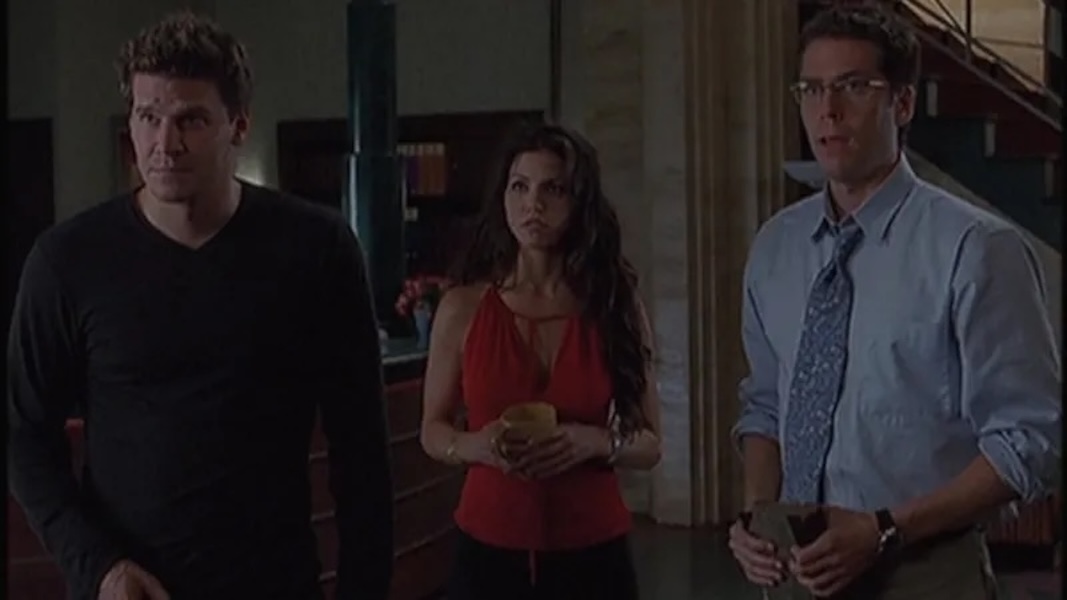
Wesley Wyndham-Pryce (Alexis Denisof) and Cordelia Chase (Charisma Carpenter) struggle in this episode to keep Angel on track with them regarding Darla. They are doing very little else at this time.
Charles Gunn (J. August Richards) gets a “duh, obviously!” moment that should belong to Cordelia or Wesley, but gives him a reason to be in the scene. Gunn does not have a chance to do much more.
Darla’s pre-vampire scenes suggests she had the rough life of a sex worker of her time, but a successful life nonetheless. The fact that she never reveals her human name to Angel at any time , though, indicates giving up on that past. When it comes to her interactions with Lindsey, she seems to have a slight interest in him. Yet, this interest is apparently much less than Lindsey’s in her. As for Darla feeling guilty, it seems like a detail that is being put on fast forward after failing to initially. Finally, when it comes to Darla’s feelings for Angel, she seems to feel both love and lust for him. Nevertheless, whether she is a human or vampire, there is uncertainty and darkness to these feelings.
The Master seems to get around in the daytime much like Spike does (Buffy Season 4, Episode 8, “Pangs”). But his choice of doing so as a priest displays his theatrical nature and detest of humanity. His religious zealotry about the elder demons also sees visual reference with his disguise and chair. The choice of locale in the 1800s, meanwhile, suggests both cunning and stupidity. Humans would get sick or not be able to stand the smell from sewer conditions, but it would be easy to trap someone — or something — in such a confining space. Thus, the irony of his fate when in Sunnydale (Buffy The Vampire Slayer Season 1, Episode 2, “The Harvest”).
William Pratt, alias Spike, does not have anything new to his characterization in this part of the last real crossover between Buffy The Vampire Slayer and Angel. Although, one might say that he brings levity to the episode’s darker scenes.
Drusilla (Juliet Landau) apparently tries to give warnings two times in this episode. The first occurs before they run into William and concerns Darla’s upcoming return to being a vampire (Season 2, Episode 10, “Reunion”). While the debatable second occurrence involves not killing the rest of the Kalderash clan; it is unclear if this is a real warning about the curse and how to undo it or her just missing Angelus. Also, her smelling fear during the rebellion suggests that this is the tip off Darla gets about the family. Although, it also may be partly a whiff of Angelus’s fear of Spike’s actions as well as a fear for the family. Finally, it appears that her vision powers help in her decision to turn William into Spike.
Holland Manners (Sam Anderson) acts with some rare excitement while praising Lindsey. He also displays his growing arrogance during this exchange because he thinks the plan will still succeed.
Lindsey’s feelings for Darla seem rather sudden since viewers do not get to see much interaction between these characters. It does allow for his boss, Holland, to more easily trick Darla by playing with the little trust they have in each other. While Lindsey apparently deciding not to kill Holland is possibly suggestive of Lindsey trying to maintain some nobility. His sense of right and wrong definitely comes forth when trying to contact Angel Investigations. Yet, this chance to seek a bit of redemption does not change things because Angel decides to torture him for the information he is trying to give. Thus, his hate of Angel grows.
The Kalderash man (Zitto Kazaan) and the security guard, Flynn (Bart Petty), serve to further populate the universe, but are pretty stock in terms of purpose and personality. That said, the Kalderash man’s existence does provide levity of the darkly comedic kind.
This entire episode is a duo character study of Darla and Angel with an almost third in Lindsey. While the narrative adds to the lore of these characters, it somewhat fails to explore anyone in the modern day.
