
All Work And No Play: An Interview With ‘The Lost Sunday’ Creator Ileana Surducan
by Rachel Bellwoar
Everyone needs time off, yet it’s one thing Nina isn’t allowed to have in Ileana Surducan‘s graphic novel, The Lost Sunday. That’s because (as the title indicates) Sunday is no more. Saturday goes right into Monday, but if Nina can find Sunday, maybe the week can be set right. For more on this story and the inspiration behind Nina’s hair, check out this interview with Surducan below:

Rachel Bellwoar: I didn’t realise until the backmatter that The Lost Sunday was inspired by other fairy tales. Is Frau Holle a story you grew up with or one you discovered as an adult?
Ileana Surducan: I grew up with the Romanian version of Frau Holle, and I discovered the Brother Grimm fairy tale later. I found it fascinating to observe the similarities, like the evil step-mother, the kind old woman and the two sisters fulfilling the same tasks in different manners. But I also enjoyed the differences – no rain of gold in the Romanian version, just treasure chests floating down a river – (hint: the trick is to choose the smaller chest, the big one is full of dragons!). And I realised that fairy tales were meant to be retold and changed, and that they retain their essence while evolving… and I thought… oh well, I’d really like to do my own take on Frau Holle! So I hope I managed to mix old motifs with new ideas.
Bellwoar: Like Cinderella before her, Nina is a character who’s used to working all the time. How did you come up with her iconic hairdo?
Surducan: When I design a character, I imagine them moving, talking and going about their day – this way I can better grasp their personality. I pictured Nina being super busy, always in a rush – and in my mind she very much resembled a wagtail – those little birds that run around like they mean business, stop for a second and they are off again. So her hairdo is inspired by bird feathers – and it perks up when she is excited or happy, and goes down when she is anxious, tired or embarrassed.

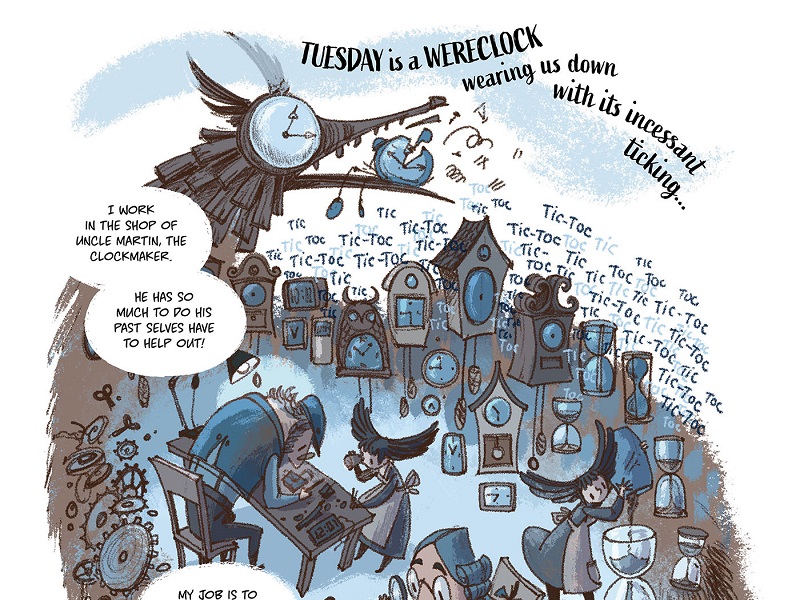
Bellwoar: So many nursery rhymes, like “Monday’s Child,” involve the days of the weeks. What was it like getting to personify those days for yourself and do you have a favorite?
Surducan: For me, each day of the week has a personality of its own, and a certain light that goes with it – from Monday’s fresh but moody morning, to Sunday’s lazy, almost melancholic sunny afternoon. My favourite is Friday, because it brings the satisfaction of a workweek well done, but also the promise of an amazing weekend. However, I also have a soft spot for Wednesday, it seems to have a cheerful resiliency to it.
Bellwoar: Similarly, wolves are usually bad news in fairy tales. Why did you decide to make all of the days of the week wolves?
Surducan: Well, I chose them exactly because of this frightful image of a pack of wolves circling their prey, waiting for the right moment to strike. In the beginning of the story, I wanted the days of the week to feel menacing, famished, wild. But, in reality, wolves are misunderstood animals, they have a lot of positive traits and they turn into dogs if you play your cards right! So in the end the reader will discover that the days of the week are not to be feared – there is a way to befriend and even tame them.
Bellwoar: Early in the story Nina is gifted a magical wishbone. Where did the idea for that magical object come from?
Surducan: The magical object idea came from a practical necessity. Nina uses a lot of tools while wandering in the enchanted dreamland of the witch (brooms, brushes, buckets), but where did they come from? I couldn’t draw her carrying all that around! A magical wishbone that can change into anything was a good way to solve that problem. It’s also something that most people would throw away, only garbage-collector lady Artemis would recognize its true value, and only Nina would appreciate such a gift.

Bellwoar: Rather than use traditional panels, your art manages to lead the reader’s eyes down the page naturally. Do you enjoy coming up with layouts or is that one of the harder parts of the process?
Surducan: The first comics I read were old school Franco-Belgian albums, so I used to think that comics must have rectangular panels with a black outlines – and I could never get the measurements right. But then I discovered authors like Joann Sfar, Isabelle Arsenault or Cyril Pedrosa, who don’t obey that rule, and it was quite liberating! It turned storyboarding from a dreaded process into a fun and exciting activity, something like a puzzle that needs to be solved – and I discovered you can really play with the page, as long as the story is still easy to read.
Bellwoar: I love the use of the word “brave” in your dedication. Why do you think it takes bravery for people to take breaks and what would you say to those who try to paint breaks out as being lazy or unnecessary?
Surducan: I used to think breaks were something you got when the work was over – a reward for a finished task. And then I became an illustrator, and I discovered free-time was not the applause you get at the end, but rather the seed from which creativity can grow. Yes, you have to take a break even though you didn’t find the right idea yet, when productivity is low, when your project isn’t coming together. That’s where you’ll find inspiration, energy and maybe even a new way of looking at things – maybe those hungry wolves would like to be your friends? Including some free time into your work process takes courage and determination (and a little bit of kindness).But if you don’t, work becomes a punishment, and your body and mind pay the toll. Burnout is no laughing matter, and the wolves might actually come after you!
Bellwoar: Thanks for agreeing to this interview, Ileana, and hope you stay safe from those wolves!
The Lost Sunday goes on sale June 18th from Oni Press.
