
Characterization In The Buffyverse—’Angel’ Season 2, Episode 10
by Benjamin Hall
This is part of a bi-weekly series concerning the characterization of Buffyverse characters. Arguably the best place to begin reading this series is at the beginning, but that is up to each reader. As a reminder this column will cover major and some minor characters from the shows Buffy The Vampire Slayer (1997-2003) and Angel (1999-2004). Other Buffyverse media, such as the graphic novel Spike: Into The Light (2014) are not pertinent to this series. Also there will be no referencing real world events that have direct relation to either show in this bi-weekly series. Although this series does reference things that have no direct relation to the show in order to examine things such as metaphors and literary analogues.

This week: Darla (Julie Benz) becomes a vampire again. Meanwhile, Angel (David Boreanaz) starts down a dark path.
(Warning of spoilers from this point on!)
Angel is all over the place as a character in this episode. He goes from frantic and seeming delirious and then ranges from his average self to dark throughout this episode. He also acts reckless and stupid when it comes to his confrontations with Wolfram & Hart and his vampire family. He could, for instance, easily stake Darla and then possibly Drusilla (Juliet Landau) at one point in their three-way fight. Instead, Angel tries to pull Darla away from Drusilla. At the same time, the moment when he fires his allies occurs in a way that is somewhat logical for his character arc. Yet, even that feels clumsy because of the speed at which the arc is progressing.
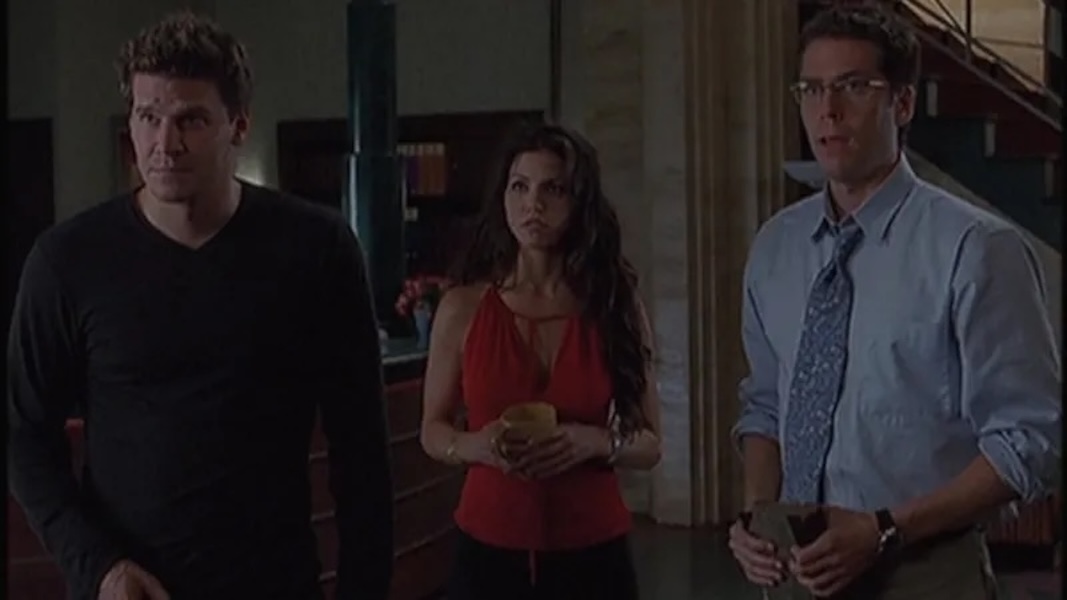
Wesley Wyndham-Pryce (Alexis Denisof), Cordelia Chase (Charisma Carpenter), and Charles Gunn (J. August Richards) are all physically present. Unfortunately, they have no apparent growth and arguably only serve to make clear that Angel is doing wrong.
Darla acts similar to her human self during her second chance at life after rising as a vampire and being angry at Drusilla. After that, she acts like the mature woman viewers see in flashbacks rather than the immature woman presented in her initial appearances (Season 2, Episode 7, “Darla” and Buffy The Vampire Slayer Season 1, Episode 2, “The Harvest”).
Drusilla is her usual mentally ill, villainous, and clairvoyant self. While she displays cleverness when confronting Angel, her real purpose in this episode is simply to bring Darla back to villainy and just be goofy.
Holland Manners (Sam Anderson) essentially fails to heed the saying “don’t count your chickens before they hatch” by celebrating a victory that is not even in view. Thus, viewers get to see Holland’s emotional break in his final scene as a living being (Season 2, Episode 15, “Reprise”).
Lilah Morgan (Stephanie Romanov) has little to do with this episode’s narrative. Nevertheless, it is with this episode — and Holland congratulating both her and Lindsey Mcdonald (Christian Kane) — that she officially starts becoming a true player in this series.
Lindsey comes across as morbid since he exhibits so much fascination with Darla and her actions with Drusilla. While this is a development for him, it makes it so he is arguably out of character because he is usually presenting emotions.
Detective Kate Lockley (Elisabeth Röhm) acts like she has more power at the Los Angeles Police Department than anyone should. Additionally, her scene makes little sense when one considers her character’s entire history.
Erik (Erik Liberman) is a foolish demon worshipper seemingly suffering from depression. He only exists to highlight that Angel is starting to act in the wrong ways.
Catherine Manners (Katherine Ann McGregor) is one of Darla and Drusilla’s victims, and also the wife of Holland Manners. She seems to exist simply to allow the two villainous vampires (and Angel) access to the Manners mansion.
Angel’s characterization and how it becomes darker looms over the rest of the characterizations here. On the plus side, this overshadowing presence helps mask the its bare bones plot.

