
An Interview With ‘Chief Of War’ Costume Designer Caroline Eselin
by Rachel Bellwoar
Often, TV turns to fantasy for large-scale stories, but real history can be just as epic. The proof is in Chief of War, a new series created by Jason Momoa (Game of Thrones) and Thomas Pa’a Sibbettabout (Braven) about the history of Hawai’i. For more on what it was like to create the clothing for the show, check out this interview with costume designer, Caroline Eselin (Moonlight):

Rachel Bellwoar: In researching Hawaiian fashions, how difficult was it to find information about the late 18th century specifically and was there a source that proved the most helpful (for instance, books, museums or local historians)?
Caroline Eselin: There are many answers to that question because every source was extremely important!! We could not have done it without The Bishop Museum and Marques Hanalei Marzan in Honolulu, the Te Papa Museum in Wellington, NZ, the Kanaka‘ole family (our costume cultural advisors), Dr Adrienne Kaeppler’s book – Hawaiian Featherwork: Sanctity and Danger: Divine and Chiefly Featherwork of Old Hawai‘i, paintings by Herb Kāne, Brook Kapukuniahi Parker, James Webber, our ‘ahu‘ula advisor Kumu Rick San Nicolas, our kapa advisor Dalani Tanahy, our aesthetics advisor Kauila Kawelo, our language coaches that also served as cultural advisors in real time on set – Keawe Goodhue and Kaho’okahi Kanuha. If I had to pick a couple (which is again very hard) – I would Say Dr Kaeppler’s book and the Kanak’ole family (Huihui Kanahele-Mossman, Kekuhi Kealiʻikanakaʻole, Kaumakaiwa Kanaka’ole)
Bellwoar: A lot of the attire and accessories look handmade. Did that require a lot of research as well, in terms of learning the techniques that were used to create the mahiole and feather capes?
Eselin: It was endless research of the history, design, and materials of the ‘ahu‘ula and adornments of Ancient Hawai‘i. Our ‘ahu‘ula advisor, a master of Hawaiian featherwork – Kumu Rick San Nicolas brought his incredible ‘ahu‘ula to us that he makes in the historical and traditional way. We spent three days with him studying the capes and their construction. This time with him was invaluable! In understanding the traditional method of construction and to feel the ahu’ula and their weights (spiritually and physically) we were able to develop our own method that could serve the show and our production timeline.
Bellwoar: Speaking of the mahiole, all of the headpieces worn on this show are incredible. How important was it to make sure each island’s mahiole was distinct, and can you explain the meaning or what rank is indicated by the headpiece where it looks like there’s a row of knobs down the centre, if that’s an accurate way of describing them?
Eselin: It was extremely important to us to be as truthful and accurate as possible in our depiction of the islands. When we found something specific to an island, it was a celebration. As shown in the series, we found in our research that the spoked mahiole (King Kahekili, Prince Kupule, Pahoa) were specific to Maui. We found that the shorter crested – sort of flat top crest- were specific to Kauai. Those are the most specific designations of the mahiole. The crested mahiole was worn on all islands as depicted in the series. As was the mahiole pōheoheo – the mushroom knobbed mahiole. It has been said that the mushroom knobs might indicate how many chiefs were killed by that warrior. It could also be just a further level of protection in battle. Before contact and the missionaries’ arrival, Hawaiian history was an oral history through spoken word, song, and chants.
Bellwoar: As Ka’iana (Mamoa) spends more time around the white colonizers (or Paleskins, as they’re referred to on the show), we see him start to adopt a hybrid style between their clothing and his more traditional attire. What was it like being able to tell that story and reflect Ka’kana’s changing views on the Paleskins through his wardrobe?
Eselin: Ka’iana in the series and in history was a conflicted man. It was important to portray this as it was truthful. I think telling the story everyday on set was difficult when it came down to malo vs pants. It’s amazing and powerful how a story can be told through a costume.
Bellwoar: The other character whose costumes evolve the most is Ka’ahumanu (Luciane Buchanan), especially after her marriage. How did you approach her dresses?
Eselin: Oh, thank you for noticing her ascension through costume! Through research and many hours of sessions with our costume cultural advisors, we learned the ways of pleating, tying, folding and applying kapa to the body to show status and royalty. There were no metals on the islands to making sewing needles. Kapa was applied to the body rather than sewn. Through research of paintings from visiting ships in the 1700s and again, our sessions with our costume and kapa advisors who have done extensive research into chants and songs that speak of dress – we were able to understand kapa dyeing, the vegetation used for dyes, the motifs used to stamp it, and the tools and beaters used to make kapa. Ka’ahumanu was one of the most famous women in Hawaiian history, and she dressed fashionably. We hope to get another season because she will rise further, and her garments and adornments will depict her ascension. We can’t wait to go bigger!

Bellwoar: Reds, yellows, and blacks are colors used by all of the tribes. Was that because those colors were the easiest to produce and, vice versa, we only see blue used at the wedding – was that a color that was reserved for special occasions?
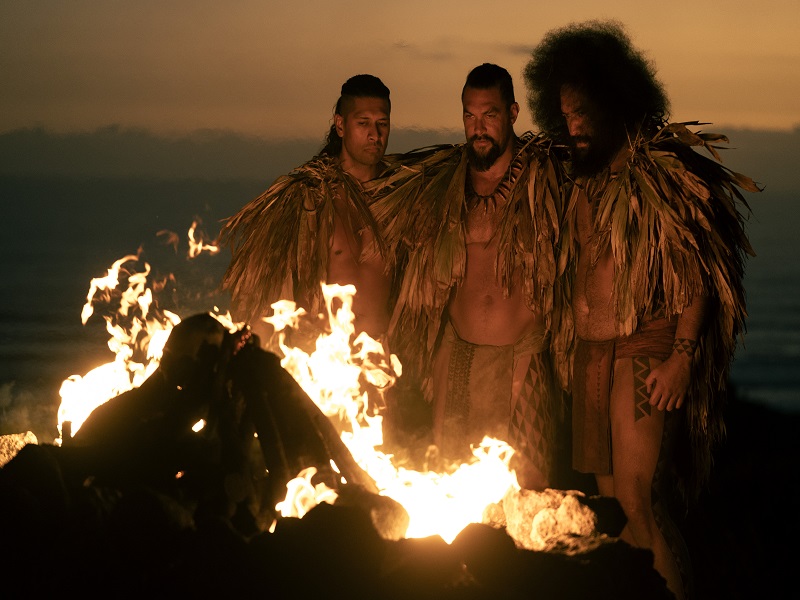
Eselin: Reds, yellows, black, white, and green were the colors of feathers used in the ‘ahu‘ula – the red, yellow, and shorter black feathers came from 5 birds that were of the honeycreeper and honey eater species. Seabirds, jungle fowl, chicken and rooster were also used. In history, all islands wore all the colors of the capes. For the series and with the blessing of our advisors, we gave each island its own identity. In history, and after Kamehameha became king, he wore a full yellow cloak made from the mamo bird only found on Hawai‘i island. It was natural and fitting to give the yellow capes to Hawai‘i. The cloak most associated with King Kahekili of Maui was made with a red ground of feathers and yellow motifs therefore, Maui was assigned the red capes. The green feathers were associated with Kauai. Oahu was then assigned the wild fowl feather capes.
The vegetation on each island was used to dye kapa, among other things. We assigned colors of kapa to each island with specific research into what was prominently available on that island. It also depended on social status and what other colors might be available to them from other islands perhaps. Ka’ahumanu’s wedding dress is from the ukiuki berry – ukiuki gave a purplish to blue dye. It was not especially used for a political union or marriage but was used in other ceremonies. It was suggested we use this color for Ka’ahumanu by our cultural advisors and was exciting for us because it would be only used for her.
Bellwoar: Is there an origin story behind the ivory tooth necklaces worn by the royalty and council members of Hawai’i?
Eselin: The lei niho palaoa (the Kū god tongue on a rung of human hair) were sacred and important adornments for the ali‘i. The palaoa was made from sperm whale teeth, but they were only obtained from a whale that had washed up in special places on the islands. There is a specific beach on Oahu where whales would wash up and the chiefs of Oahu kept the original whale tooth shape as their palaoa as a way to honor the whale. The human hair was from the chiefs’ deceased family and ancestors. The lei niho palaoa would carry the mana of their ancestors.
Bellwoar: Most of the series takes place outdoors and the characters tend to be very active. What kind of challenges does that create, in terms of making sure the costumes hold-up and keeping the actors safe from the elements?
Eselin: It took us three months to find the material that would mimic our kapa. We found a material called Evolon. It’s a non-woven pressed polyester fiber material used for art archival, mattress covers, car interiors, and many other industrial uses. It’s green, sturdy, moisture-wicking, dyeable, and washable. We needed a material that could indeed stand up to the elements, stunts, and day-in and day-out wear. It’s a miracle material, and it looks and feels like kapa! In the cold of NZ we made ponchos and dive coats with smooth materials so as not to rub off tattoos and to keep everyone warm.
Bellwoar: Rather than focus on keeping their skin covered, it seems like mobility was valued more than protective armor during battle. Is that true, and what was it like getting to design battle gear for female warriors as well as men?
Eselin: Both Chief and Chiefesses wore ‘ahu‘ula in battle and ceremonies. In our lessons with our advisors, we learned that women too wore a form of malo. You can see our women warriors in the series in their romper-style malo. Huihui Kanahele-Mossman made a special trip to Oahu to our costume prep space to show us in person how to make these shapes right on the body. It was thrilling to learn this and begin applying to other garment constructions for priests, fisherwomen, and women warriors.
Bellwoar: What’s been your favorite part about working on Chief of War?
Eselin: Ooh, it’s countless things. It’s a gorgeous culture and incredible history. It was amazing to begin learning – there is still and always will be so much to learn. That and the ohana we created – beautiful and incredible humans made this series. I miss them all and hope to be reunited soon!!
Bellwoar: Thanks for agreeing to this interview, Caroline!
Chief of War debuted August 1st on Apple TV+. New episodes drop on Fridays until September 19th.
