
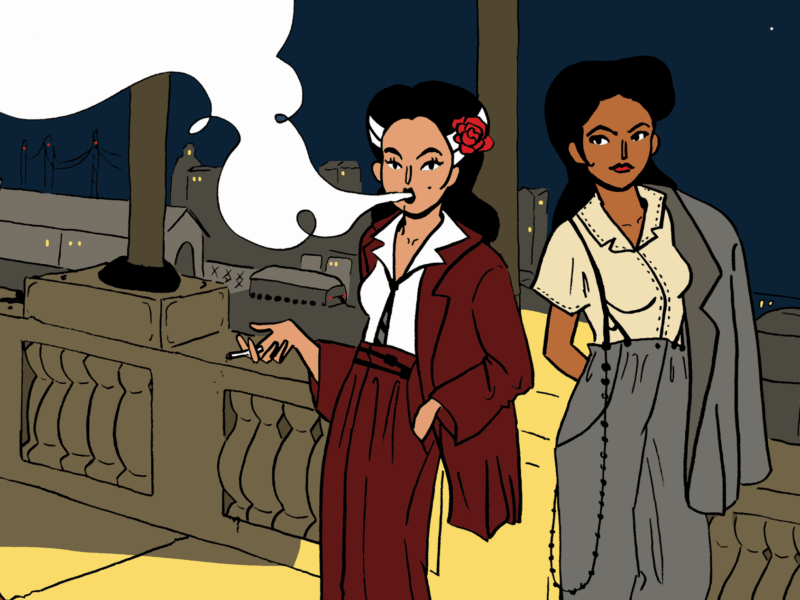
‘Death To Pachuco’ Writer Henry Barajas Talks Noir, Zoot Suits, And Chavez Ravine
by Rachel Bellwoar
Pros
Cons
The first time I heard about the Zoot Suit Riots was probably watching Luis Valdez‘s 1981 film, Zoot Suit. Now for some readers, writer Henry Barajas and artist Rachel Merrill‘s new series, Death to Pachuco, will probably be that moment. Whether or not pop culture should be our introduction to these important moments in history, the fact remains that movies and comics can be great starting points that instigate further learning. Death to Pachuco promises to educate as much as it entertains and, for more on the series, here’s what Barajas has to say:

Rachel Bellwoar: There’s so much American history that doesn’t get covered in schools. When did you first become aware of events like the Sleepy Lagoon murder and the Zoot Suit Riots and what were they like to research?
Henry Barajas: I was a very nosey child. If someone said I couldn’t read that or look at that, I would do everything in my power to look at it and read it and find out why it was not appropriate for me. I was the “metiche” of the family, hence the nosey.
As we’re seeing it now, there’s a subsection of the population that thinks they shouldn’t feel guilty or ashamed of what their ancestors did or had a part of in the past. There’s a concerted effort to remove text books, amend curriculum, and ban various other forms of media from schools to show a more exemplary idea of “history” and what America is to them.
Thankfully, Death to Pachuco isn’t meant to be a subversive text for classrooms. It’s nice if teachers gravitate towards the comic and use it in their curriculum. But it’s a crime noir told with pictures and words. Nada más.
But the feelings were invigorating. I was so excited to learn about something I think should be known, like in 1985 police bombed a Philadelphia neighborhood, or the Tulsa massacre, or the Trail of Tears. We tell these stories so history doesn’t repeat itself.

Bellwoar: In Death to Pachucho, Ricky Tellez is a private investigator who’s been hired to help prove a young girl’s innocence. How does he compare to other great private investigators of noir, like Sam Spade?
Barajas: I like that you’re connecting him to your favorite private investigator. I am 99% sure I fell in love with noir through watching Turner Classic Movies or AMC back when I was a boy. Then it was all versions of Batman — and finding Sherlock Holmes novels at my elementary school library. I know for a fact that the iconic video game series Max Payne 1 & 2 by Sam Lake, best known for Alan Wake 2 at this point, was and is a huge inspiration to me and this book.
One of my favorite lines in the book is “I’m the one you call when you can’t call the cops.” It was important to me that the reader knows what Ricky is doing is not easy on any stretch of the imagination. Sherlock can work with the police, Ricky can’t. His office is above a bakery in Chavez Ravine where Dodger stadium stands now, so his base of operations will be at jeopardy. It really writes itself.
But Ricky is still new to this. He has spunk and drive, but there will be a lot of growth in this one. Hopefully, he’ll have his stuff figured out for the next job. Don’t worry, he won’t.

Bellwoar: The first issue opens at a movie theater, where you have these reasonable sounding war ads playing while, in the audience, Mexican Americans are being singled out and attacked. It’s the contrast between propaganda and reality. How long did it take to work out that opening and were there other options you considered?
Barajas: Well, that actually happened. I wanted to paint a picture of the moments leading to that real event. When I started reading about the “Zoot Suit Riots” my mind started to paint the story for me. I wanted to try to replicate the uncertainty and fear of what might have gone on. I’m 99% that has always been the one and only opening I had in mind for this story. And everything in between has changed numerous times.
Bellwoar: The title of the first issue is “Now’s not a good time to be a Mexican,” but unfortunately that’s not just true of the 1940s. Had you intended to write this series for this moment or is it one that’s been in the works for a while and the timing’s only gotten more urgent?
Barajas: I started research and completed the first script in 2023. Due to having a grade school understanding of history, this was going to be relevant no matter when you crack open this comic open. That’s the trick, simón? How do you write this with a sense of urgency while making sure it feels timeless. I hope we found that balance, and I’m sorry we did. I also hope while reading this you get to see the beauty of the language, music, history, and people. It’s a bad time to be Mexican or whatever that isn’t what this administration deems legal or American. It’s also a beautiful time to a Mexican.

Bellwoar: For those interested in learning more about the events you cover in this series, are there any books or documentaries you’d recommend?
Barajas: I hope this series points folks to Luis Alvarez’s historic Broadway play: Zoot Suit. Death to Pachuco is not only a love letter to Los Angeles, and a response to his play in the most respectful fashion. Luis and the play placed the bar high up when you try to tackle Pachucos and the historical event. I hope we can place the bar even higher. Fashion plays a big role, so I hope everyone can see where Rachel is gleaning her inspirations. Collectively, we hope you watch the PBS documentary on the Sleepy Lagoon Murder Trial and riots narrated by the legendary Hector Elizondo. Bonus points for the folks that seek out Ken Burns’ Jazz documentary.
Bellwoar: Death to Pachuco is being marketed as a miniseries, but is it possible Tellez could return for more cases in the future?
Barajas: If people like it and buy it, we plan on doing more Ricky Téllez stories until I die. I’ve already spoken to Rachel about what’s next. She is excited for it. Thankfully, Los Angeles is nothing short of historical indignities against marginalized communities — and how they make perfect backdrops of what we’re trying to do here.
Bellwoar: I wish that wasn’t the case for LA, but I do hope they’ll be more arcs in the future. Thanks for agreeing to this interview, Henry!
With colors by Lee Loughridge and letters by Barajas, Death to Pachuco #1 goes on sale October 8th from Top Cow and Image Comics. The FOC date is today.

