
We Comfort Ourselves With Nostalgia — Discussing Mad Cave’s ‘Xero’ With Vaho And Felipe Flores
by Tom Smithyman
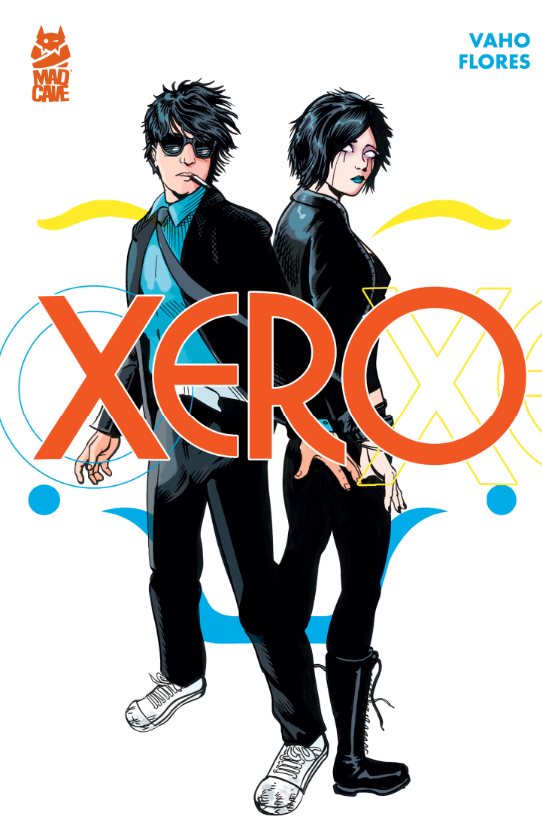
Being stranded in a shopping mall is either your idea of Heaven or Hell, depending on your age. That’s the situation facing the main character in Xero, a new genre-fluid graphic novel hitting shelves on October from Mad Cave Studios. Writer Vaho and artist Felipe Flores have created a character, Xero, who is searching for his pregnant girlfriend while trapped in a doomed reality — aka a mall. In an interview with Comicon.com, the pair opined on the nature of malls and how the entire concept came out of a dream.

Tom Smithyman: Am I right in thinking that you both spent a lot of time in shopping malls growing up?
Vaho: Yes, definitely. As a kid growing up in the 1990s, my mom would drag me to them every weekend to window shop and look for deals. (In fact, the first grocery store I remember going to was in a mall.) Then, of course, I’d hang out there in my teens buying clothes and video games while being hopped up on Orange Julius. Eventually, I’d come full circle and end up working at a dry cleaner there and then a suit store for the summer after graduation.
Felipe Flores: As a working-class kid, the mall was the only optimistic space in my childish world. They were like these futuristic cathedrals that had anything you could want. I love the austere, brutalist malls of the late ’70s and early 80s. In the 90s, they made them all look like European villages. Who are we kidding? We are there to consume, not larp as an Italian countess.
Smithyman: Felipe, I understand that Xero started from a recurring dream you had. Tell us about that dream.
Flores: I would have recurring dreams about an endless labyrinth of a mall. I’ve come to understand that this space actually represents my own subconscious, with each store representing an aspect of my own persona. The mall in my dreams used to be an optimistic place, but as I get older, the mall becomes increasingly dilapidated. The feeling of these dreams are more like the vibe of A Clockwork Orange — kind of an abandoned state where people are scavenging. In some dreams, the mall has been demolished.
There is a sense of wistful nostalgia because not only does the mall not live up to the reality of what it was in real life, but it cannot live up to my own dream logic from 10 years ago.
Smithyman: Vaho, how did you write a narrative around that trippy dream?
Vaho: I wrote the narrative around the panels Felipe produced from that dream. During Covid, he posted them randomly on Instagram one day and then took them down a few hours later. I was immediately taken by them because: 1) the character in the drawings looked like me, and 2) I got his vibe immediately.
There was a sense of loss and isolation in his illustrations that I connected with, and being lost myself at the time, I think the art revved some kind of motor in me that would not stop turning.
So the ideas and thoughts around the panels came to me fast and easy, and I emailed them to Felipe, who agreed with them, and we started building from there. In fact, I somehow had the Batman: The Animated Series writer’s bible on my hard drive, and I used that as a template in building the narrative. It was sectioned off into parts: Introduction (the vibe of the show), General Series Concepts, History of the World, Rules of the World, Writing Structure, Styles/Themes, Characters. I’d fill each section in and send it to Felipe for approval. Needless to say, he liked it and the rest is well, history … or the present, I guess.
Smithyman: Is it more challenging to weave together different genres and artistic styles when creating a graphic novel, or is it no different from sticking to a single genre?
Vaho: I don’t think there is. We knew we wanted to make a throwback story to our childhoods. In times of crisis, we comfort ourselves with nostalgia, and Xero was a vehicle for doing just that. But instead of us consuming nostalgia, we decided to create it instead.
Flores: It is much easier for me to switch genres every issue. I become easily bored and take every opportunity to stylistically adopt a new narrative device as the story goes on. If there’s a flashback, I am definitely going to draw it in a throwback style. Even characters within the same frame are rendered in totally different styles.
We have robotic characters colored like the 2000s mixed with characters who are muted ’80s colors, and then black and white characters, all in the same panel. Even speech balloons are totally different depending on what faction the character is a part of. I’m not even sure if it all makes sense, but it’s the type of maximalist art that appeals to me.
Smithyman: Talk about your creative process, aside from dreams. How do the two of you work together?
Vaho: Generally, we work apart (as I lived in the Bay Area and he lived in LA). If Felipe has a drawing, I’ll take inspiration from that and run wild. I’ll also just freestyle ideas and outline story arcs. I’ll send him a beat-by-beat outline for approval and get to work on the dialogue. Once we agree, it’s time to frame the comic panels. I wholly trust Felipe’s aesthetic decisions, so he’ll pitch on the framing too, because sometimes I can go overboard with how many actions can occur in a panel.
We’ve found a pretty good flow with this back-and-forth approach, I think, and look to create more together in the future.
Flores: Vaho’s the word and I’m the pictures. There are a few areas where there’s an overlap. I’ll introduce a concept and a design, and he’ll give it the structure and thematic sense of purpose.
Smithyman: In the beginning of the story, Xero categorizes people in the mall into punks, nerds, jocks, and squares. Which of those categories do each of you fit into, and why?
Vaho: I think I’ve tended to be more jock-ish growing up, but I guess that’s because I played a lot of sports. I wasn’t a bully or anything, though. I generally floated amongst groups in school and just tried to be friends with different people so I could be exposed to as many interests and perspectives as possible. I think being an immigrant to different countries growing up gave me a sense of isolation that I’d tried to break through by socializing as much as I could.
Flores: I was punk. But I can be any of those things on any given day, because I am a complex human being. I think those archetypes are strong, and there are reasons they endure in our culture. All of those stereotypes can easily fit into the major arcana of the tarot or Myers-Briggs.
Smithyman: It feels like there are lots of messages in Xero. What do you want readers to come away with after finishing the book?
Vaho: I’m not totally sure, to be honest. I think Felipe and I wrote this as an expression of our need for the good ol’ days, mixed with a mistrust of authority. But as we find out, usually, the good ol’ days were just an amalgamation of the best times. Or just the times we all came out unscathed. Xero longs for something he thought was the best, but once he finds it, well…it turns out to be a little more complicated than he remembered.
Flores: I think some people want to rule the world and shape it in their own image. Others hold onto something and, in doing so, pervert it. These people do a lot of damage, and I think most of us just want to love and be loved. We have to navigate around these psychopaths.
The characters in Xero live in an endless mall. If you could be stuck in only one mall store for all eternity, which shop would it be?
Vaho: Tower Records.
Flores: Borders Books and Music.
Smithyman: Boy, I wish either of those were still around! Best of luck with Xero!
