
The Weekly 2000 AD Prog 2451: Back To The World Of ‘Zenith’ With Red Dragon
by Richard Bruton
Taking a look inside the UK’s greatest sci-fi comic, the Galaxy’s Greatest, fast approaching 50 years of brilliance —it’s the Weekly 2000 AD.

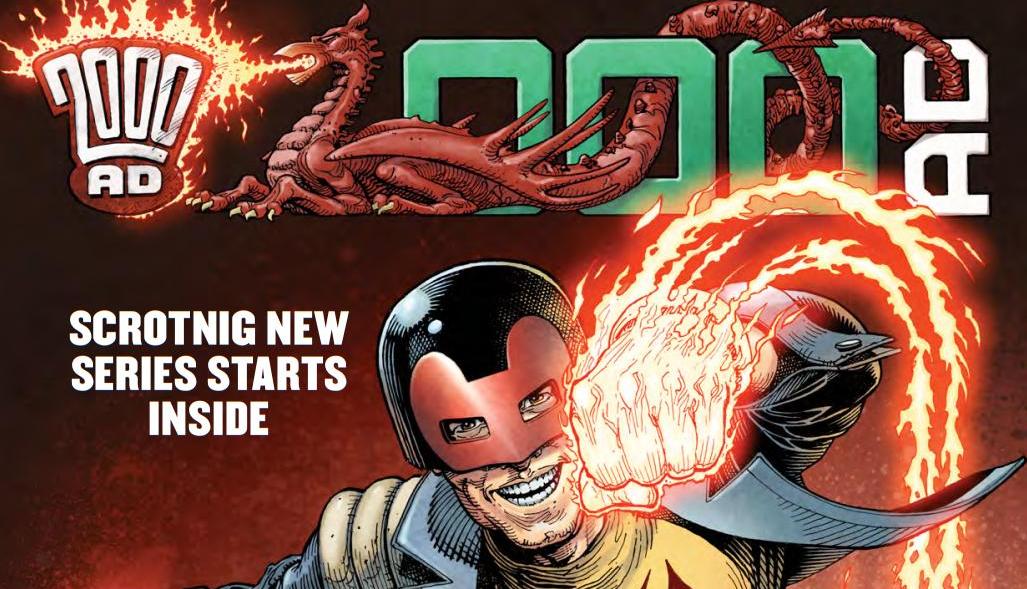
Last week was a bumper jumping on Prog, complete with the four new series that keep on keeping on this time round. So, that means the second part of the new Williams and Flint Judge Dredd; ‘And To The Sea Return’, which already looks very special indeed. Then there’s second episodes of the cosmic psychedelic rebellion tale of Void Runners, some classic Rogue Trooper action taking us right back to the beginning in Ghost Patrol, and then there’s the long-awaited epic continuation of Brass Sun, a strip I never honestly thought we’d see again. And of course, as you can see from the cover, we’ve got a very special new series, Red Dragon, written by Rob Williams with art by Steve Yeowell and Patrick Goddard, telling the tale of Siadwell Rhys, who we first (and last) saw in the iconic Zenith by Grant Morrison and Yeowell back in 1987.
And, as promised, that rather special Cliff Robinson and Dylan Teague cover…

I do always love it when the art crashes the logo that way. And it’s something that Robinson does so very well.
2000 AD Prog 2451 is out now in the UK. If you happen to be in the Americas, head to your local comic shop and ask them nicely if they’ll order the four-weekly bundles. It’s always a good time to jump onboard, but here’s a perfect time, with five great strips perfectly showcasing the variety, diversity, and brilliance that’s been a mainstay of 2000A D over its nearly five decades of publication now. Here at Bruton Mansions, NV, things have settled down from the techno apocalypse of last week. This week, nothing but blue skies here and tech doing what it’s meant to be doing. Of course, outside these four walls, the country continues a slide into what can only be called a Judge Dredd future.
Anyway, time to take a peek inside…

JUDGE DREDD: AND TO THE SEA RETURN – PART 2 – BY ROB WILLIAMS AND HENRY FLINT, LETTERS BY ANNIE PARKHOUSE
The Barge, home to over 11.000 perps cubed onboard, has gone missing. The commanding officer, Judge Guthrie and all the Judge jailors presumed dead. There’s a mist hiding where it could be, a mist that bodes ill for all concerned in Mega-City One. Oh, and everything ended in suitably portentous fashion with Anderson tracking down Alfred Marx, gibbering ominous phrases… ‘Not… not that kind of story…’ ‘The Barge, it’s on there…’ and ‘Carver… Carver spoke to me.’ All leading to this…

So, who’s Carver? What’s Marx done? And what’s the big black worm got to do with it? Well, we get a few answers this time, although, as you’d expect, in the best Williams-written Dredd fashion, the answers only lead to bigger questions.
Marx turned from normal cit to mass murderer, hallucinating thanks to a parasitic worm usually found in the Black Atlantic, something Marx knows as ‘Scolex’ (go look up your Greek mythology). What all this has to do with the Barge, just who Carver is, well, the answers to those questions and more will be teased out, deliciously, perfectly, in the episodes to come, no doubt. In the meantime, Dredd, Anderson, and their team are headed to the Black Atlantic coastline, where they’ve lost touch with Sector House 108, thanks to the mist that’s rolled in and knocked out all comms.
Oh yes, this one’s developing quite beautifully. There’s that real sense of dread about it all, the mystery of what’s happening here slowly playing out, like the start of some huge horror tale. It’s the sort of thing Williams writes so well, and having Flint on art just elevates it into true great Dredd territory, surely one of the greatest modern Dredd artists moving into the ranks of all-time great Dredd artists with his work in recent years.


RED DRAGON – PART 1 – BY ROB WILLIAMS, STEVE YEOWELL, PATRICK GODDARD, COLOURS BY DYLAN TEAGUE, LETTERS BY SIMON PARKHOUSE
Now, if you know Grant Morrison and Steve Yeowell’s Zenith, you’ll know this is both a surprising and a risky move. Surprising in that I doubt many of us had the return of a classic supporting character from 1987 on our 2025 bingo cards. Risky in that Zenith is one of those strips that was, particularly in the early phases, rather perfect, and revisiting it with a prequel would seem rather unnecessary.
If you don’t know Zenith, well, you’re missing a real treat. Very early Grant Morrison writing a superhero for 2000 AD, a comic that had never done superheroes at all. Alongside Morrison, a young Steve Yeowell gave life to the characters Morrison and Brendan McCarthy designed. Zenith wasn’t your US hero though, an arrogant, preening wannabe pop star who doesn’t want anything to mess up either his hair or his face. It was different, it was fresh, it was rather good. You should definitely go read it.
Anyway, one of the supporting cast was Siadwell Rhys, the Welsh superhero Red Dragon, a powerful pyrokinetic and former member of the ’60s supergroup Cloud 9. However, by the time Zenith and fellow former Cloud 9 member Ruby Fox/Voltage got to him, he’d… well, changed a little…

Zenith and Ruby sobered him up, reawakened his powers, and headed off to do battle with the Nazi superhuman possessed by the one of the Lloigor or Many-Angled Ones, demonic extra-dimensional entities bent on conquest of this reality.
It didn’t go well for the Red Dragon…

Yep, 20 short pages from introduction to death. That was the story of Siadwell Rhys, the Red Dragon. Until now.
This is where Red Dragon the strip comes in. It’s both prequel and legacy for the character, with Yeowell on art duties for the technicolour tale set in the sixties that delves into Siadwell’s part in Cloud 9, whilst Goddard’s b&w pages detail a journalist’s investigation of the legacy of the Red Dragon.
Well, that’s rather a long intro to a six-page strip this week, isn’t it? But it needed it. Especially if you come to this with no knowledge of the original.
The first episode is split, three pages of Yeowell in the sixties, three pages of Goddard in the now, both parts acting as an intro to it all.
back in the sixties, we get an Alan Whicker-like journalist on Carnaby Street giving us a rundown of all that’s hip and happening, including the new hippy supergroup Cloud 9, where Siadwell, always the outsider of the group, the one who left when the ideas for these new Gods to supplant humanity got too much, crashes down hard – the drink always going to be a problem…

After this, it’s an artistic switch to Goddard’s bleak b&w now, as journalist Martin Howe, mourning the loss of his wife, pours himself into work, newfound interest on his books on Zenith prompting a possible follow-up and a documentary. So, it’s off to Wales for Martin, and they’re off to Wales.

I wasn’t sure what to expect from this. The legacy of Zenith loomed large, and we all know – cough, Before Watchmen, cough – just how bloody awful it can be when revisiting the classics.
But, what do you know, this one comes at things from a good place. You get the sense that Williams has a tale in mind that plays with the concepts of Cloud 9 that Morrison and Yeowell introduced, whilst also doing something interesting and low-key with the modern day portion of it all. Having Yeowell on the art for the sixties parts sure helps things move smoothly along, keeps a continuity of style and all that.
One episode in, and it’s won me over. It’s not Zenith, of course it’s not. But I don’t think all concerned ever started with the idea that it would be. Instead, we get the beginnings of something that’s fascinating, something that could well be damn good.
(You can read more about this new strip by reading Rachel Bellwoar‘s interview with Williams, Yeowell and Goddard here.)


VOID RUNNERS: BOOK TWO – PART 2 – BY DAVID HINE AND BOOK COOK, LETTERS BY ANNIE PARKHOUSE
Void Runners Book One introduced us to the wonderful world that awaits us, expansive, psychedelic, a whole galactic Federation ruled by Ankorites, fuelled by Kali’s Dust. It was, to use the expression, a trip.
We met notorious Void Runner Captain Alice Shakari, tasked by the Ankorites to find more of the swiftly diminishing kali’s Dust. They didn’t exactly pick well, as their Captain Shakari wasn’t the most stable of creatures. So now, in Book Two, it’s the wonderfully over-the-top Shakari with a new mission, to free the people from the evils and the tyranny of the Federation.
That’s all you need to know with this one to enjoy it. And it’s one of those strips where enjoying it is best done with the expectation that it’s all going to be strange and silly and camp and so much fun. Hine’s writing it like a mystical drug trip, throwing in as many strange characters as he can to push things along in what is, at its core, a good old-fashioned take on the never-ending struggle of the forces of good (rebellious, counter-culture types) against the oppressive regime of those in power. Aiding and abetting, we have Boo Cook, always a go-to artist for the beautifully bizarre sorts of organic wonders you’ll see here. Honestly, there’s no better artist to have onboard when you’re creating a truly alien look for things. It’s a combination of perfectly out there imagery and flowing storytelling that makes Void Runners, as with everything Cook draws, read so well.

This time round, we’ve already seen Shakari and the crew of the Nautilus down on Rigel-16 with the intent to free the downtrodden Manjukak from their ruling masters the Prima, with Shakari’s dream of freeing oppressed peoples across this universe from the yolk of the Federation. In doing this, there’s going to be consciousness expanding going on. Like I say, it’s a trip.
Of course, there’s the flipside of things as well, as we spend the first few pages checking in with the Ankorites and their continuing quest to get their hands on all the Kali’s Dust they need. But after that, we’re dropped back into Shakiri’s own quest, full of the strange and bizarre, packed with primal religious motifs and overwhelmingly wonderful strangeness. Oh, it’s a blast, it really is.


BRASS SUN: PAVANE – PART 2 – BY IAN EDGINTON AND INJ CULBARD, LETTERS BY SIMON BOWLAND
As I told you last time, Brass Sun was last in these pages a long seven years ago. Frankly, I’d put it down as one of those tales that we just wouldn’t get any more of. Thankfully, Edginton and Culbard never gave up on the series, and that means we finally get the continuation of one of the most genuinely epic of 2000 AD tales. Oh, it’s a good thing, it really is.
Of course, they could have simply taken up where they left off, carried on with the adventures of young Wren as she seeks the pieces of the key that will reignite the Brass Sun at the heart of this strange solar system. But no, instead, we’ve something way better, something that takes the seven-year gap and makes it a feature of the story. Young Wren is no longer young. Her quest stalled and faltered, her life completely different when we meet her again.
The wonder of Brass Sun still comes, for me at least, with the guiding concept behind it all. There’s no better worldbuilding I know of than this, a whole solar system of living, breathing beings living their lives on a massively scaled-up model Orrery, each planet connected to the next with rails between worlds, all given life by that dying Brass Sun.
Except, as we found out in part 1, way in the future, the Brass Sun didn’t die, the worlds didn’t fall to cold. And here, as we go back to a time when things were still at risk, yet knowing that things really do get better. Like I say, they could have gone the easy route and given us a straight continuation, as if no time had passed. But no, instead, what we get is better, more challenging, as we head into the world of a different Brass Sun.
So it is, after the first episode of scene-setting, that we drop into this with a very different, older Wren, beaten down by her life and its tragedies, taking up arms and being the boss. Joined by the pirate Ariel O’Conner, they’re on a mission, it’s just that we don’t know quite what that mission is yet. Hell, even Ariel’s not sure about the changes in Wren, so God knows where this is going now, seeing as the lead character, the good in all of this, has changed beyond recognition…

So yes, Brass Sun is back. It’s as good as it ever was. All that sense of a huge, epic-scaled thing is there. But Edginton’s upended all that we knew of things with the passage of time, giving us something both recognisable and yet new. It’s a fascinating way to move this one along, and it works.
Alongside Edginton and his ideas and storytelling, we have Culbard, long one of my favourite artists, whether it’s for 2000 AD things like Brass Sun or the equally wonderful, yet completely different Brink, or for his Sherlock Holmes collabs with Edginton, or his solo works bringing the Lovecraft horrors to life. His art is like nothing else you’ll see, simplistic at first sight perhaps, although any longer look will show you it’s nothing of the sort. He’s the sort of artist that can do so many different things, all of them so good, that seeming simplicity of style containing multitudes of depth.
Simply, it’s so good to have Brass Sun back. Different, yet the same, epic yet always character driven, the huge scale of things told through the small scale of genuinely emotive and affecting character driven stories.


ROGUE TROOPER: GHOST PATROL – PART 2 – BY ALEX DE CAMPI AND NEIL EDWARDS, COLOURS BY MATT SOFFE, LETTERS BY JIM CAMPBELL
The first episode of this one, trailed as a major Rogue Trooper storyline, didn’t disappoint, giving us a proper Rogue tale set right back at the beginning of the project that led to the creation of Rogue and his fellow Genetic Infantrymen, cursed, as we all know, to be massacred by a traitorous General on their first major deployment.
We’re here at the very genesis of the GI project, or not. Because last time, we were introduced to Gordon Macinrow, a veteran of the Nu Earth wars, dragged back into things by the Army Intelligence Corps and the hook of uncovering what happened to Sergeant Huxley, one of Macinrow’s fellow soldiers in the war, now mysteriously disappeared. That’s some 10 years later on from the GI project’s beginnings.
So, it’s back to Nu Earth for Macinrow. 10 years on from the GI project, 10 years of war, bloody, nasty war, a war that’s seen the Genetic Infantrymen slaughtered thanks to the machinations of the Traitor General.
The problem here is the time shift. It’s there in the preview below. Page 1, Macinrow headed back to Nu Earth, 10 years later. Page 2, Macinrow on Nu Earth 10 years prior. But it’s just not made clear enough. Hey, perhaps it’s just me, but the first time I read it, it passed over me, I just didn’t get the time shift, and that meant the rest of the episode left me confused. Second time round, after re-reading episode 1 and concentrating on episode 2, I did get it. But I don’t think it should be that uncertain, don’t think it should be that difficult to make out. Or it could just be me.
Anyway, with that little moan out the way, what we get, as I understand it, is Macinrow back on Nu Earth, parachuting into battle, all done real well by Edwards, who gets all the action sequences just right.
And when he does land, it’s to a massacre…

And into the chaos, we get Rogue, coming in as some majestic saviour, racing into battle like he always does.
It’s a classic bit of Rogue Trooper, told from the perspective of a grunt, done really well as far as it goes. But there’s still that issue with the time shift. It’s just not clear enough for me. But hey, like I say, perhaps this one’s just on me. Perhaps I’m just not getting it. But, that niggle aside, it really is a rather great Rogue tale.


