
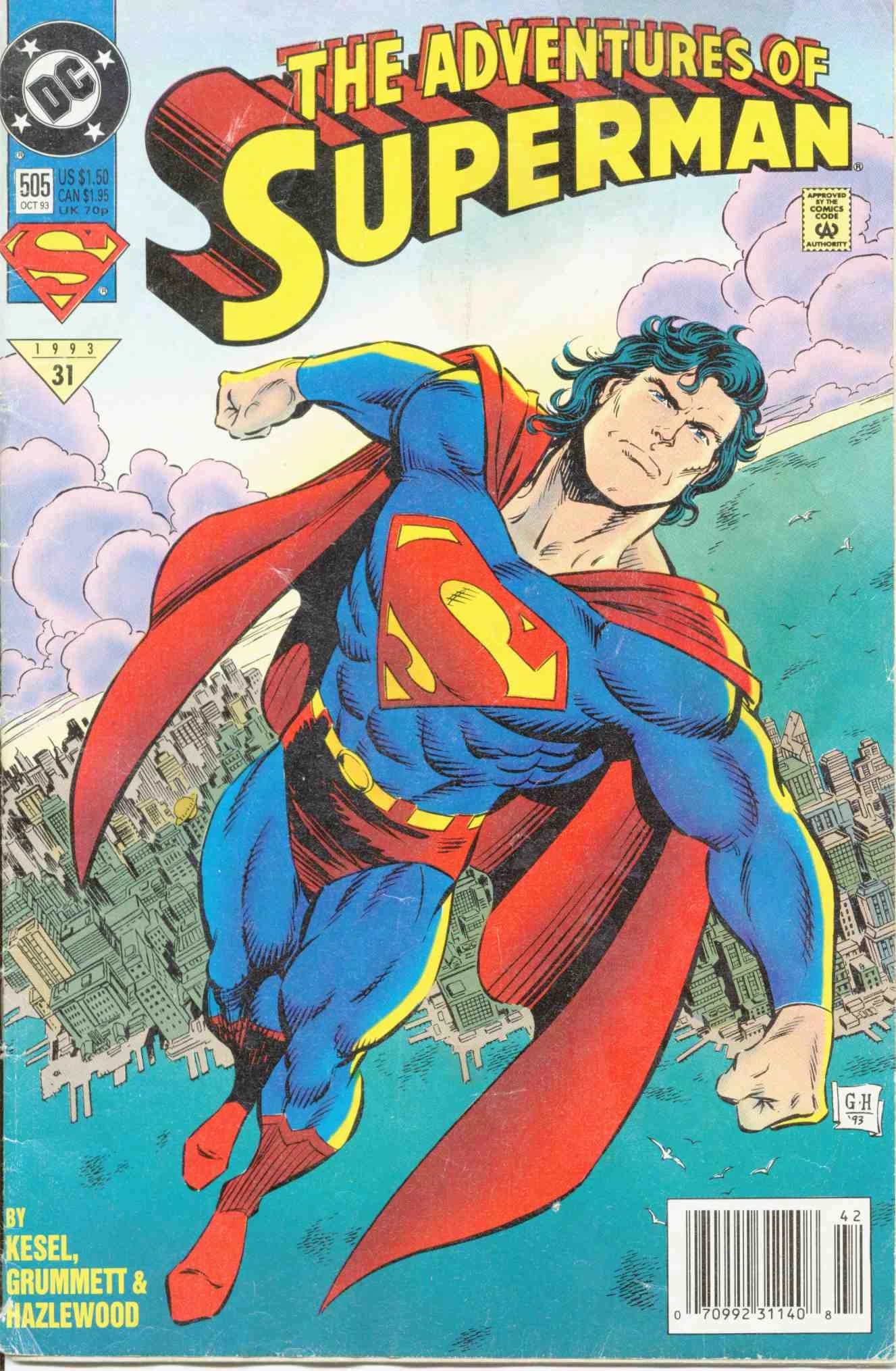
Comics I’m Thankful For: The Peak Of Comics In Superman’s Triangle Era
by Tony Thornley
There’s no way other to say this, but if it wasn’t for the famous Superman triangle era, I wouldn’t be the person I am today.

That’s not a statement of values. I’m not saying I’d be a terrible person, or a better person or anything like that. Just simply put, I wouldn’t be the same.
Last year for our Comics We’re Thankful For feature, I talked about G.I. Joe and how it ignited my fandom for life. But around the time I was 11, G.I. Joe ended with issue #155, three years after I’d started reading. I was so mad about the cancellation that I told myself I’d never read another Marvel Comics series again (Ha!).

Now, around that same time, DC Comics’ ultra successful Death and Return of Superman was wrapping up. I didn’t sit down and read that entire story start to finish, but I picked up bits and pieces of it (unfortunately I missed Superman #75 then and picked up a couple different copies of it more recently). But it’s incredible how much that run, and the comics that came after shaped me.
I really wasn’t a regular Superman reader until around 1999, during the end of the Triangle era. But it was probably the title (or titles) that I picked up the most off the rack before that. It was almost always either Louise Simonson and Jon Bogdanove’s Superman: The Man of Steel or Dan Jurgens’ Superman (whether it was Jurgens, Ron Frenz or Matthew Ryan drawing it). I don’t know why it was mostly those two and not Adventures of Superman by Karl Kesel and Stuart Immonen or Action Comics from Roger Stern, David Micheline and more (Jerry Ordway and Marv Wolfman both moved on by the time I was reading semi-regularly).

Regardless, there was something about those Superman stories that I kept getting drawn back to. The format — with one Superman title released each week continuing the ongoing story — meant that there was always forward momentum to the plot. Sometimes that meant a villain of the week format, other times it was a multi-issue brawl or disaster.
But underneath that was a deep respect for serialized soap-opera style storytelling. Notice those writers’ names? Outside of Jurgens, they’re all Marvel writers brought over to DC, meaning they came up writing X-Men and Spider-Man, the industry’s character rich masterpieces. The drama of Clark Kent and Lois Lane’s lives felt real, but the writers also developed a rich supporting cast.
All of the writers would advance the stories of Lois and Clark (and often Jimmy Olsen). However, Simonson would flesh out the life of Perry White and the man on the street in Metropolis’s Suicide Slum. Kesel would play with the more fantastical elements of Project Cadmus. Jurgens spent time with the Kents back in Smallville, as well as The Daily Planet staff. Every one of them made Metropolis feel lived in and authentic in a way that we’d never seen before or since.

I look at those stories, and those comics, and I’m so glad I read them. I’m so disappointed that it took me so long to go back to them and actually collect them. This is what made me a Superman fan, but it also helped me understand what goodness is, and built so much of my morality and ethics.
Superman is good. No matter what he’s facing, who he’s fighting, the story he’s writing, ultimately in the end Superman is good. With all the soap opera of the triangle era, that’s what it boiled down to. Faced with an impossible threat- he still defends others, despite the cost of his own life. His entire world changes in some way- he finds a way to stand up for what’s right.
He’s Superman. He’s a standard I could aspire to, and do my best, despite living in a very human, very fallible body. And I’ve tried to be that ever since.
Right now, I’m out of work in my day job. It’s been hard, I’ve had extremely difficult moments, as has my family. But I’ve found myself keeping hope, and I can’t help but think that the standard Superman showed me is why. At least … in part.

I’m who I am today because of Superman. And Superman is who he is today because of the Triangle era, and comic book fans really owe to themselves to give it a second chance.