
Previously On X-Men: ‘Unbreakable X-Men’ #3 Is The Best Of A Rough Bunch
by Austin Gorton
What do this week’s batch of “Age of Revelation” tie-ins have to do with “Age of Revelation?” Not much! Does that stop them from being good? Mostly! But there’s still a some diamond’s in the rough — including the stupid fun Spider-Man & Wolverine!
Iron & Frost #3

By Cavan Scott & Ruairí Coleman
Emma Frost sacrifices herself to save Tony Stark. It doesn’t work.
- It turns out a shrunk down Firestar is powering the Iron King armor, which seems like a waste of the character but at least reveals the fate of the last cast member introduced in the first issue.
- The Eastern seaboard of the US seemingly blows up by the end of the issue? What are the chances this gets referenced anywhere else?
- The conclusion of the story involving information about the “Age of Revelation” being sent back in time is basically the same thing as the main thrust of the event (in which Cyclops and Beast’s minds are sent back in time to try and prevent the future); presumably, this is meant to be another way for the event to live on even after it ends/is averted, but it’s not exactly clear if there’s place in which these Iron Man/Avengers-centric plotlines can get further attention.

This series had one of the more promising starts, but flamed out quickly; after that first issue, the rest of the series is basically one like scene inside a mansion inside a crevasse. The ending, with Emma sacrificing herself to save Tony, is predictable. The twist that Iron King overpowers Tony even after that does admittedly give it a bit of a welcome sting, but like so many of these books, the conclusion does very little to justify the book existing in the first place.
Longshots #3

By Gerry Duggan, Jonathan Hickman & Alan Robinson
Wonder Man and Hellcat save the world, earning Mojo boffo ratings.
- The first couple pages here are a metatextual commentary on the creation of the series, with the comic book writers credited with the script that Longshot is passing on.
- Bishop makes a crack about having been in Marauders, but it’s okay cuz Duggan wrote that series as well.
- Later, he gets dressed up as Stryfe, Cable’s arch-enemy and leader of the Mutant Liberation Front in the 90s, and it turns out Bishop is the person Bishop blasted in the previous issue (time travel, I guess? It doesn’t make much sense).

- We get a pretty spot-on retelling of key events in Wonder Man/Simon Williams’ life; what that has to do with “Age of Revelation” Brevoort only knows.
- The subsequent page, via a cheeky editorial footnote, offers an explanation: this is all setup for a Wonder Man book co-starring Hellcat. (Ed. Note: If Duggan and Hickman are writing it, I’d at least read the first issue.)
- Rhino and Kraven get transported into pastiches of Home Alone, The Talented Mr. Ripley, Batman, and Thelma & Louise.
The opening pages of this issue sure seem to suggest this series exists as a troll on the part of Hickman and Duggan, while the Wonder Man/Hellcat material makes it clear it’s more about setting up Duggan’s upcoming Wonder Man book than tying in to “Age of Revelation” — which makes sense, because it has nothing to do with the event, to the point where I wonder why they even bothered to put the full page ad for the “Age of Revelation” finale issue at the end – it’s not like that issue is going to be addressing/tying up anything from this series.
Sinister’s Six #3
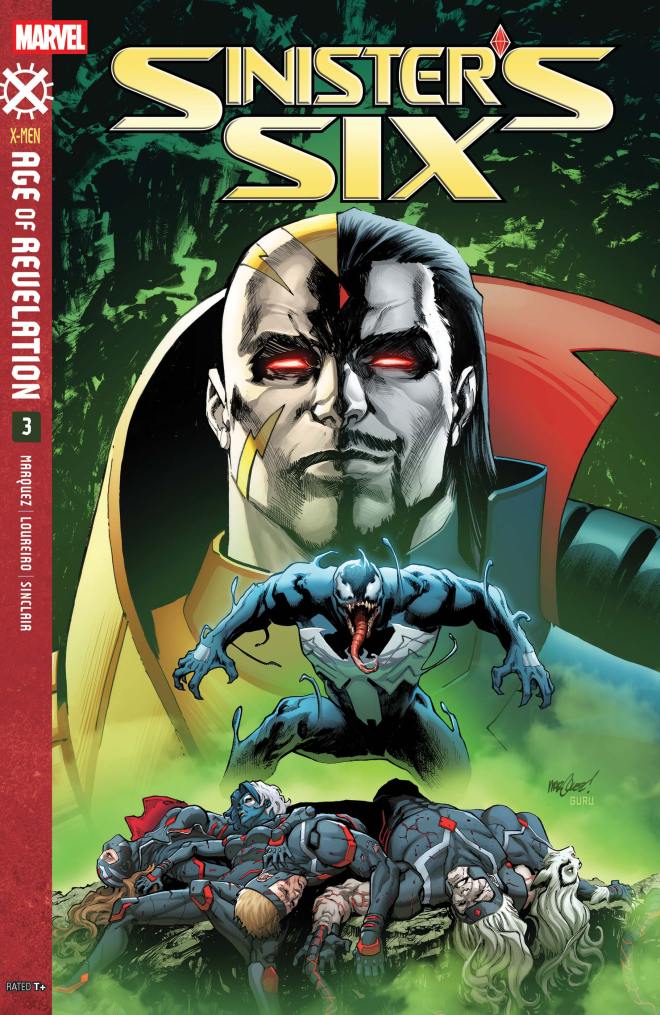
By David Marquez & Rafael Loureiro
Sinister’s Six battle Revelation, his Choristers, and Seraphim. It doesn’t go well.
- Similar to “Emma will turn human and die to save Tony” on the scale of “well, duh” reveals, it turns out Polaris is Venom. How/why she acquired the symbiote doesn’t seem to be important.
- Sinister’s team is pretty easily and summarily wiped out, though Havok at least gets to go out with dignity, which is more than he got in the Mark Russell X-Factor series.

- The closing panels seem to insinuate that Sinister has seeded his DNA into the flora of the Revelation territories (similar to how he managed to infect everyone who was resurrected on Krakoa with his DNA), but I suspect nothing will come of that.
This was another series with a strong start and a befuddling ending that makes the whole thing seem like a waste of time. I’m all for alternate timeline “everyone dies” endings, but they have to be in service to something. When Colossus left all his students to die in Generation Next, it said something about Colossus, which spoke to his “regular” character at the time as much as the alt version, and helped sell the stakes of the broader story. I have no idea what “everyone dies, Polaris is a Venom, and also, Sinister will be reborn in this alternate timeline we’ll never talk about again” is trying to say.
Spider-Man & Wolverine #8
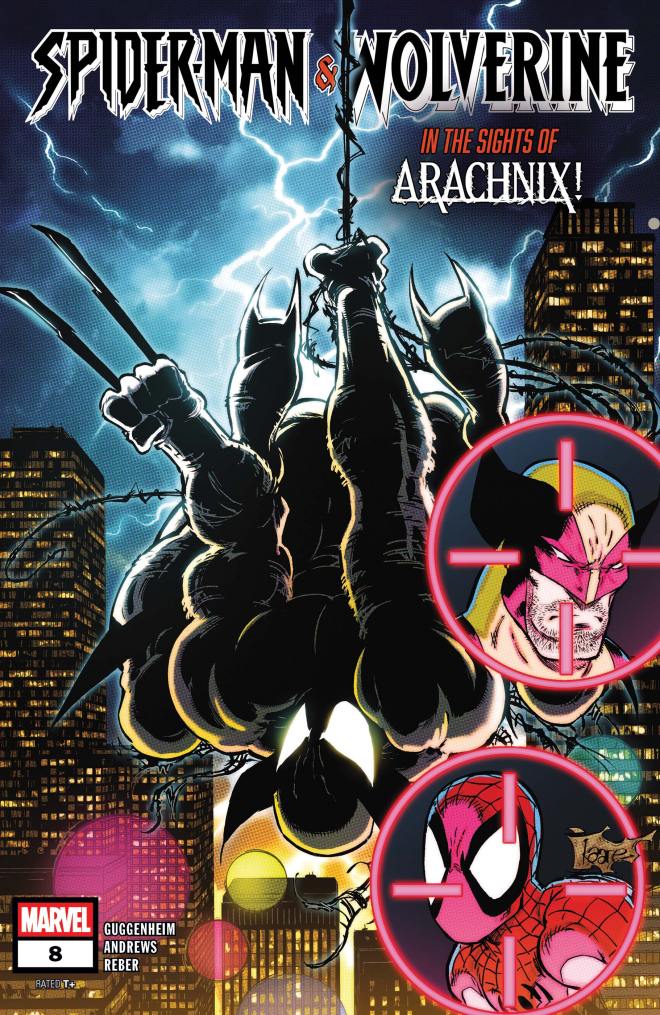
By Marc Guggenheim & Kaare Andrews
Spider-Man and Wolverine take the fight to the Revengers in an attempt to beat Arachnix. It doesn’t go well.
- The idea behind the alternate reality this story takes place in seems to be that everyone is an amalgamation of two existing “regular” characters. So Arachnix isn’t just someone with both Spider-Man and Wolverine powers/aesthetics, but was “Peter Logan” before getting his powers and becoming a super-villain.
- Which makes me wonder if Reed Richards is an amalgam of someone.
- Wolverine wielding a big 90s gun is the kind of thing you come to a Kaare Andrews for.

- Spider-Man refers to Arachnix’ lair as an ossuary and makes a crack about having a word-of-the-day calendar; given the term was recently used in Laura Kinney: Wolverine, I wonder if the X-office has the same calendar.
- Wolverine acknowledging he hasn’t sought out Mariko since she was resurrected is a nice “hang a lampshade on it” moment from Guggenheim.
- Like Peter Logan, the rest of the Revengers are amalgams like Namor/Thor and an Iron Fist Ultron.
- Andrews recently announced that issue #10 (presumably the end of this arc) will be his last on the book; given it exists as a showcase for his work (and the fact that Marvel tends to kill most series at either five or ten issues these days), that likely means the end of the book.
It’s not high art but there’s a lack of pretentiousness to this that I appreciate. It’s big dumb alternate reality nonsense with art that, whether you love it or hate it, at least has a unique sense of style; if more of “Age of Revelation” was like this, maybe it wouldn’t feel like such a slog.
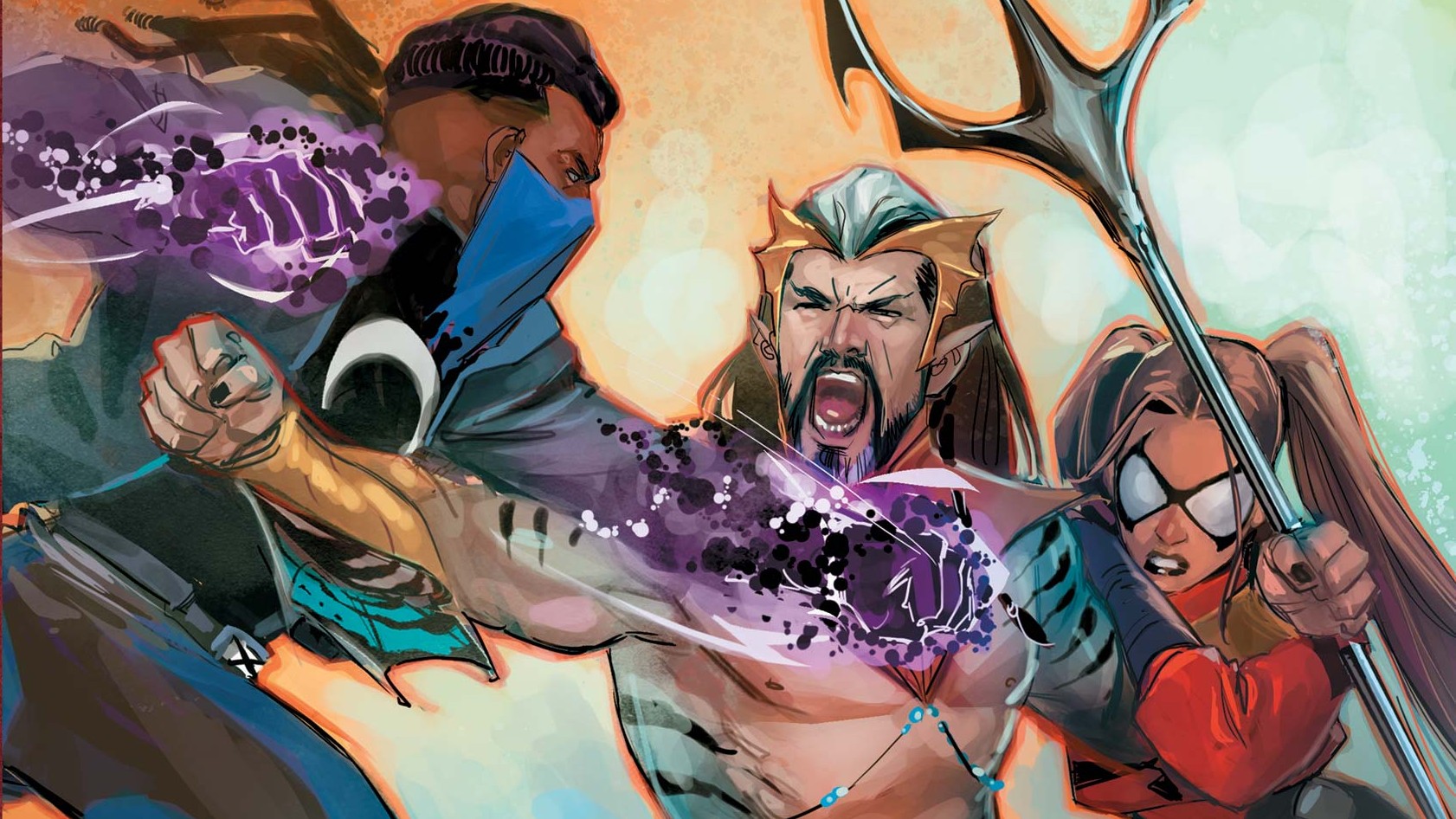
Unbreakable X-Men #3

By Gail Simone, Mario Santoro with Luciano Vecchio, Tiago Palma, Davide Tinto & RB Silva
The X-Men must confront Namor as part of their mission to stop Shuvahrak.
- The prologue to this issue shows the Outliers making the pact referenced last issue, to always come together to stop Shuvahrak if needed. It is is set in “the present”; presumably some time shortly after the end of the “Dark Artery” story in Uncanny X-Men #16 so more specifically in the recent past.
- Calico refers to the Outliers as “the five of us”, including Ember.
- We’ve got another small army of artists working on this issue, though in an appreciated touch, Luciano Vecchio draws the “present day” material, making it visually consistent with Uncanny X-Men.
- Calico calls Gambit her father here; we haven’t gotten a ton of interacting between the two in the main page yet. Presumably, this is something that will explored in the future.
- Gambit told Ransom he can be a mutant or walk the mutant road (which still feels like distinction with less of a difference than Simone seems to think…) in Uncanny X-Men #20.
- Namor calling Gambit a “gnat” and then Gambit asking Namor how he even knows what a gnat is was kind of funny.
- It’s kind of funny that Gambit has spent much of this series hurling exploding cards at things despite being blind, but NOW he needs to be able to hear Namor’s ankle wings in order to fight him.

- The fact that Deathdream trades his immortality to revive Rogue presumably explains his appearance in this series after dying in Amazing X-Men #1 ie up to this point, he’s immortal and can’t die so he just didn’t in Amazing X-Men #1 (or that takes place after this, and he did die for good). Either way, eh.
- It’s also not clear with whom/what Deathdream made the trade.
- We never really get an explanation for why Shuvahrak heads towards Atlantis in the first place (presumably because Galactus is there, but why does Shuvahrak care about Galactus?).
- Unlike most of the other “Age of Revelation” series, this book goes back to being Uncanny X-Men next month.
- I’m calling this the Book of the Week but that’s mostly just because everything else is so bad, not because this is particularly good.
What does set this book above the rest this week (and largely the event overall) is that the emotional core is strong — Gambit’s grief, the sense of family amongst the X-Men/Outliers, even the “final stand” showdown with Namor, all resonate. Ultimately, given its happy ending, you could read this entire thing as simply a tribute to the Gambit/Rogue relationship.
The plot, however, makes next to zero sense (why drag Atlantis into this at all Why does Shuvahrak care about them? Why Namor as the character against whom Gambit has his final dramatic stand?). And I ultimately can’t decide, given how generally lackluster the event as a whole is, if this series completely and utterly ignoring “Age of Revelation” to just tell a story that could have been a three issue “flash-forward”/alternate timeline tale in Uncanny X-Men (this books takes NOTHING from “Age of Revelation” — it’s one direct reference to an AoR books is via Rogue Storm, which ALSO does nothing with the event), is a frustrating display of poor teamwork from Simone, or an admirable expression of “eff this Revelation nonsense, I’m just going to do my own thing, try and stop me” independence. At this point, I’m honestly leaning towards the latter.
X-Men: Age of Revelation #6
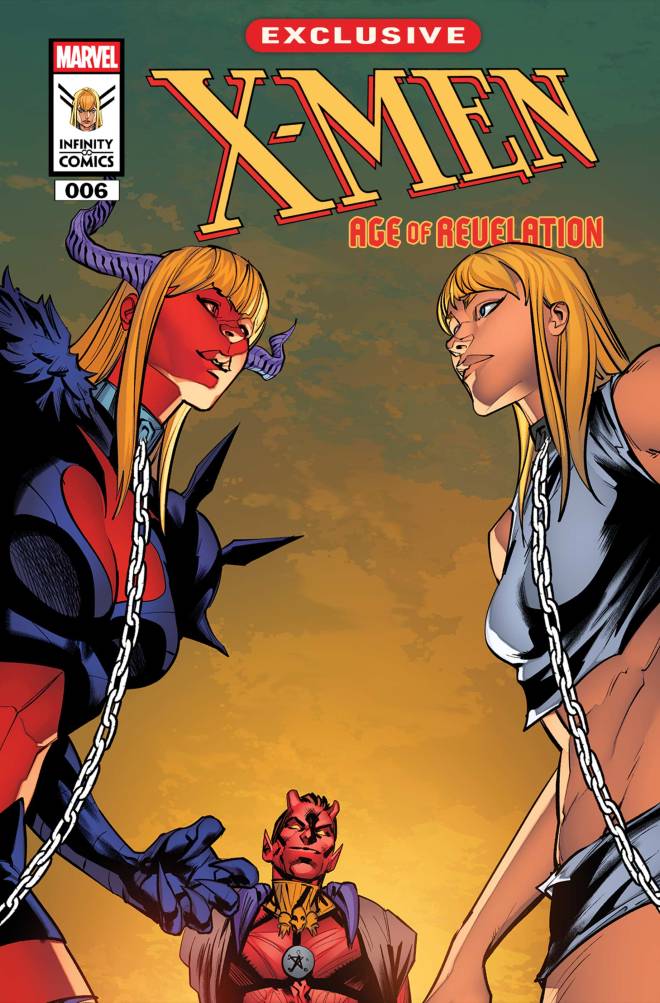
By Tim Seeley & Phillip Sevy
Illyana and Darkchild succeed in their mission, but Darkchild ultimately wins the day.
- The idea here is that Illyana and Darkchild split in two when Illyana died because of how Belasco had broken her soul years ago.
- While Illyana and Darkchild succeed in their mission of engineering a conflict between S’ym and Belasco so they can get back together, Darkchild ultimately wins the day by gaining possession of Illyana’s soul stone for herself.
- Thus, Illyana goes to heaven and Darkchild remains in Limbo, which explains why Darkchild is on hand for “Age of Revelation.”
- Which, all things considered, isn’t a terrible ending for Illyana.
- This is the best issue of the story in terms of taking advantage of the “Infinite” format, with some taller-than-print panels and vertical splashes.

- At no point is any explanation given for why Belasco is in charge of Limbo again and how he deposed Madelyne, or why Darkchild manifested in S’ym’s control.
The biggest issue with what Seeley is ultimately trying to do with this story (beyond the footnote-y “here’s what happened to Illyana” bit) is play with the idea that Illyana and Darkchild are two sides of the same coin, and not separate beings. Except, that’s basically what Ashley Allen did in the recent Magik solo series, and better.