
Snap Into Marvel: Maverick Unleashes ’90s X-Men Kewl On ‘Marvel Snap’
by Austin Gorton
Real Name: Christoph “Christopher” Nord
First Appearance: X-Men (vol. 2) #5, February 1992
First Multimedia Appearance: Maverick appeared in X-Men: The Animated Series, voiced by an uncredited actor. A version of the character, under the name Agent Zero (which Maverick was using in the comics at the time) appears in 2009’s X-Men Origins: Wolverine, played by Daniel Henney.
Powers and Abilities: Maverick was introduced with the ability to absorb kinetic impacts without damage to himself (so he could basically take a punch or jump out a window and not feel any ill effects). His power later evolved to include a discharge element, such that the kinetic energy he absorbed could be dispelled via blasts from his hands.
Additionally, Maverick is an accomplished hand-to-hand combatant and marksman.

Comic Book Chronicles
In one of the most “1990s things ever,” Maverick has the distinction of debuting more or less at the same time on a trading card as in a comic, with the first series of X-Men-specific trading cards, drawn by Jim Lee, first going on sale right around the same time as Maverick’s debut in X-Men (vol. 2) #5, the second part of the first story in the new adjective-less X-Men title entirely plotted by Jim Lee following the departure of longtime X-Men writer Chris Claremont.
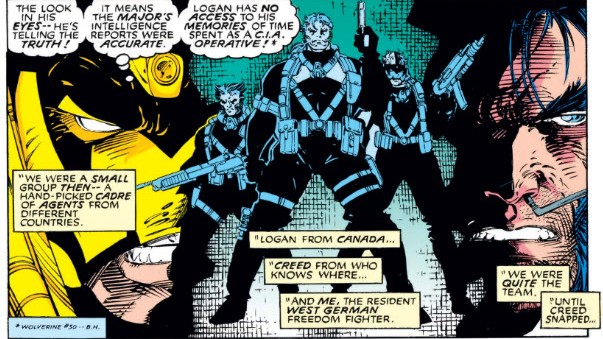
Like many characters of his vintage, Maverick initially existed as little more than a cool visual (in Maverick’s case, a nifty gold-and-black metal mask) and a too-kewl-for-school attitude. And like many such characters, Maverick was introduced with connections to Wolverine’s shadowy past — in Maverick’s case, he was part of a multi-national secret ops team alongside Sabretooth and a pre-Adamantium Wolverine.

With his kewl look and ties to the mega popular Wolverine, Maverick seemed destined for greatness, but that never really came to be. In part, it may be because his co-creator left X-Men (and Marvel) shortly after Maverick’s creation to help found Image Comics. With his co-creator unable to champion his existence and with so little of his actual characterization established, Maverick lingered on the fringes of the X-books throughout the ’90s.
Eventually, he became one of several semi-high profile mutants to contract the Legacy Virus (a deadly virus which targeted mutants in a thinly-veiled AIDS allegory which hung over the X-books for much of the ’90s), one of those characters who could contract the virus and be more than a faceless generic mutant to give its threat some oomph without creators actually having to tackle the virus head-on by infecting one of the significant X-Men. Shortly thereafter, Maverick received his own solo series, a notable achievement at a time before Marvel was handing X-Men characters solo series like they were candy. Despite featuring art from a young Jim Cheung, it only lasted twelve issues.

Maverick has popped up here and there since, usually in narrative proximity to Wolverine. He parlayed a recurring role (under the name “Agent Zero”) in the mid-2000s Weapon X series into an appearance (sort of) in the Wolverine solo film (which, like most of the Fox X-Men films, adapted his character in the most blandly visual way, meaning Maverick was missing his signature mask).
He lost his powers on M-Day (the day Scarlet Witch rewrote reality to remove the mutant powers of all the mutants in the world except for the ones who starred in X-Men comics), serving a similar role as in the Legacy Virus storyline as a recognizable character who could be pointed to as a notable victim whose loss of powers wouldn’t impact the actual marketability of the X-Men. Most recently, writer Ben Percy has taken a shine to him, using him as a recurring character in his Krakoa Era Wolverine and X-Force runs, as well as his “From the Ashes” Deadpool/Wolverine series; he also briefly became a vampire during the “Blood Hunt” event.
Fit & Finish
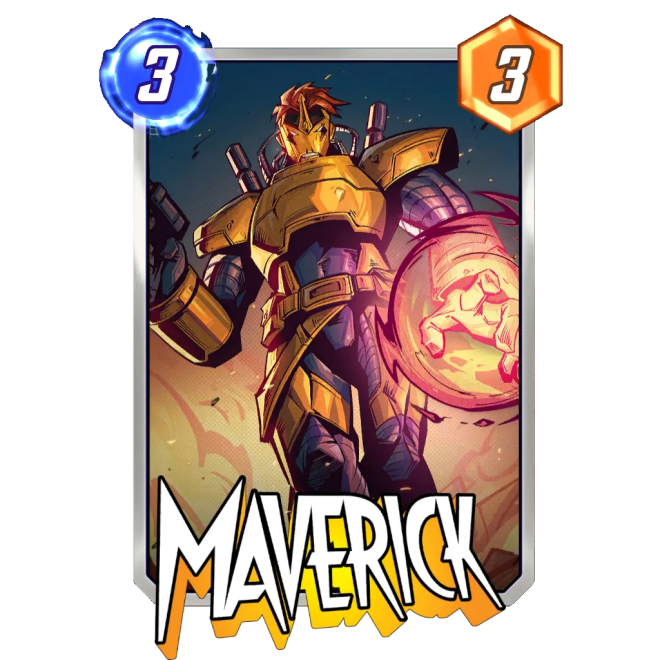
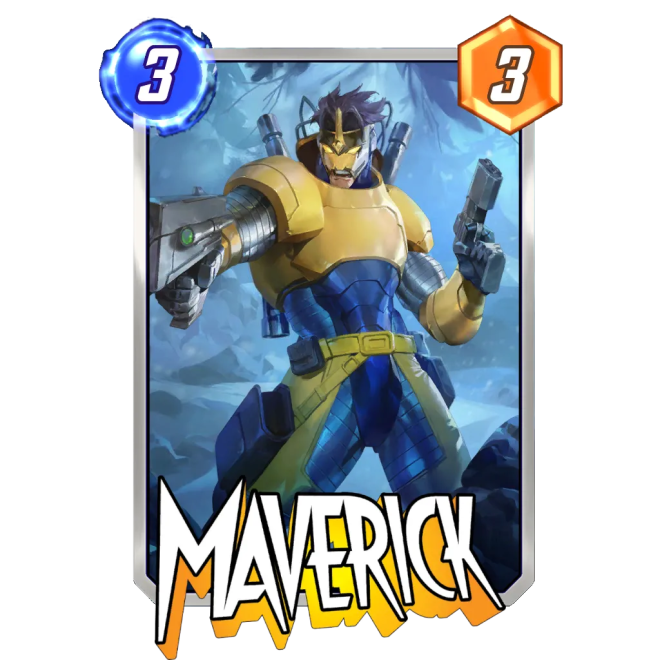
All of Maverick’s initial variants are basically riffs on his “main” look — the gold armor with silver highlights, maybe some weapons or tubes connected to it, and the iconic mask.
It’s probably for the best given his most notable alternate look, as Agent Zero, is basically a generic dude with a vest, cargo pants and a balaclava.
Form & Function
Not surprisingly, the Maverick card ability draws its inspiration more from the “expels energy” portion of the character’s power set than the “absorbs kinetic energy” part with which he started. It’s simply an easier ability to translate into game play.
And while there’s nothing inherently “amplifying” about it (ie he just shoots the energy at bad guys, he doesn’t use it to power up other characters) in the comics, “just blasts stuff” is a tough power to translate into the game (in part because it describes so many powers) so the amplification element at least helps Maverick fit into a niche within the game.
