
Reviewing ‘Hellboy And The B.P.R.D.: The Ghost Ships Of Labrador’ And Reflecting On Conversations with Guy Davis, Disability Representation, And The Monsters Who Made Me
by Anton Kromoff
Summary
Hellboy and the B.P.R.D.: The Ghost Ships of Labrador is a great maritime mystery that showcases why these stories continue to be the benchmark for storytelling on the paneled page.
Moreover, this particular story does more for disability representation in comics than I’ve seen in mainstream comics, a fact that continues to prove why the well-storied world of Hellboy and the B.P.R.D was, is, and will likely continue to be one of my favorite pieces of mythology that has been crafted in these modern times.
Overall
10/10Welcome to the table,
It’s story time. When I was in my early 20s, a friend and I used to travel up and down the East Coast. We hit comic conventions and pop culture shows, big and small, in some gonzo journalist fever dream existence. Looking back on it, we kind of’ resembled Fear and Loathing in Las Vegas meets Big Bang Theory with no laugh track, way less drugs, and oddly the same number of bats … if not more.
One of the coolest moments in that time of my life happened at Heroes Con. At a panel on Horror in Comics, the legendary Guy Davis and a fellow he was on stage with were taking questions from the audience.
I, in a sleep-deprived state and emboldened by the multitude of energy drinks rushing through my system, asked my first question ever at a panel. Normally, as someone who used a wheelchair because of my disability, I preferred to observe and not interact. I was taught for the majority of my youth that I was twisted and strange, and it was best I only be seen or heard when it was convenient for others … but this was the Guy Davis and B.P.R.D. was and still is one of my favorite books of all time.
My question was simple. I asked something along the lines of, “With Panya starting to become more mobile and making the use of a wheelchair to get around, would there be some visible signs of accommodations made to the B.P.R.D. headquarters to make it easier for her to get around?”
For those not dialed into the series, Panya is a mummy who was slowly coming back to life. The B.P.R.D. headquarters they were in at the time had doors that very much resembled the oval doors you would see on a ship or submarine, with no real easy way for someone who can’t step over the threshold to get from room to room.

The other fellow on the stage, an artist in a suit, said I was “what was wrong with comics,” and he was just there to “collect a check,” and readers needed to not care so much about things like that because he didn’t. That statement that hurt a bit, as I was a fan of his work and it was already a bit anxiety inducing actually speaking up in a crowd of that size.
Guy Davis did not scold the other man. He said softly and kindly while maintaining eye contact with me, “No, no, he makes an excellent point. Mike Mignola* and I have been talking about this…”
He went on to say that they were in the process of making some updates to the headquarters and some other things in the comic to reflect the characters as they evolved.
I was delighted that Davis took the time to even address the question, but I very much wanted to escape that room as soon as the panel was over. I felt awful having disrupted the other artist’s day and somehow earning his disdain. The panel wrapped up shortly after, and as I was trying to get out of there.
What came next is a core memory for me. As I attempted to leave the panel room, Davis called out to me. In that moment, I thought for sure he was going to quietly scold me as the other artist had. Instead, he grabbed a chair from the ordered rows set up in front of the stage and turned it to face me in my wheelchair. He sat down and produced a small notebook, and we proceeded to have an hour-long conversation about accessibility, representation, art, comics, folklore, and monsters.
He asked me to come to his table with him, a table that had a Jörmungandr-sized line waiting for his return. There he presented me with a stack of sketch books and a really cool Marquis shirt an ex-girlfriend stole years later.
I saw him a few times over the next handful of years. Even when he was with other people, titans of the industry or those who just wanted a moment of his time, he would call out and wave at me. I reached out to him earlier this year just to thank him for the kindness he showed me all those years ago and to check up on him, as I’m going to far fewer shows these days due to the very real dangers of the world we live in.
His work is now mostly focused on crafting the brilliant beasts we see in film rather than on the paneled page. I fully expected to hear nothing back or, at best, get some kind of “Mr. Davis is fine, thank you for inquiring” from an assistant.
What I received back was a very kind correspondence from Davis himself, telling me he was happy to hear what I had been working on and asking what I was doing with my life now. It was a powerfully heartwarming moment, one more provided by someone who has and will always be a hero of mine.
I tell you that story to tell you about a new Hellboy and B.P.R.D. moment, that very much reminded me of those days where I felt unrepresented and unseen in my own world, and how far we have come, even in these very dark times we are living in.

Hellboy and the B.P.R.D.: The Ghost Ships of Labrador was created by Mignola and Rob Williams with art by Laurence Campbell, colors by Lee Loughridge, and letters by our man Clem Robins. The series is a two-issue story that takes place in 1990 at Red Bay, Labrador, also known as Balea Baya, or “Whale Bay.”

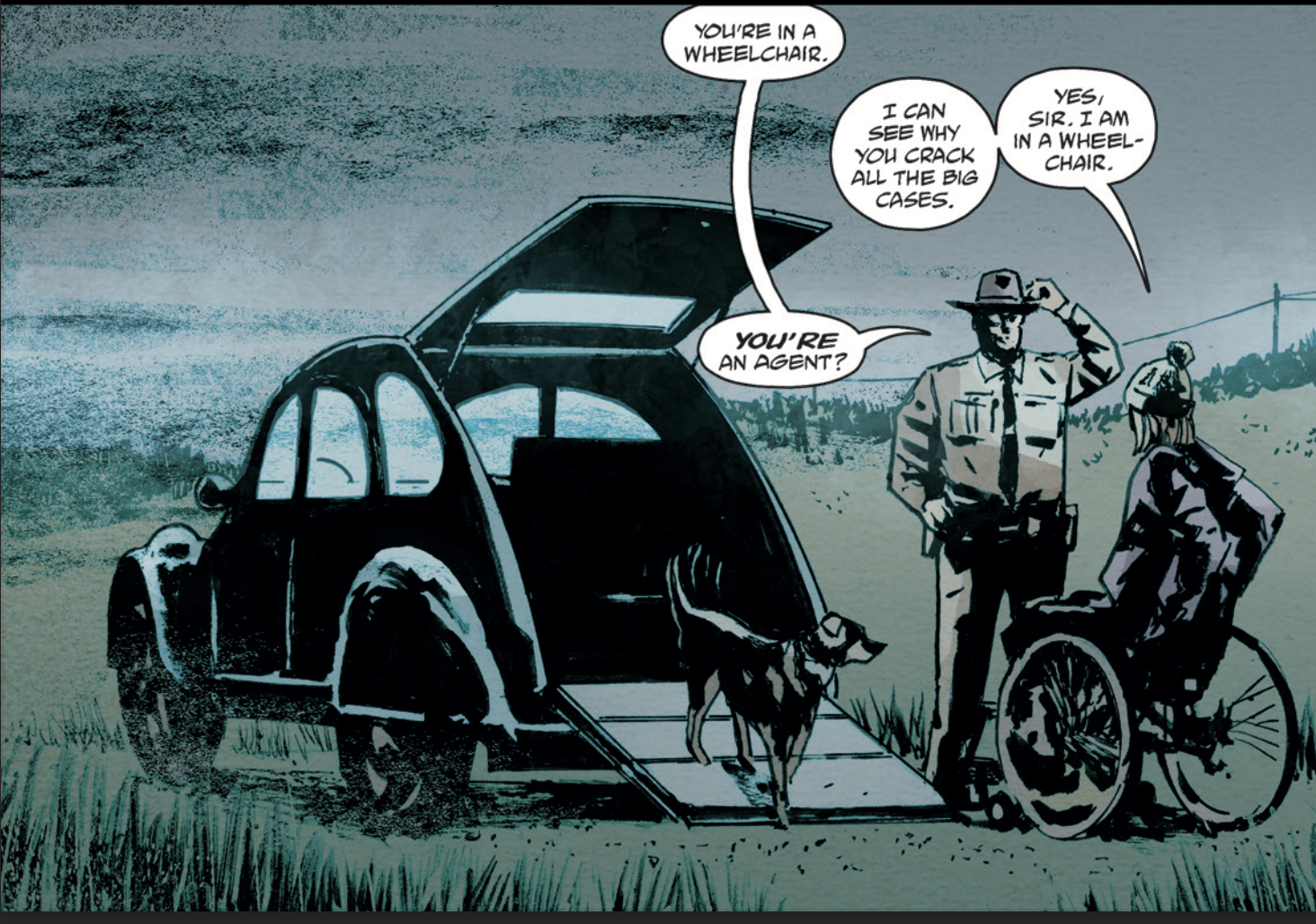
It’s a fun monster-of-the-week-style maritime story where ghostly sailors pull into port, scaring the locals and causing the B.P.R.D. to get involved. What is especially delightful is the arrival of Agatha, a wheelchair-using B.P.R.D. agent with a service dog, who arrives first on the scene to investigate the strange happenings at this isolated port town.

Agatha Blunt, sent alone, mind you, meaning she is more than capable of taking care of herself in paranormal situations, heads off into the mist in her chair to figure out what is going on. Not only does Agent Blunt have a modified car, but she is also an exorcist and bold as brass on a sea of black leather.
I’m here for this character because representation is so important, and when it comes to a book like B.P.R.D. that serves as one of the foundational works of my lifetime, both as inspiration creatively but also as a comfort when I needed to escape the darkness of the real world in a place where monsters, something I have been called due to my disability, can be heroes.

Agatha goes missing, and the local law enforcement uses her B.P.R.D. car phone to call for help. Abe and Hellboy show up, and even though they are there to help, we get a little glimpse that small-minded folk, regardless of how much folks try to help them, still judge books by covers.
The guys find Agatha in a pub called The Whalers Lament, where, once they dispatch of a few of the ghosts, or at least disrupt them, they find Agatha and her dog. Agatah tells them the ghosts are not here to menace, but to hide, as something far worse than they is out stalking the bay.
At this point, a strange toothsome ghost ship bursts through the wall, eating Hellboy and returning to sea, bringing issue one to a close.

I have written a number of books and worked on a number of projects in my life. When I tell you I would spend a good part of the rest of my days writing about the stories of Agent Agatha Blunt of the B.P.R.D. and her dog Elba, I need you to understand how serious I am.
Dark Horse, Curious Objects, if you are reading this, know that I know these stories, I know this world, and I would spin you such tales of horror and wonder with this brilliant character at the center that Mignola, Guy Davis, and Rob Williams would be proud.

How can you not respect and adore this character? They took The Oracle out of the chair and “fixed her” so she could hop rooftops again. Professor Xavier always needs to be saved. The Chief is a toxic jerk. Agatha is out here being an absolute champion in her own right and sitting alongside other members of the B.P.R.D. with the same level of intelligence and calm befitting a member of one of the most powerful and important organizations in the known world.
She’s not played for laughs. She is not played for heartstrings or pity. She is not played for anything other than what she is, a member of the Bureau. She is just as capable as the rest of the agents, and that all comes across in these pages in the best possible way.
I digress, back to the review. Issue #2 kicks off with half the pub missing and Hellboy attempting to escape the hold of the toothsome ship known as the Saint Juan, only to find that even leaping overboard results in his teleportation back to the belly of the ship and into the company of the cursed and worried spectral crew.
<<Spoilers Follow>>

Agatha and Abe are distressed to find that the ship is nowhere to be found, as it seems Hellboy is trapped along with the rest of the ghostly crew of the Saint Juan. Thanfuly Agatha is a skilled exorcist, and with the aid of a handful of spirits and a harpoon as a focus, she is able to channel her mind towards the Saint Juan, where Hellboy is shackled and in a bit of a stupor as the nameless ghost of the captain looms over him.

Elba’s barking drifts through Agatah’s mind as it connects to the space between spaces where Hellboy is being held and shakes our big red boy out of his stupor, allowing him to shatter the shackles holding him to the Saint Juan.
When Hellboy breaks free, the ship shatters, and then we get this wild double-page spread of ghost whales before the adventure wraps up. Agatah lets Abe and Hellboy know she has it covered in a very non-trope-filled way, and Hellboy is left sitting on a dock making a joke about swimming in a circle because one arm is bigger than the other.
Hellboy and the B.P.R.D.: The Ghost Ships of Labrador is a great maritime mystery that showcases why these stories continue to be the benchmark for storytelling on the paneled page.
Moreover, this particular story does more for disability representation in comics than I’ve seen in mainstream comics, a fact that continues to prove why the well-storied world of Hellboy and the B.P.R.D was, is, and will likely continue to be one of my favorite pieces of mythology that has been crafted in these modern times.
*Davis may have called him Mignola or Mike. I was disoriented and felt about as small as one could feel in that moment, as every eye in the room felt like it was now on me, so I couldn’t recall completely.
