
’28 Years Later: The Bone Temple’ Ups the Gore And The Lore
by Paul Ceruti

Until Deadline reported last December that the third-and-final installment had been greenlit, the fate of the 28 Years Later trilogy — that is, the latter three films in a five-part series kicked off by the original 28 Days Later — hung on the success of its would-be middle entry. 28 Years Later’s $150 million worldwide gross last summer confirmed there was still considerable interest in the long dormant, cumbersomely titled franchise. With part three underway, 28 Years Later: The Bone Temple will tell whether that interest can be sustained over two more films.
Far from post-apocalyptic London, 28 Years Later and its sequel transport us to northern England, where life for the surviving uninfected has reverted to a precarious but predictable state of hunter-gatherer communalism. The Bone Temple resumes the action on 12-year-old Spike, played once more by Alfie Williams, after he’s left the relative safety of home and fallen in with a lethal gang of hooligans all named Jimmy. Jack O’Connell, fresh off his lead villain role in Sinners, plays the head Jimmy with flamboyant, ultra-violent verve, our early clue as to who the real monster will almost certainly end up being.
O’Connell brings as much menace and pathos to his role here as he did in Sinners, a notable feat considering that his Bone Temple character is fairly one-dimensional on the page. Jimmy is magnetic and theatrical but little more than a mass murdering sadist, preying on infected and uninfected alike — all while costumed as the mega-cancelled British TV presenter Jimmy Saville. Far more than the next zombie ambush, the film’s biggest chills come from the extended torture scenes enacted by Sir Lord Jimmy and his followers.
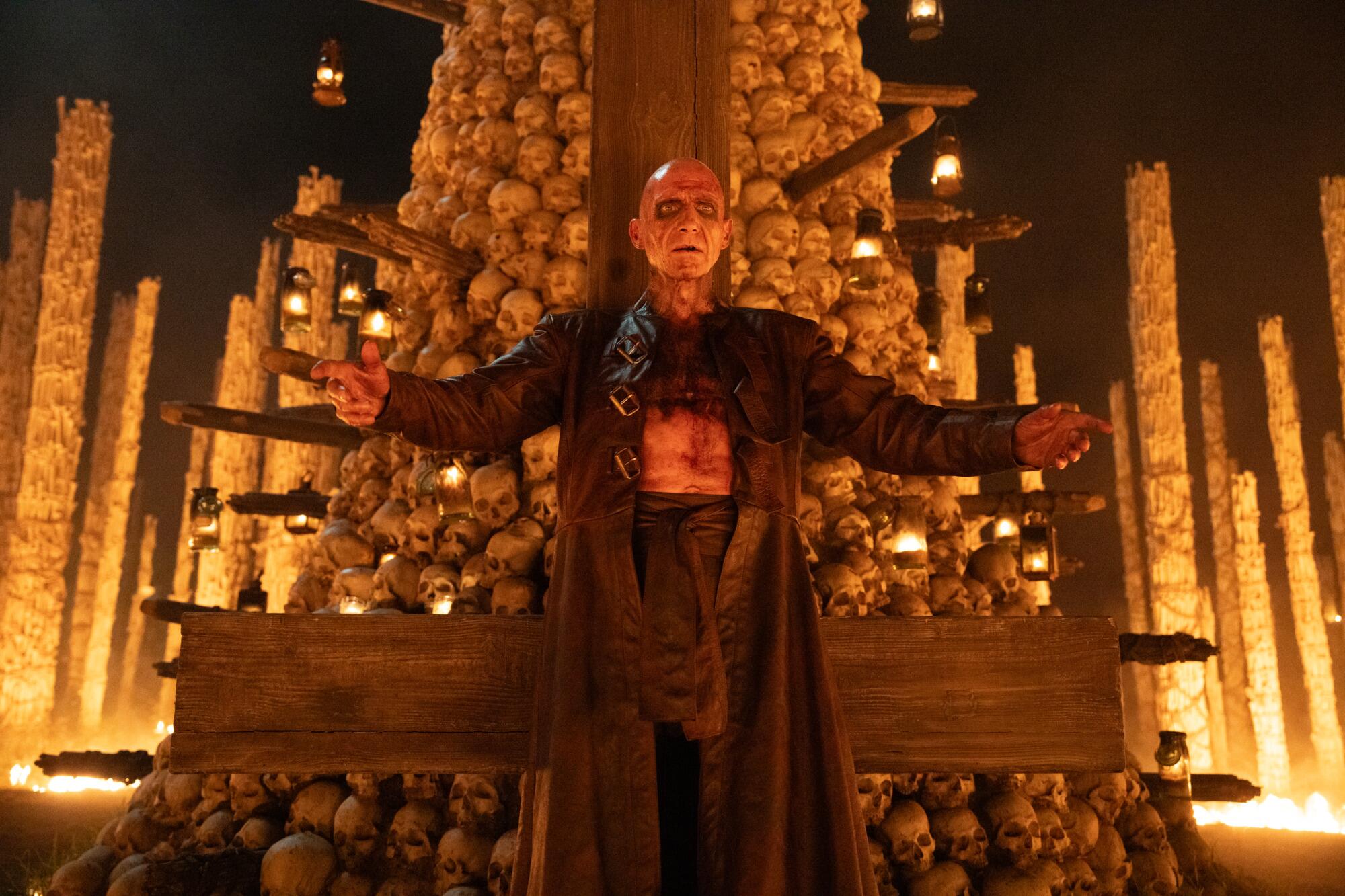
On the other side of things, Ralph Fiennes returns as Dr. Ian Kelson, general practitioner of medicine and mortuary services. Despite his freaky appearance, Kelson is our moral center. The gentle urbanity Fiennes applies to the role is a familiar mode for him — touches of Monsieur Gustave from The Grand Budapest Hotel and Cardinal Lawrence from Conclave — but it’s especially welcome here amid the bleakness of perma-pandemic Britain. Besides maintaining the titular Bone Temple, Kelson keeps busy researching ways to mitigate the effects of the rage virus. His test subject is a new breed of infected introduced in 28 Years Later: an “alpha” nicknamed Samson (Chi Lewis-Parry) whose unique relation to the virus grants him super strength in addition to unbridled psychotic rage. Kelson and Samson’s budding relationship hints at a way for the infected and uninfected of Great Britain to live peaceably at last, a likely direction for the final entry in the series.
One of the signature innovations 28 Days Later brought to the zombie genre was to ramp up the sluggish, moribund action to a full sprint. The running infected were made extra kinetic by director Danny Boyle’s handheld camera and frame rate flicker, a technique he pushed even further in 28 Years Later. Franchise newcomer Nia DaCosta — director of 2021’s Candyman sequel and last year’s acclaimed Hedda — takes a different approach to The Bone Temple. Stating that her first goal was to serve the script rather than recreate Boyle’s hyperactive style, her slowed-down process allows for carefully composed images of unflinching cruelty and strange beauty. The way she wraps the lens around key elements in the frame creates a visual language for the film’s mythic sense of itself, emphasizing the characters’ own blurred senses whether by derangement, disbelief, or judiciously portioned pharmaceuticals. Her direction over certain stretches of the film feels a little anonymous, but otherwise, DaCosta does a more than adequate job taking the reins from Boyle.
If there’s an overarching vision for The Bone Temple and the 28 Days Later franchise at large though, it belongs to screenwriter Alex Garland. His reputation as a torchbearer for cerebral sci-fi began with 28 Days Later, a horror thriller doubling as cultural commentary about all the latent rage in post-industrial society. With 28 Years Later, he refined that statement by tying in new ideas about male rites of passage, England’s post-Brexit identity, its mythologized martial tradition, and most poignantly, the uses of public monuments to the fallen. The Bone Temple has plenty of its own ideas, but the focus is less on our own world and more about expanding the lore of the film series itself. After Days, Weeks, and Years, the only story worth telling is how it all wraps up. Be there for the next one, but as for The Bone Temple, it’s ultimately just a side quest.
28 Years Later: The Bone Temple is now in theaters.

