Extra, Extra!: ‘His Girl Friday’ Reviewed
by Rachel Bellwoar
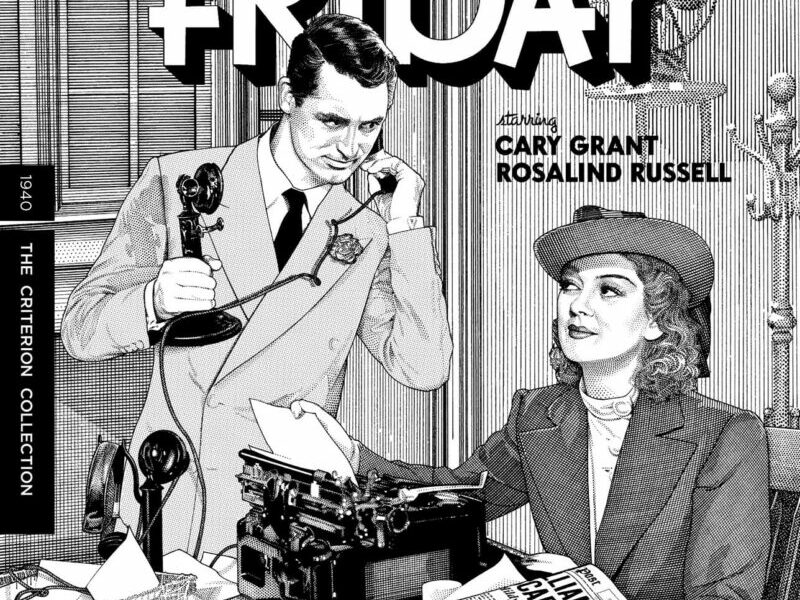
Nothing could’ve seemed cooler than Rosalind Russell the first time I saw Howard Hawks’ His Girl Friday. The flashy hats. The bold combining of stripes that probably instigated my love of pinstripes. Before Gilmore Girls, His Girl Friday was my first time experiencing quick patter dialogue. Hearing people speak at a normal clip would forever pale in comparison.

As much as I had been looking forward to revisiting His Girl Friday thanks to Criterion, different aspects of the movie stuck out this time around. The film follows Hildy (Russell) as she tries to quit her job as a newspaper reporter so she can marry her fiancé, Bruce (Robert Bellamy). The problem is her boss is also her ex-husband, Walter (Cary Grant), and he has no intention of letting her go without a fight. The big story they’re reporting on is the pending execution of Earl Williams (Out of the Fog‘s John Qualen), who killed a Black cop (while the film adds this racial dimension, it barely touches on it). When Williams escapes from prison, Hildy has to decide once and for all what she wants to do with her life.
His Girl Friday is the second film adaptation of Ben Hecht and Charles MacArthur‘s groundbreaking play The Front Page (more on the first film adaptation later), and famously saw Hawks gender-flip the role of Hildy from a man to a woman. On the one hand, the change works seamlessly. The role doesn’t feel massively rewritten, and professionally, the other reporters treat Hildy like one of the guys. The fact that she’s a woman isn’t remarked on at all.
The problem comes in changing Hildy’s boss into her love interest. Instead of becoming a film about whether Hildy has to give up her job to become a wife, Walter becomes tangled up in the decision. It’s never just about her career. Somehow choosing to be a reporter means also choosing to get back together with her ex. The two decisions shouldn’t be connected, yet the film treats them as inseparable, and this time around, that wasn’t as charming to watch or easy to gloss over.
If the first time I watched His Girl Friday I was swept up by the fast-talking characters, this time around it was the slower, quieter characters who made the bigger impression. The contrast between Walter and Bruce isn’t necessarily meant to be flattering. Bruce’s inability to keep up with the clever retorts is used against him. At the very least he’s meant to be less exciting, yet whether or not he’s the right guy for Hildy (and arguably he’s not) he’s not the forgettable placeholder I (didn’t) remember him being either (and that’s the truth — I didn’t remember Bellamy’s character at all going into this rewatch).
The biggest problem I had with the film this time around, though, is with how the film treats Mollie Molloy (Helen Mack), a suspected accomplice of Williams’. For a film which (as critic Farran Smith Nehme writes about in her foldout essay) inspired so many to go into journalism it doesn’t paint the kindest picture of the profession, and is there corruption in journalism? Absolutely (though I do wonder why movies are always so willing to call out reporters while being more forgiving of other professions like the police), but the lack of concern shown towards Molloy and the way the film moves on is really cold and could’ve been handled differently, and — indeed — is handled differently in the first film adaptation of The Front Page directed by Lewis Milestone.
That’s the best part about Criterion’s Blu-ray – it includes Milestone’s The Front Page and while his version doesn’t have the energy or under-a-deadline tension of Hawks’ His Girl Friday, it does have some human touches which I found preferable. Namely [and beware: SPOILERS] the scene where Molly jumps out a window reads very differently in Milestone’s film versus Hawks’. First of all, Molly doesn’t jump out the window in Milestone’s version — she falls by accident. The way the reporters react, though, makes the biggest difference in the world. In Hawks’ film it’s like it never happened. You can almost get to the end of the movie and be like oh yeah — how could I have forgotten a woman tried to commit suicide. While the reason this is allowed is that the film implies immediately after the fact that Molly somehow survived the fall, there’s no follow-up scene to confirm she’s alive. In Milestone’s version, on the other hand, while the reporters aren’t completely portrayed as night and day different, there is one scene where they are shown checking on her condition and it matters. Life doesn’t completely stop for them and there’s no promise that they’ll treat women better in the future, but at least they care and aren’t completely heartless and jaded.
My favorite bonus features on Criterion’s release are for The Front Page as well. Specifically, this film has a fascinating restoration history that writer Michael Sragow touches on in his foldout essay, and which gets covered in more detail in the twenty-four minute program “Restoring The Front Page.” This goes beyond just comparing the old footage with the new restoration. There’s a lot more to it, including the fact that there were different prints of His Girl Friday made with different cuts of scenes for the domestic and international markets, and the print the Library of Congress turned out to be different from the one they discovered in producer Howard Hughes’ archive. Hecht expert David Brendl‘s program on the writer and ex-reporter is excellent as well.
His Girl Friday is available on 4K/Blu-ray, standalone Blu-ray and DVD from Criterion. Since The Front Page is considered a bonus feature, it’s on a separate Blu-ray (or DVD) disc that’s included.