
Characterization In The Buffyverse — ‘Buffy The Vampire Slayer’ Season 5, Episode 16
by Benjamin Hall
This is part of a bi-weekly series concerning the characterization of Buffyverse characters. Arguably the best place to begin reading this series is at the beginning, but that is up to each reader. As a reminder this column will cover major and some minor characters from the shows Buffy The Vampire Slayer (1997-2003) and Angel (1999-2004). Other Buffyverse media, such as the graphic novel Spike: Into The Light (2014) are not pertinent to this series. Also there will be no referencing real world events that have direct relation to either show in this bi-weekly series. Although this series does reference things that have no direct relation to the show in order to examine things such as metaphors and literary analogues.

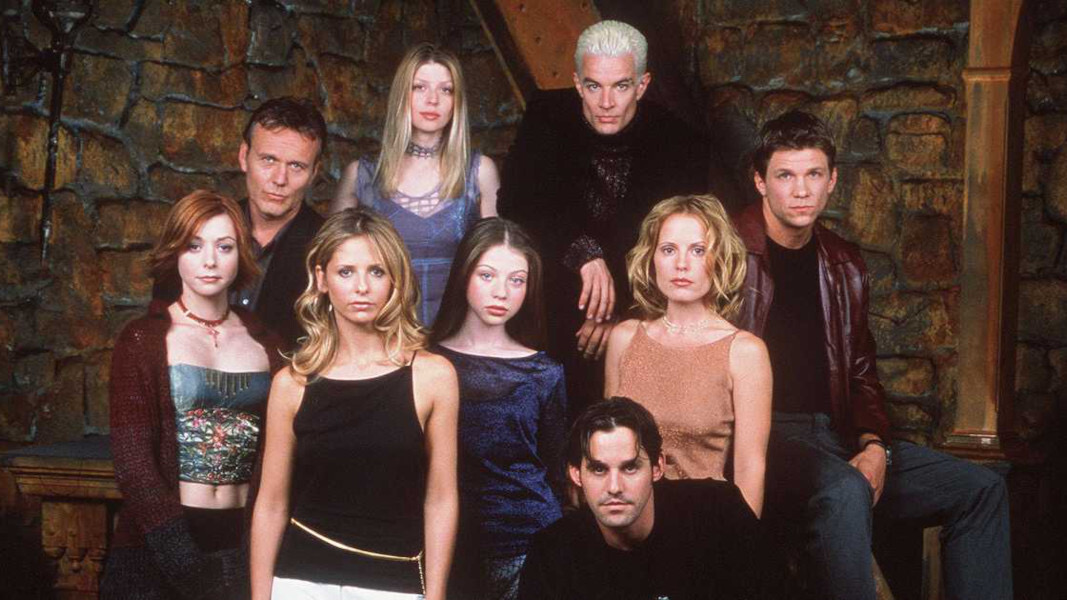
This week: Buffy Summers (Sarah Michelle Gellar) deals with a personal matter involving her mother, Joyce Summers (Kristine Sutherland). Also, a vampire (John Michael Herndon) attacks a place of the dead.
(Warning of spoilers from this point on!)
(Trigger warning for talk of mental and emotional manipulation)
It is unclear whether the group dinner scene is a memory or a fantasy. If it the former, then it probably is Buffy’s own. However, it could somehow be Joyce’s last one — seeing as her face is the one viewers see after it plays out. In the case of it being Buffy’s fantasy, then it is foreshadowing her upcoming mental breakdown (Season 5, Episode 21, “The Weight of the World”). Since there is no in-universe explanation for this scene, it comes across as ambiguous which is why the characterization in it is left out of this analysis.
Buffy starts out emotionally fine despite exhibiting some hints of sadness from a recent battle (Season 5, Episode 15, “I Was Made to Love You”). Upon finding Joyce’s body, Buffy reacts through a good portion of the episode with shock and grief. Thus, some of her actions — such as fixing her mother’s skirt — while illogical become logical because of these feelings. When dealing with her friends and family learning about Joyce’s passing, she acts rather stoic. And while these are believable things to do when facing someone dying, her reliance on stoicism is probably not healthy.
Dawn Summers (Michelle Trachtenberg) deals with teenage social drama in a realistic way. For the most part, she appears to be managing the gossip about her relatively well from both mental and emotional standpoints. Then, upon learning of her mother’s death, she has a justifiable breakdown in a public setting. However, when she and the others are at the hospital, she acts unusual by tracking down her mother’s corpse. This moment — like the overly-long struggle Buffy has with the vampire — occurs in a way that seems to be “running out time” in the episode while emotionally messing with the viewers.
Rupert Giles (Anthony Stewart Head) acts paternal to Buffy upon realizing the state she is in after she informs him that Joyce is a body. The fact that Buffy has to tell him suggests whatever feelings he has for Joyce are stopping him from immediately realizing and accepting what his eyes are telling him.
Xander Harris (Nicholas Brendon) exists in this episode to raise the question of “is anyone at fault?” for the death. He also represents the anger portion of the process of grief, plus the urge to want something to defeat when one is feeling helpless.
Anya’s (Emma Caulfield Ford) past experience as a demon with a very long life is at play here, but her reactions to the death of Joyce arguably makes it appear like she is possibly on the Autism Spectrum. An example of this: her questioning what to do in terms of social etiquette when it comes to death.
Tara (Amber Benson) displays grief over Joyce’s passing and commiseration for Buffy and Dawn. This comes in the form of a story about her own mother that debatably makes Tara’s origins as a witch more contradictory because of the previous stories (Season 4, Episode 13, “The I in Team” and Season 5, Episode 6, “Family”).
Willow Rosenberg (Alyson Hannigan) exhibits grief in a similar fashion to her friends. But in her case, it mostly presents through indecisiveness since she grieves not just the missing connection, but the lack of a sense of order from the loss.
Joyce is literally and figuratively a plot device in this episode. The most one can say is that her existence within the episode is to confirm her death and assist in the manipulation of the audience.
Kevin Berman (J. Evan Bonifant), Kirstie (Kelli Garner), the art teacher (Tia Matza), Lisa (Rae’Ven Larrymore Kelly), the 911 operator (Loanne Bishop), Harris the first paramedic (Stefan Umstead), Wick the Second paramedic (Kevin Crisalton), and the vampire are all generic stock characters. Although, Kevin and Lisa exhibit some more personality than the others.
Dr. Aaron Kriegel (Randy Thompson) makes his final appearance. Yet, all he exposits is the idea that Joyce just died from a random medical occurrence with her having prior awareness of it being a possibility.
The entirety of this episode lacks music, seemingly to make the character moments seem more realistic. Thus, the impact of each character’s emotional reaction to Joyce’s death probably hits harder for a lot of viewers. By doing this, the characterization arguably manipulates the majority of the audience emotionally and mentally. It probably causes certain traumatic memories to crop up in the minds of certain viewers. So while Buffy and the Scoobies are acting in believable and logical ways, the chemical responses in the brain are allowing viewers to overly relate to the characters. Therefore, this writer argues that, despite the episode deviating from the series’s premise, there are good character moments — but this is only because there is some subtle gaslighting.