
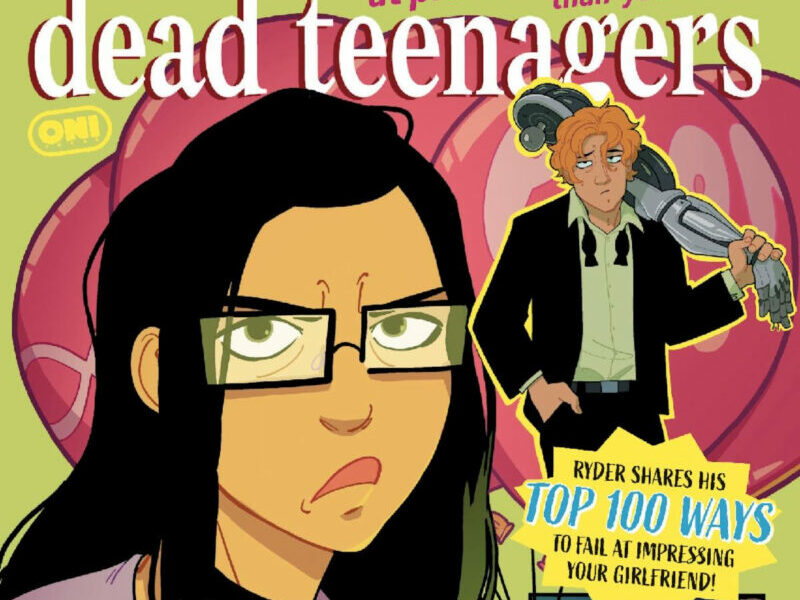
Talking ‘Dead Teenagers’ With Jude Ellison S. Doyle And Caitlin Yarsky
by Rachel Bellwoar
Prom is always scary but it’s not supposed to be deadly. Then again, it’s not supposed to happen over and over again, either, but that’s exactly the time loop nightmare Alicia Torres and her friends keep experiencing in writer Jude Ellison S. Doyle and artist Caitlin Yarsky‘s new series, Dead Teenagers. For more on what’s knocking these teenagers off, check out this interview with Doyle and Yarsky below:

Rachel Bellwoar: Dead Teenagers is set in the 1990s. As someone who still finds it strange to think of the ’90s as the distant past, what’s been your favorite part about revisiting that decade?
Jude Ellison S. Doyle: I really love ‘90s horror camp — not the good slashers, like Scream, but the sub-sub-sub Scream stuff. There’s been a huge revival of obscure ‘90s and ‘80s B-movies thanks to free streaming platforms like Tubi. So you can now watch Brainscan, which is about Edward Furlong accidentally summoning a demon with his super-advanced CD-Rom computer game, or Class of 1999, where a bunch of punk teenagers get mowed down by killer robot teachers played (in one instance) by Pam Grier. I wound up watching a ton of those just to get the look and feel of the decade, and I love them all.
I am also not-so-quietly obsessed with ‘90s fashion, especially the parts most people would rather forget. Brandy is our token Popular Girl character, and she’s a clothes horse, so I was able to find some bonkers outfits to recommend for her. According to teen media from the time, it was absolutely normal to wear, like, a knit bikini top and neon-green bell bottoms to science class, and I felt obligated to honor that truth through Brandy’s choices.
Caitlin Yarsky: It was a fun, nostalgic time for me, researching fashion and the “vibe” of that era. I was a kid in the ’90s and remember it well — it brought up memories of Delias catalogues, The Nature Company, wild haircuts and a time without phones (and the internet wasn’t so ubiquitous or entrenched in our lives). It was nice to reminisce.
Bellwoar: The late ’90s specifically is when TV shows like Buffy and Charmed first premiered. Do you think teen dramas like those (and even Beverly Hills, 90210), which continue to have large fanbases, have created this pop culture association between the ’90s and high school (the same could be said of ’90s movies like Clueless and Scream)?
Doyle: Teen Culture really came into its own in the ‘90s — it was big in the ‘80s, too, with The Breakfast Club and Fast Times at Ridgemont High, but by the late ‘90s, teen girls in particular were becoming this massive commercial force. They made the Spice Girls and Britney and the Backstreet Boys happen. They made Titanic the most successful movie of all time. Young adult fiction kind of took off in that decade, thanks to a wizard book I absolutely will not name. I remember that by 2003, there were these huge features in Vanity Fair or Rolling Stone about the emerging Power of the Teen.
So it really was a very youth-culture-centric moment in history, and I’m glad for that, because the truth is that this is just when I was a teenager and consuming the most teen entertainment. Like, Clueless and Scream might be classics now, but they were also just movies that I watched 50 times apiece because I was bored and only had a limited number of movies to watch on VHS, so they’re engraved into my brain as examples of how a script or a story works. Generation X, the teen X-Men comic, along with Buffy, taught me to write group dynamics. 10 Things I Hate About You is another touchstone — my freshman-year roommate, in college, watched that movie every single afternoon for an entire semester, and I honestly never got sick of it. When I wrote this, I was drawing as much from teen rom-coms and superhero comics as I was from horror, and I think it shows.
Yarsky: Absolutely – the ’90s had such an iconic look to it, a playfulness that reflects some of the joy and chaos of growing up. A time when people were in less of a hurry to look and act like adults. Buffy was a huge part of that for me, and for most of my friends. For the last few years I was listening to a podcast called Buffering the Vampire Slayer, and it was a huge hit — the next generation is discovering these shows and it adds to the romanticization of that era.

Bellwoar: Time loops tend to inspire strong opinions. Were you a fan of that device before working on this series and what made you want to wrestle with your own time loop?
Doyle: I’m just a fan of non-linear storytelling in general. All my scripts have jumped around in time a lot, and “time loop” just seemed like a way to take that to extremes. I think a lot of people felt caught in stasis when they were adolescents, and you might as well make that literal — every day is different, but nothing you do matters, so every day is the same.
Bellwoar: The repetitiveness of time loops means generating and using up scenarios fast. Has that been exhilarating or difficult to get used to?
Doyle: I for one love the speediness of time loops. You have to tell each loop’s story very fast, sometimes just in a single panel, sometimes just in a page, and that means you can ramp up in bizarre and ludicrous ways that you could never get away with in a long story. It’s very easy for me, as a writer, to just jump into the most eventful portion of a story and jump back out again without doing any of the work of explaining how or why it happened. What I figured out, though, is that you actually do have to stay in some scenarios for an extended period of time if you want the plot to make sense. Plot is consequences, and you have to stay in one reality for a while if you want to accrue consequences. So as we move forward, it’s a mix of longer loops and shorter ones, with the shorter ones being like a little vacation into the land of consequence-free silliness.

Bellwoar: How was it assembling your cast of teenagers for this series?
Doyle: Slashers and teen comedies both work in archetypes, and there have been so, so, so many attempts to “deconstruct” those archetypes for slashers, in particular. But they do work. So I started with archetypes and tried to build them out in unexpected ways: Who’s the nerdy girl who gets a glow-up? Who’s the hunky, alternative-rock Jordan Catalano guy? If this is Mean Girls, who’s Amanda Seyfried, and if it’s Black Christmas, who’s the girl who’s always drunk, and can I make them the same person? I wanted to start with stereotypes and slowly uncover the complications and humanity inside them, until you realize that even the characters who look perfect and happy are fairly screwed-up. Being a teenager is miserable for everybody, even if you can make it look good in a picture.
Bellwoar: The solicitation text says five friends but there are only four on the cover. I know this is probably one of those questions you can’t answer, but how long does it usually take people to realize this (because it was only after reading the first issue that I realized how cleverly you were playing this up)?
Doyle: This is hard to talk about without spoiling things, but I will say that by the time we meet these characters in issue #1, their roles have hardened into stereotypes. There’s the person who always dies first. There’s the person who always dies worst. There’s the person who always dies heroically, and the person who always dies hiding, and the Final Girl. That’s kind of about slashers — how the characters always slot into neat little stereotypes within a pre-set formula — and it’s also kind of about high school, how everyone has their little box and their social niche and they’re not really allowed to step outside of it. But by issue #2, the time loop has been knocked out of whack, and we’ll see that people aren’t always playing the exact same role every time. People will become visible in new ways, and vulnerable in new ways. Who you were in high school is not who you will always be, and these characters are learning that they have the capacity to change.

Bellwoar: The title, Dead Teenagers, is provocative by nature. Why did you want to choose such a strong and direct title?
Doyle: “Dead Teenager Movies” was Roger Ebert’s term for slasher movies — he viewed them as repetitive, generic stories in which non-characters get mowed down by big men in masks over and over and over. The phrase is jolting: In real life, a dead teenager is a tragedy, not entertainment. It’s a life that’s over before it had a chance to start. I wanted readers to think about how disposable the young people — usually young women — in these stories always are, and hopefully to put the focus on the characters as people: Who are the dead teenagers? What do they want out of life? Who would they grow up to be, if they weren’t constantly getting murdered mid-sex by Jason Voorhees? Everyone has a story, and no-one is disposable. Not even teens who are hunted by robot teachers played by Pam Grier.

Bellwoar: Thanks for agreeing to this interview, Jude and Caitlin!
With lettering by Becca Carey, Dead Teenagers #1 goes on sale March 18th from Oni Press. The FOC date is February 23rd.

