
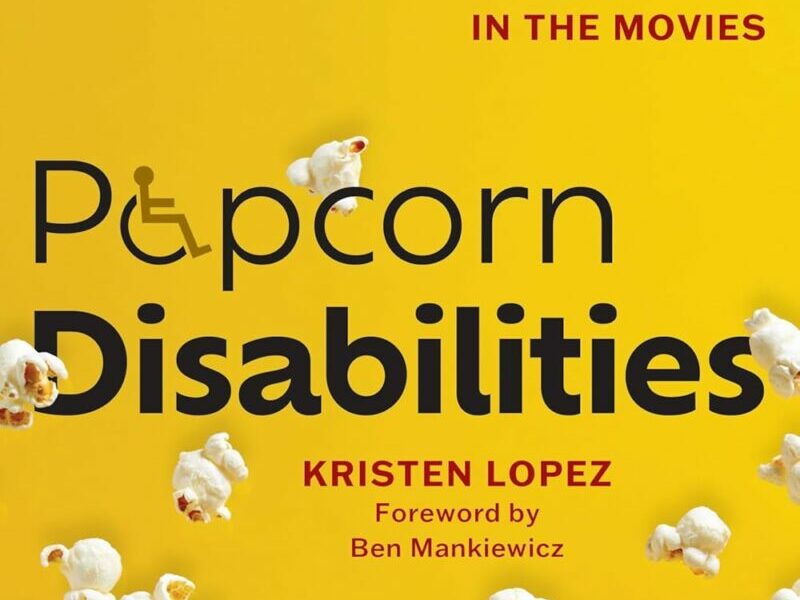
An Interview With ‘Popcorn Disabilities’ Author Kristen Lopez
by Rachel Bellwoar
Movies still have a long way to go when it comes to representation of all kinds. For her latest book, journalist Kristen Lopez is focusing on disabled representation — what movies have done right and what movies could do a whole lot better. So grab your snacks. Settle in. Our discussion of Lopez’s Popcorn Disabilities is about to start:

Rachel Bellwoar: Your first book, But Have You Read The Book?, focused on the books behind literary film adaptations like Mildred Pierce and Valley of the Dolls. How did you decide on the subject for your second book?
Kristen Lopez: I was looking for a second book idea to keep the momentum going. I’d pitched a few ideas that had been passed over and around this time, I was starting a day job and wanted to do something that wouldn’t require 24/7 of research. I had been writing about disability in the movies for years and figured now might be a great time to gather all that knowledge I’d amassed over my years as a journalist and put it into one tome.
Bellwoar: “Popcorn movie” sometimes bring to mind the idea that the first job of movies is to entertain. Does that put movies about disabled characters at an immediate disadvantage, as they’re often put under added pressure to represent and educate as well as entertain?
Lopez: It’s more that there’s a belief that there’s nothing inherently entertaining about disabled lives, or that what makes them entertaining must be the sensationalized or the stereotypical. Part of why I named it “Popcorn Disabilities” was to emphasize that movies sell a belief that people take as fact. Though movies are meant to entertain, they are taking elements of reality and presenting them onscreen, and audiences too often take what they see about disability and believe it’s more fact than fiction.
Bellwoar: With your first book, the subtitle “52 Literary Gems That Inspired Our Favorite Films” provided a framework for how that book would be organized. What was it like coming up with chapters for Popcorn Disabilities?
Lopez: It was tough because the first book had so much immediately established: the books, the movies, the format. Here, I was responsible for everything, from the movies I wanted to feature to the angles and story I wanted to weave. I had to be cognizant of so many different stereotypes in movies, disabilities, and ways to weave in research and other voices. I say in the intro that the book isn’t comprehensive, from both a cinematic or disabled standpoint, because I knew I could only tell so much.
Bellwoar: One of the things you look at is how certain genres, like horror, have been more open to telling disabled stories. Is there a type of film or genre you haven’t seen disabled stories told in yet that you’d love to see in the future, or a story you’d love to see get told (I love the point you make, for instance, that we only know Helen Keller as a child from The Miracle Worker but where are the films about her life as an adult)?
Lopez: I was recently on the Vulgar History podcast talking about a disabled icon named Sarah Biffen and I do think we need far more biopics about disabled women and disabled people of color. I’d also love to see more disabled musicals just because I love musicals.
Bellwoar: Sign of the Ram is a film I discovered thanks to Tubi, though without the context of knowing actress Susan Peters’ real story. I also enjoyed reading your thoughts on Coming Home, a film that’s available on Blu-ray from Kino Lorber but all of the bonus features are with the cast and crew. I don’t know if you’re a physical media collector but I really enjoyed your interview with the Disc-Connected. Is there a film that either you cover in this book or that you think is a great unsung example of disabled representation that you’d love to work on a supplemental feature for someday?
Lopez: I’m a big physical media collector and I do think the few movies about disability, positive or negative, should have more disabled voices on their bonus material. I’d personally love to see Sign of the Ram get a proper release (and happy to contribute to it if it ever happens) just so more people can learn about Susan. I talk about Lon Chaney Sr. a lot in the book and would love to contribute to any of his films. I was fortunate that an episode of my podcast, Ticklish Biz, was included as part of Criterion’s Tod Browning release a few years ago.
Bellwoar: In the intro to Popcorn Disabilities you write about how you avoided watching Unbreakable for a long time because of how many people would suggest it to you. It reminded me of my own reluctance to watch The Good Doctor (a TV show I still haven’t seen) because of how many people would bring it up when I mentioned my brother had autism and the expectation it created that my brother should be a savant because those are the autistic stories people know. Is there a disabled film that makes you see red or that you have trouble naming any redeeming qualities for?
Lopez: [laughs] I get asked a lot what the “worst disabled movie” is and I usually say, “Most of them.” I think the two I always end up going on long rants about are Me Before You and Million Dollar Baby. Both make me angry in different ways but both just revel in the “beautiful tragedy” of their respective stories while situating things as how an abled person benefits – personally, emotionally and financially – from a disabled person’s demise.
Bellwoar: Thanks for agreeing to this interview, Kristen!
Popcorn Disabilities: The Highs and Lows of Disabled Representation in the Movies is on sale now from Bloomsbury.
