
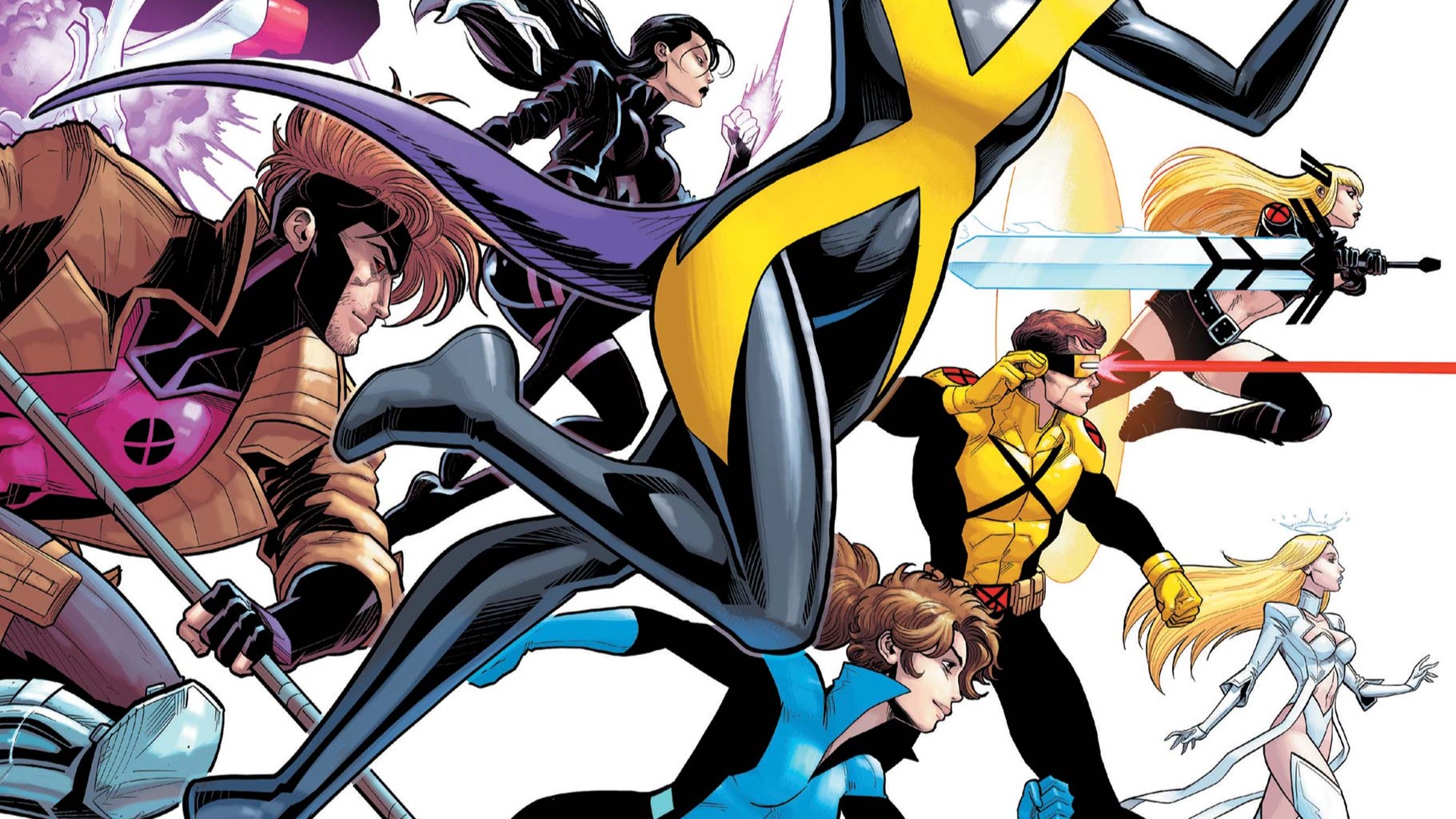
Previously On X-Men: ‘X-Men United’ #1 Poorly Executes A Strong Premise
by Austin Gorton
The big launch this week is X-Men United, which has been positioned as a flagship book for the line. It’s…not great, but there is at least one solid X-book out this week!
Logan: Black, White & Blood #3

By Karla Pacheco, Pere Pérez, Marc Bernardin, Jan Bazaldua, Daniel Picciotto & Phil Noto.
Logan gets revenge for a friend in the Dust Bowl, prevents a white supremacist bombing in New York, and saves the daughter of an old buddy from a dangerous drug trial in 1980s San Francisco.
- Wolverine blowing up a cow with the sound effect “Cowboom” might be the best thing I read in a comic this week.
- The third story being set in 1982 — ie the year the Claremont/Miller Wolverine miniseries was published — yet taking place in Logan’s pre-Wolverine history is a stark reminder of the sliding timeline and how it can open up new time periods in certain characters’ backstories.
Artwise, my favorite of these three is probably the first, and story-wise, it’s the third, which tries to do a little more than just have Wolverine righteously kill people. That said, all three of these stories involve the “important friend from Wolverine’s past we’ve never heard of before”, which is one of my least favorite Wolverine story tropes, so I’m not super enthusiastic about any of these.
Magik & Colossus #2 – Book of the Week
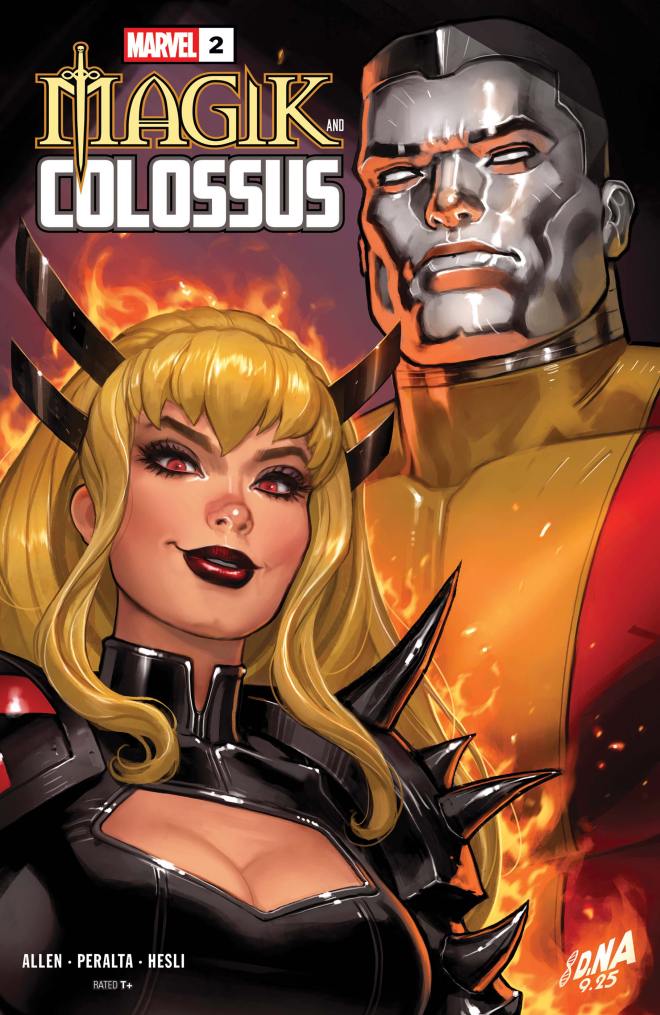
By Ashley Allen & Germán Peralta
Magik and Colossus continue to fight their way through Russian folklore — and each other.
- The page when Illyana and Colossus are on the train and Peralta draws seven nearly identical panels where the only thing that changes is Illyana and the tracking spell is a fantastic bit of visual storytelling.

- Colossus spent a good chunk of the Krakoa Era X-Force series under the control of his older brother Mikhail, while Illyana’s upbring as a ward of Belasco was depicted in the ’80s era Storm & Magik miniseries; I like the way Allen draws an explicit parallel between them here, something I hadn’t considered before.
- As can be derived from the context, rusalkas are basically evil Russian mermaids. The Banni is a bathhouse spirit that is generally depicted as he is here, though in some accounts is a shapeshifter.
- Illyana wields her second sword, the Wraithsword, which she acquired from a group of rebellious demons in issue #6 of her previous series.
The “fighting tour through Russian folklore” serves as an effective vehicle for what continues to be a complex character study of Illyana and Colossus’ relationship. Allen finds a way to write Colossus that makes him sympathetic without letting him off the hook for years (decades?) of bad decision making while finding new ways to contextualize the siblings’ views of each other.
Storm: Earth’s Mightiest Mutant #2
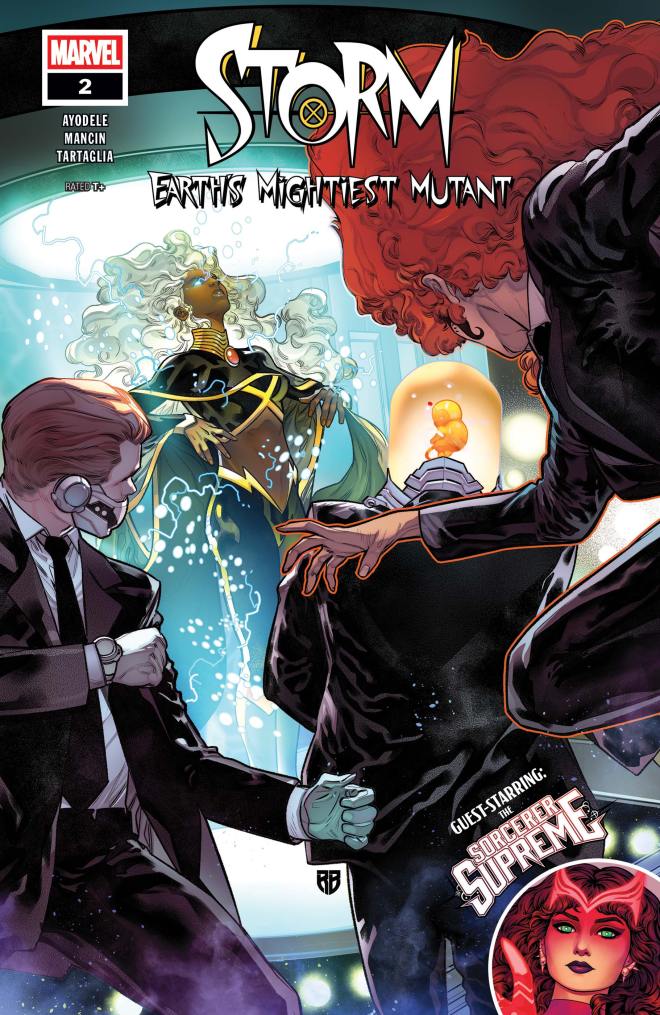
By Murewa Ayodele & Federica Mancin
Storm trains with Scarlet Witch while Akujin furthers her efforts towards an invasion of Earth.
- This issue has two recaps, a first page one citing specific earlier issues of the series, then the traditional one with the credits a few pages later.
- I have no idea why Storm’s inner monologue in the opening pages is lettered white on black text.
- The Mandos are a deeply obscure alien race which appeared in Warlock (vol. 1) #15.
- The “Doctor Strange was shot by a gun” bit is presumably a reference to the Dr. Strange: The Oath miniseries (though that gun was the gun which killed Hitler, so not exactly a normal gun).
- Doctor Strange defeated the Sun God which battled Hulk in New Avengers (vol. 3) #21
- The War of the Seven Spheres was first mentioned in Strange’s early ’90s book; it later was revealed to have spawned General Strange in Jed MacKay‘s Doctor Strange
- Doctor Doom does indeed have a soft spot for Storm, as first established in Uncanny X-Men #145-147.
- Storm saying she’s never gone solo before is a strange line; she’s had several literal solo series before this in which she took on threats by herself, away from the X-Men.
- She first took over as leader of the X-Men from Cyclops circa X-Men #138.
- The FBI killed Maggott and injured Manifold in Storm #10.
- FBI agent Fabiyi is reading something called “Cosmic Leviathan”
- The person floating in the tank is Galacta, Daughter of Galactus, from Marvel Rivals and Marvel Snap. Presumably, the idea here is that she was born of the goo harvested from Galactus per the recap page, and the “daughter” part is more symbolic than literal.
- Akujima and her sisters, Iwin and Bogey, are trying to find a way to bring their army to Earth to fight Storm, though Akujima was on Earth last issue, attacking Biarritz, so I’m not sure what the issue here is. This is the first appearance of both Iwin and Bogey.
- I have no idea what aside from vibranium Hera would want from Wakanda.
- Dimension Blood is home to a race of vampire-like creatures from Doctor Strange (vol. 4) #384.
- The Screaming Labyrinths haven’t appeared before, but were mentioned previously in Doctor Strange (vol. 6) #5
- Both Saucier and Armor appear in the Storm Sanctuary, helping Storm help the Birarritz refugees.
- The Iceman looking mutant who doesn’t like humans is, I believe, a new character.
- The idea of being able to make a Doctor Strange wraith because he’s someone who has died multiple times but never made it to Death’s realm is fun.
A surprisingly linear issue for this series/writer, albeit one which lays bare just how much this depiction of Storm is just doing its own thing and is not terribly consistent with the character’s previous depictions (outside of the core idea of the conflict being Storm refusing to kill a defeated foe and risking all instead, which Storm largely brushes aside here). The cosmic sprawl of it remains appealing, but it feels more than ever like Ayodele is fitting Storm to the story he wants to tell versus telling a Storm story.
X-Men United #1
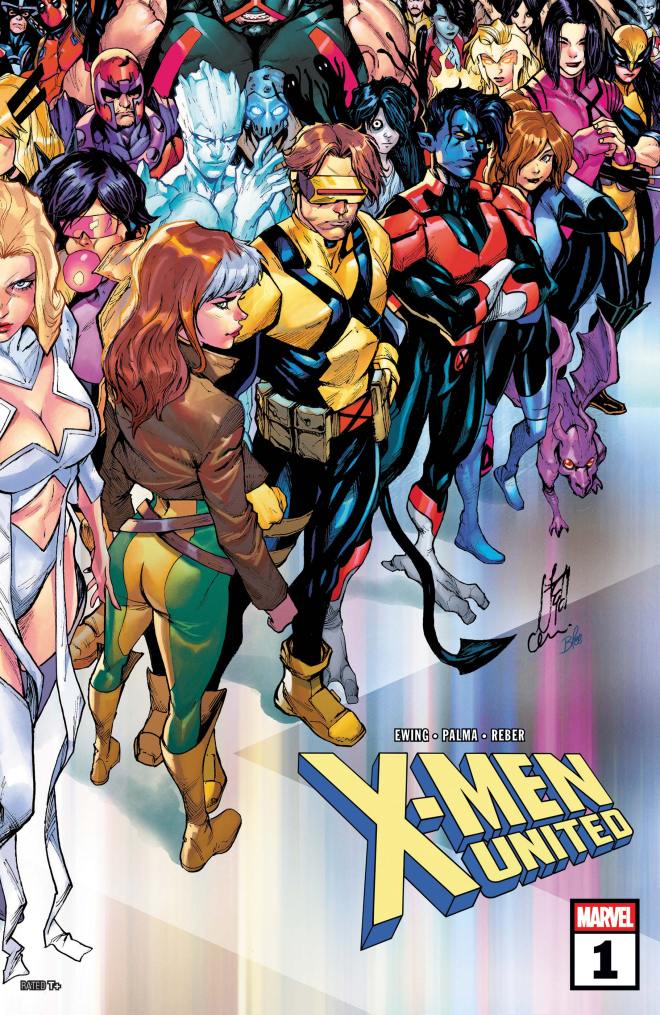
By Eve L. Ewing & Tiago Palma
Emma Frost and Kitty Pryde open a new school with the help of their teenage charges.
- I remain curious why everyone on the cover(s) are facing the reader except Rogue, who is butt-forward (I mean the reason is “a certain subset of readers like seeing female characters’ butts, but I curious if anyone involved has an alternate rationalization or why it’s just Rogue’s ass on display).
- Amongst the characters seen going through the doors in the cold open who aren’t cast members of a current series are Forge (late of X-Force), Shark-Girl (late of Dazzler), Bishop (late of, uh, that Timeslide one-shot), Random (late of, uh, I dunno, ’90s X-Factor?), Vulcan (late of X-Men Red), and Madrox (late of Dazzler).
- On paper, the initial premise set up here — hey, let’s do a school again, but in a mental place so everyone can come from anywhere and it’s more safe — is solid, but in execution it makes very little sense/is hugely contradictory. It’s supposed to be a shared mental space, but the Empathy Engine is a physical thing. Sometimes people see a door to enter, sometimes they don’t. It’s not clear if, when they go through the door, are they physically going somewhere or is their mind just going somewhere? If the school exists on the Astral Plane or whatever, how is Rift teleporting people to France? Why is Magneto still in his chair if it’s a mental space? If the school is a mental place, why do they need an infirmary? Wouldn’t the physical body (wherever it is) need to be treated, not the mental projection of it?
- Ordinarily, these kinds of questions could be tabled for awhile as a series gets going, but given both the track record of this sort of thing in the Brevoort Era as well as the fact that there’s no guarantee this book will last more than 5-10 issues, odds are none of this will ever be made clear.
- Similarly, Cyclops’ characterization here makes no sense — for one thing, he’s being positioned against Rogue and her X-Men more like he was at the start of “From the Ashes” than he is currently (a conflict which, while in the past, was never really properly explained, see above re: Brevoort’s track record in this era). For another, if Graymatter Lane is a mental place and not a physical one, then his argument that it creates a target for mutants makes less sense because they’re not all gathered in one place. Plus, he’s not wrong to be concerned that the school is using tech purloined from Mister Sinister, considered the X-books did a whole crossover (“Sins of Sinister“) a few years ago about an entire dystopic future created by the X-Men trusting Sinister too much. And also, the text is asking the readers to think Cyclops is being irrational even though we know that the simple nature of comic book storytelling requires conflict, which means he’s at least generally correct that things won’t be hunky dory at the school, so we either have to act like idiots or take a position against the protagonists of the series, which is an odd thing for the creators to do.
- Less egregious but still annoying is Rogue being distrustful of everyone, which doesn’t really fit her characterization now or in the past — especially given her background as a reformed villain.
- Storm is also here, her Brevoort-imposed exile from X-Men team books apparently at an end now that her solo book is on its last legs and Jed MacKay’s Avengers roster has been disbanded. She has no dialogue, so this new era for Storm is off to a banging start.
- Xavier wanting a school to be re-established is a reference to his parting words in X-Manhunt Omega #1.
- The Sinister tech purloined for the school was retrieved in Exceptional X-Men #10.
- That’s also when Marigold first appeared.
- I get that Ewing is understandably going to want to center her group of original young mutant characters in the book she’s writing, but it definitely seems like there’s been some kind of a time jump between this and the end of Exceptional X-Men, given the way Axo, Bronze, Melee and Rift are positioned as “sophomores” and seem to have better control over their abilities. None of the other books following Age of Revelation appear to have more than a month or two time jump.
- Especially given the fact that all of the “freshmen” we meet in this issue are either characters who are older in-universe than that quartet or with a longer (albeit not very robust) publishing history. They include Dryad (who first appeared way back in New X-Men (vol. 2) #1 and was last seen in Way of X #1); Galura, Karma’s girlfriend (who debuted in Marvel Voices: Pride #1) and is an adult; Loolo (first appearance: X-Men Red (vol. 2) #6); Wolf Cub (who debuted in the 2002 Chamber miniseries then was a regular in the short-lived Young X-Men in 2008; he was last seen in last in X-Men Unlimited #68 Infinity comic); Flourish (who first appeared in Storm (vol. 3) #1 in 2014, then popped up in Dark X-Men and was seen in the Hellfire Vigil oneshot); Woofer (who first appeared at the tail end of the Krakoa Era/”Fall of X” in X-Men (vol. 6) #22); and Ben Liu and Jen Starkey, from the current adjectiveless X-Men book, who are also both adults.
- Sophie and Axo were revealed to be in a long-distance relationship back in Exceptional X-Men.
- The name “Rift” was first used by the character in Expatriate X-Men (their team in that series was called the Blue Dashers, which also gets name-checked here).
- The Empath Engine as an alternate to Cerebro is a clever idea, re-centering the “find mutants” goal specifically on “mutants in emotional distress” vs. “any mutant”, a necessary evolution given the modern mutant population.
- Mariama LaChange is a new character.
- Glob’s reference to Emma experiencing the deaths of her student before is presumably a reference to Uncanny X-Men #281-282, when the Hellions were killed by Trevor Fitzroy; but she also lost a student during a bombing in Generation X, plus had all her students wiped out on Genosha at the start of Grant Morrison’s New X-Men.
There’s seeds of a good book here — an all-telepathic school is decent twist on the concept (and I don’t mind Ewing keeping her Exceptional kids at the center of the series). But the execution of the premise is a mess, built on out-of-date or nonsensical characterization and a lack of clarity on how exactly it works and thus what the stakes art. It also has embarrassingly-weak art for a big, high profile launch, especially compared to Carmen Carnero‘s work on Exceptional. Palma’s figure work reminds me of Secret Wars II era Al Milgrom, of all things (never a good thing), and the visual are all strangely muted — if Graymatter Lane is a school that exists within the mind and thus can be anything, why is the Danger Room just a drab warehouse-like room, less visually-engaging than even the old physical Danger Room (even before it got holographic upgrades)? Ewing’s strength is in character work, and it sure feels like she got saddled with this premise as a way to keep her Exceptional stuff going. if this series is going to succeed, she’ll need to find a way to square that premise with her strengths as a writer.
Check out Tony Thornley‘s review here.