
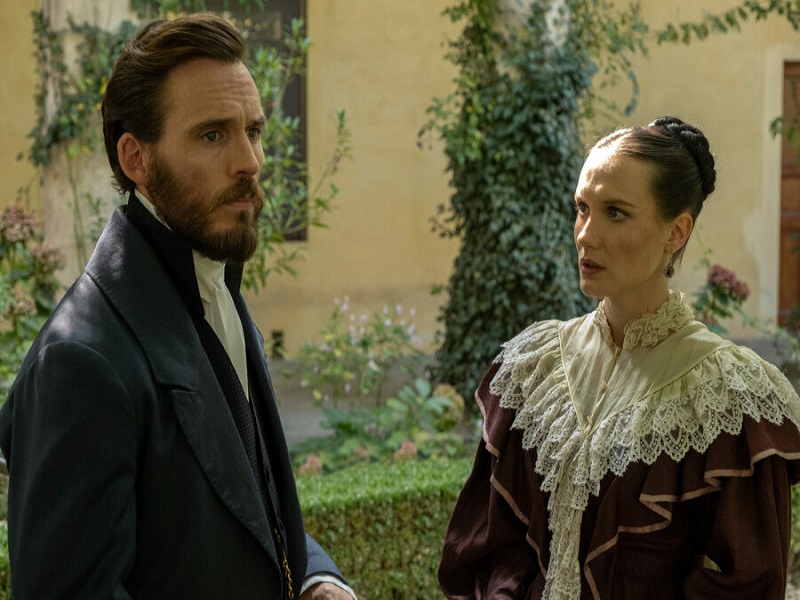
Talking PBS’ ‘The Count Of Monte Cristo’ With Actress Ana Girardot
by Rachel Bellwoar
One of the most famous tales of revenge of all time, Alexandre Dumas‘ The Count of Monte Cristo has been adapted numerous times, both for the big screen and small. The latest — an eight-episode miniseries directed by Bille August — is currently airing on PBS Masterpiece and here the tell us about her role as Edmond Dantès’ lost love, Mercédès, is actress Ana Girardot:

Ana Girardot: I first heard about the project quite early on, when it was still taking shape with Bille August attached. That immediately gave it a certain weight and sensitivity.
I had read The Count of Monte Cristo when I was younger, but like many people, I remembered the revenge more than the emotional cost. Coming back to it for this project, I was struck by how much it’s actually about time, loss, and the impossibility of going back.
Bellwoar: What excited you the most about the role and made you want to play Mercédès?
Girardot: What drew me in was that Mercédès is often perceived as “the one who waits,” but I didn’t see her that way at all.
For me, she’s someone who survives. She adapts. She makes choices that are not romantic but necessary. There’s something almost brutal in her pragmatism.
I was interested in exploring that tension between the woman she was, full of hope and love, and the woman she becomes, who has learned to live with compromise.

Girardot: That was actually the most challenging and the most interesting part.
Because the transformation doesn’t happen in front of us, you have to carry it internally. Almost like a ghost version of the character that still exists underneath.
I didn’t want to play two different women, but rather the same woman who has buried parts of herself to survive. So it became more about restraint than transformation. What she doesn’t say, what she holds back, what she refuses to feel.
Bellwoar: How helpful was hair and makeup in conveying Mercédès’ transformation, and what was your reaction when you first saw the costumes?
Girardot: Hair, makeup, and costumes were essential because they allowed us to express time in a very physical way.
When I first saw the costumes, I immediately felt how constrained she had become. The silhouettes are more structured, more rigid. It’s almost like her body is no longer free.
That helped me a lot. It wasn’t just visual; it changed how I moved, how I breathed, how I occupied space.
Bellwoar: After his return, Mercédès’ interactions with Edmond can be very formal yet highly charged at the same time. What was it like navigating those scenes, and were you able to rehearse or discuss them with your co-star, Sam Claflin, beforehand?
Girardot: Working with Sam Claflin was very fluid. We didn’t over-rehearse in a technical way, but we talked a lot about what had happened between them, all the years we don’t see.
Those scenes are really about what cannot be said. The formality is almost a protection, but underneath there’s something unresolved, something dangerous.
So it became a question of tension: how far can you hold it before it breaks?
Bellwoar: What was it like working with Bille August as director, and did it help having the same director for the whole season?
Girardot: Working with Bille August was very grounding.
He has a very calm, almost invisible way of directing, but he’s extremely precise about emotional truth. He doesn’t push for big effects. He strips things down.
Having the same director for the whole season created a strong coherence. It allowed us to build the characters over time, with a shared language and trust, instead of constantly readjusting.
Bellwoar: Thanks for agreeing to this interview, Ana!
New episodes of The Count of Monte Cristo air Sundays on MASTERPIECE on PBS. The entire season is available to stream on PBS Passport.
