
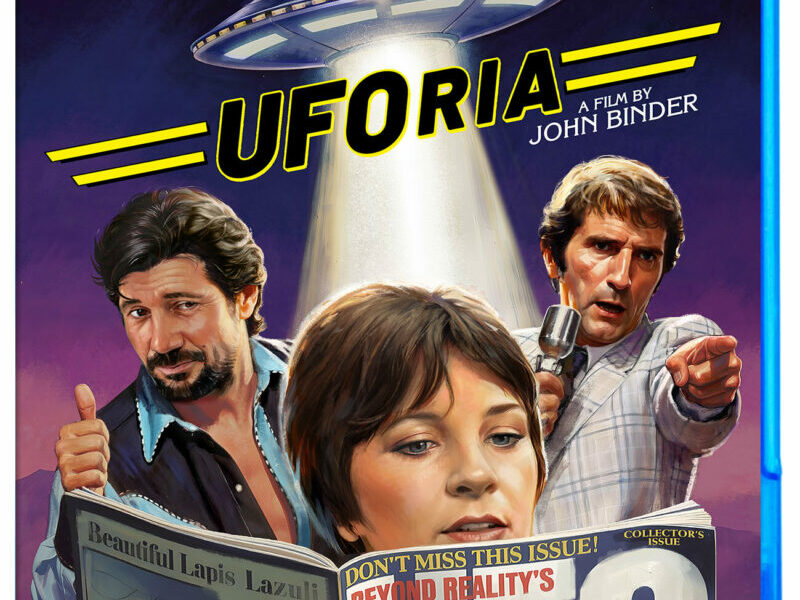
Flying Saucers And Harry Dean Stanton: ‘Uforia’ Reviewed
by Rachel Bellwoar
It is a truth universally acknowledged that a scam artist does not a good boyfriend make, which is why it should be a relief that Arlene catches on to Sheldon so early.
After meeting at the grocery store (Arlene — Laverne & Shirley‘s Cindy Williams — works the cash register), she then spots Sheldon (Tremors’ Fred Ward) at a revival meeting, claiming to have a bad leg when he was walking just fine when she caught him shoplifting. Sheldon then proceeds to act like he’s been cured by the meeting’s snake oil salesman of a preacher, Brother Bud (Big Love’s Harry Dean Stanton). In other words, Arlene has a clear picture of Sheldon’s character from the start in John Binder‘s film Uforia (1984). She just chooses to date him anyway in spite of the many red flags.

Uforia is an eccentric, slice of life film about two people with very different beliefs who are nonetheless drawn to each other and have to decide how much they’re willing to change to be together. Arlene, for her part, is convinced that a dream she recently had is a sign that aliens are coming. What makes Uforia interesting is how believers and non-believers coexist in this movie. It’s not so much about changing minds or exposing scam artists as liars.
Arlene doesn’t especially agree with Brother Bud (especially his eagerness to take money from his parishioners) yet there isn’t a sense that she’s going to stop attending his revival meetings. Does that make her complicit? Complacent? Uforia isn’t a film that passes judgement. Sometimes people go about their lives without making decisions based on moral reasons. Right or wrong, that’s a truth and Uforia shows that reality.
There’s definitely an authenticity to the world building of this movie. It feels like a real, recognizable small town community with a lot of eclectic personalities. Betsy Heimann and Thomas Ed Sunly are credited as the costumers and the wardrobe definitely stands out, from Brother Bud’s flashy jackets to Sheldon’s western shirts. The sparkly capes and antenna headbands that come out when Arlene starts spreading the word about aliens is exactly the kind of response you’d expect. There’s nothing a crowd likes more than a theme (that’s why it’s so fun whenever there’s a scene at the grocery store to realize what sale is going on because inevitably the poor staff are being made to wear accessories to match). A lot of care was taken in putting together Uforia‘s country music soundtrack as well. It wasn’t until hearing Roger Miller‘s song “Euphoria” during the closing credits that the full meaning behind the title Uforia registered.
Kino Lorber’s Blu-ray comes with a commentary by Binder and his now-wife Jeanne Field (who was an associate producer on Uforia and joins the conversation later on). Moderated by filmmaker Daniel Kremer, Binder shares anecdotes about Stanton and Williams (while it sounds like Stanton campaigned for the role of Sheldon, Williams wanted Harrison Ford to play the part). Two background details about Binder that are enlightening is that he previously worked with Robert Altman as well as on the 1972 documentary Marjoe (about child evangelist preacher turned actor Marjoe Gortner).
Uforia definitely has Altman-esque qualities in its focus on idiosyncratic characters, while Binder gives a specific example from the revival sequence that was inspired by what he saw working on Marjoe. Binder also touches on the film’s troubled distribution which unfairly has made Uforia tricky to track down in the past. Uforia isn’t necessarily a profound movie but it’s one packed with personality and flair.
Uforia is available on Blu-ray from Kino Lorber.

