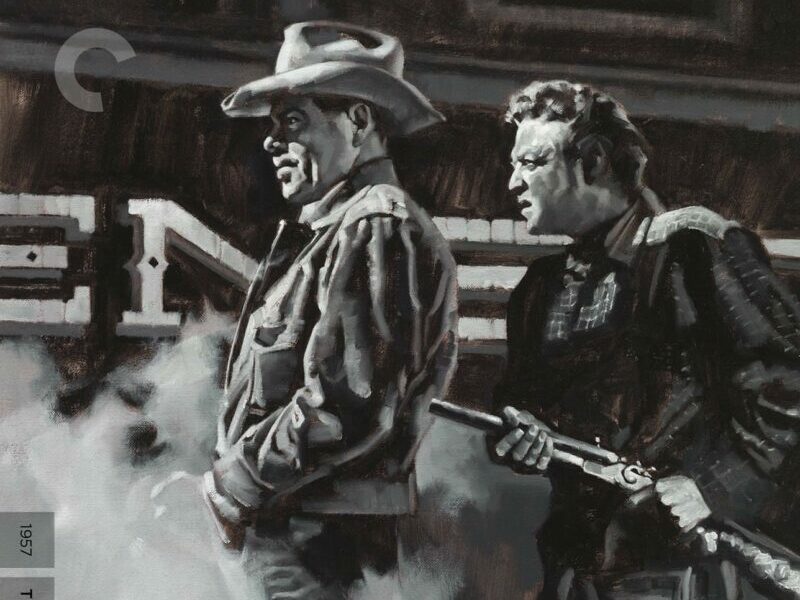
Catching The ‘3:10 To Yuma’: Reviewing The Classic Glenn Ford Western
by Rachel Bellwoar
When it comes to sticking one’s neck out, people like to talk a big game, but rarely are those words ever tested. In Delmar Daves’ 3:10 to Yuma (not to be confused with the 2007 remake starring Russell Crowe and Christian Bale), Dan (Van Heflin) has no complexes about not being a hero. It’s other people who seem to have a problem with the fact that he’s not having an identity crisis over choosing to put his and his sons’ lives first when they witness a stagecoach robbery.

Westerns have this reputation of being about macho men who don’t say much but are strong and honorable, or at least those are the John Wayne westerns I grew up on. It’s why discovering posse westerns and westerns post-High Noon have been such a revelation. In these westerns there’s a criminal at large and in order to catch him, a posse must be called together. In High Noon, that posse’s never formed as Gary Cooper learns he’s alone. In 3:10 to Yuma there’s some success forming a posse at first but, unlike Cooper, who’s waiting for the criminals to arrive on the noon day train, the wait in this film is to put the criminal they’ve caught – Glenn Ford’s Wade – on the train. Wade is the one who led the gang who robbed the stagecoach and killed its driver – the one Dan didn’t try to stop because he probably would’ve been killed, too. The more time passes, the longer Wade’s gang have to figure out where he’s being held and that’s not very good for posse morale.
Some would say that death is a way worse fate than the embarrassment other people – including Dan’s wife (Leora Dana) – seem to assume he must be feeling for standing by and doing nothing in front of his kids (Jerry Hartleben and Barry Curtis), but that’s what makes Dan (and Van Helfin’s performance) so interesting: he doesn’t rise to the bait. He defies the stereotype of the quick-tempered Western male. He doesn’t let his ego get the best of him, and when he agrees to help guard Wade until the train comes, he shows what good doing the right thing does for a person.
Posse westerns are westerns that get dirty and have stakes and make characters face moral questions they’d rather not answer and 3:10 to Yuma is a superb example. A highlight of the film is when Dan and Wade hunker down in a hotel room to wait for the train. The claustrophobia of the room is extremely effective as you see these two characters size each other up and try to pick out things in the room that they could use to get the upperhand. The room is so small Dan has to lie on the bed, but it all matters, especially the window which is both important plot-wise and for the masterful mood lighting by cinematographer Charles Lawton Jr.
If the film hits any false notes it’s with Ford’s Ben and the noble outlaw, I’m-a-leading-man-so-I-can’t-be-completely-unlikable cliche. Also, High Noon did it, too, but it is possible to wring the life out of a title song, no matter how many creative ways you spin it.
Criterion’s Blu-ray only includes two interviews: one with Ford’s son and biographer, Peter Ford, and the other with Elmore Leonard, who wrote the short story Halsted Welles’ screenplay is adapted from. They’re both good, especially the Leonard interview. In it he acknowledges the High Noon comparisons, but says if the film was an influence on him it wasn’t knowingly. There’s also a booklet essay by Kent Jones that focuses on Daves and also provides another perspective on the characterization of Wade. While more supplements would’ve been nice, the quality of the ones included can’t be faulted.
3:10 to Yuma is available on 4K and Blu-ray now from Criterion.