
Talking ‘Mister Magic: The Graphic Novel’ With Kiersten White
by Rachel Bellwoar
Val doesn’t remember being on Mister Magic as a kid. When a reunion of the cast 30 years later for a podcast starts to jog Val’s memories, she comes to realise there’s a lot more she’s forgotten and a lot about her time on the show that needs to be resolved. Adapted by Scott Peterson and illustrated by Veronica and Andy Fish, Mister Magic: The Graphic Novel see Kiersten White‘s novel brought to a new medium. For more on what that was like, here’s White’s thoughts on the experience below:

Rachel Bellwoar: Mister Magic is the second time one of your novels has been adapted into a graphic novel. What do you enjoy about the process?
Kiersten White: It feels like magic to me. Getting to see a story I wrote reinterpreted in another medium by people who are astonishingly good at what they do is a genuine delight and privilege. Watching Scott Peterson figure out how to transform the text, and then marveling over the way Veronica Fish and Andy Fish bring scenes to such vivid, emotional life blows me away.
Bellwoar: Of your books, were there any other titles you considered (or are considering) adapting? What made you choose Mr. Magic and Hide?
White: I connected with my editor at Ten Speed Graphic when Hide was announced. Kaitlin Ketchum is so fantastic to work with, and Meggie Ram and the whole team really made the process seamless for me. I’d do anything they ever wanted. I do think those two novels in particular lent themselves well to adaptation, given the modern-day settings and relatively streamlined stories. I’d love to work in middle grade for younger readers someday, too.
Bellwoar: For Mr. Magic, you’re working with the same creative team that worked on Hide. How has that collaboration been and was there anything you learned from adapting Hide that helped you this time around?
White: I feel beyond lucky that we were able to get Scott Peterson, Veronica Fish, and Andy Fish back for another round. They’re a dream team. The biggest thing I learned during the process of adapting Hide was that graphic novels are so much more complex and technical than I ever realized. I always thought I’d write one at some point, but doing editorial on Scott’s expert script made me realize I don’t have the skillset. Fortunately, my only job was editorial. Which mainly consisted of freaking out over how good everything was.

Bellwoar: Does it help that Mr. Magic already exists in a finished form or does that make it more difficult to let go of preconceived notions?
White: I’m a firm believer in flexible adaptation. I already told the story I wanted to, in the way I wanted to. Visual storytelling is inherently different; changes that serve the story should be made. So, rather than difficult, I found it really joyful. Every new batch of art from Veronica and Andy felt like a gift.
Bellwoar: Were there any changes that surprised you or caused you to think about a scene or character in a way you might not have initially intended?
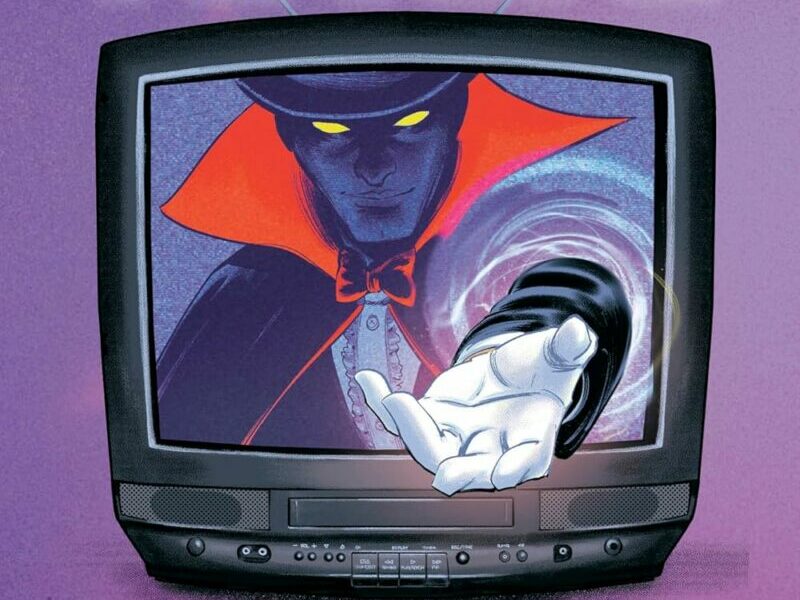
White: We went back and forth on the design of the Mister Magic character. For obvious reasons, Veronica and Andy wanted him to have more features, whereas in the book he’s sort of this black void. I think we came to a good compromise where he’s visually interesting but still a bit of a blank slate. I also have to shout out a creepy gala scene that comes near the end—Veronica and Andy absolutely nailed the aesthetic in a way that made me laugh out loud when I saw it. It was like they’d tapped into a very specific part of my past. That happened in Hide, as well. My spouse and sister-in-law both thought I was describing my oldest kid as the main character, Mack. I wasn’t. Then Veronica and Andy sent over the character design based on my description, and surprise! She looked exactly like my daughter. Whoops!
Bellwoar: With the book, readers get to bring their own memories of the kids shows they grew up with to Mr. Magic. Like, for me, it was Barney and Friends and Zoom. Does it make it more difficult to avoid specific references when there’s a visual component?
White: Barney was the inspiration for the whole idea, actually! My spouse joked about how funny it would be if the kids grew up and realized Barney had been real the whole time. And I said, “Now he’s back…and hungry.” I always make things creepy, I can’t help it.
As far as the visuals, Veronica and Andy were so good about capturing that ’80s/’90s children’s show vibe with the fashion and the color palette. It absolutely looks like a show you watched every day after school but completely forgot about.
I don’t think any of us worried about getting too close to existing children’s programs. The bigger challenge was figuring out whether we could depict actual websites for the scenes showing conversations about Mister Magic. It was tricky to pull off, and I’m still impressed with how it came together.
Bellwoar: Later this fall, you and James Tynion IV are releasing a novel set in the world of his comic book series with Werther Dell’Edera, Something Is Killing the Children. How has it been taking the opposite approach — going from a visual medium to one completely reliant on words and where it’s not your original source material?
White: It was definitely a challenge! I’ve worked with licensed properties before — Buffy the Vampire Slayer and Star Wars — but this was the first time I’d engaged with a story that existed solely in comic format. Dell’Edera’s art is so visceral and dynamic; he captures an unbelievable amount of movement and emotion in a single panel. I kept going back to his action scenes and studying them to imitate how quickly they move and how brutal they feel. And Tynion’s writing is beyond compare; it was an incredible blueprint for dialogue, world-building, and characterizations. It was intimidating to be entrusted with a character as iconic as Erica Slaughter, but they’d already set me up for success. And of course, I had James, which made everything easier and less terrifying. (At least the drafting. The book itself is quite terrifying, we hope.)
One thing we really leaned on was interiority. What is Erica thinking behind those expressions? What is she feeling beyond the limited text that we get? We had a lot more room to invite readers into her head, which was thrilling.
That, to me, is the pleasure of adaptations and new formats. The characters and story you love, but in a new way of experiencing them.
Bellwoar: Thanks for agreeing to this interview, Kiersten!
With colors by Veronica Fish and letters by Greg McKenna, Mr. Magic: The Graphic Novel goes on sale June 9th from Ten Speed Graphic.
