
Talking Virginia Woolf’s ‘Orlando’ With Jules Scheele
by Rachel Bellwoar
Virginia Woolf may have been ahead of her time when she wrote Orlando but Jules Scheele‘s graphic novel adaptation couldn’t be more timely. For more on the book, check out this interview with Scheele below:

Rachel Bellwoar: You’ve dedicated this book to the trans community. How does it feel putting out a graphic novel adaptation of Virginia Woolf’s Orlando at this moment in time?
Jules Scheele: Honestly, it feels very emotional. It’s difficult to process living in this world as a trans person right now, and there was a fair amount of comfort I took from working on this adaptation. Orlando, published in 1928, although dated in some aspects, was so ahead of its time on ideas about gender and identity and the rejection of conformity and binary thinking. These are themes that still feel so radical today and even more so in recent years, as we all have to endure endless culture wars in the media. Trans and gender non-conforming people are often positioned as some kind of new trend there, when in fact we’ve always existed in the world, no matter how the terminology for us changes or how free society is.
Bellwoar: Do you remember the first time you read Woolf’s novel, and has your opinion of the book changed over the course of working on this project?
Scheele: I think I was 17 when I first read it, and honestly, I found it difficult to process at that time. It felt very important, but in a way I wasn’t quite ready to deal with. I spent many years hiding my own feelings about gender from myself and became quite avoidant about media that made me interrogate this in my 20s. I finally picked it back up after transitioning and was amazed at how current it felt. I got really interested in the different adaptations of it as well – the Sally Potter film, of course, some of the plays, and the more abstract ones like the movie Freak Orlando from 1981, by German filmmaker Ulrike Ottinger (which is also loosely based [on] Todd Browning’s Freaks) and the recent Orlando: My Political Biography from 2023, a documentary by academic and activist Paul B. Preciado, starring 26 contemporary trans and non-binary people, aged 8-70, as Orlando and themselves. Orlando has been adapted so differently and creatively over the years because the fluidity of the book allows artists to really dig into it in a very personal way, and that’s something I really love about it.

Bellwoar: Famously, Orlando tells the story of a character who lives through multiple time periods and gender expressions. Was there a lot of pre-planning involved, in terms of deciding what they would look like or how they would dress at different points in the story?
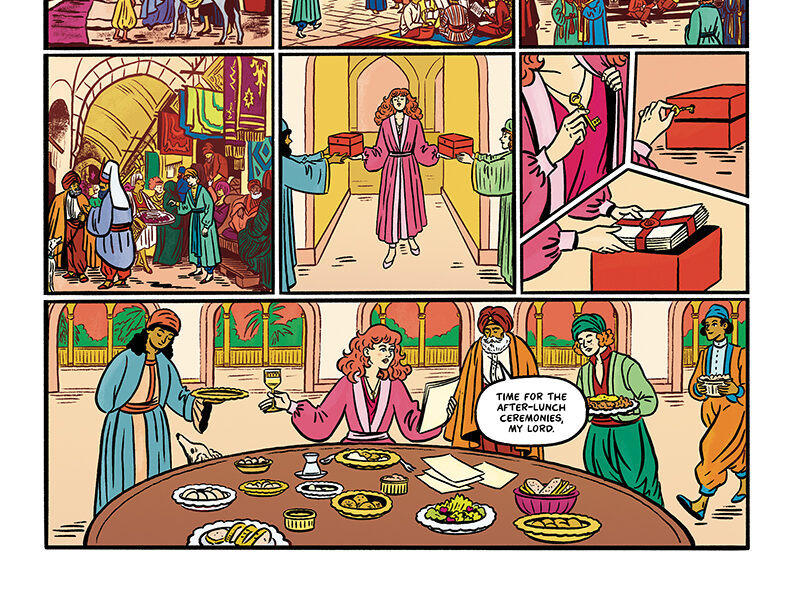
Scheele: I spent a lot of time on research — some of it at the Mitchell Library in Glasgow, and a lot of it was also done online (a bit of a challenge these days, as a lot of time was spent circumventing AI slop and fact-checking sources). First thing I did was compile mood boards for the different versions of Orlando and the other named characters. I tried not to get too hung up on historical accuracy; however, as the book itself is quite playful about this, I wanted to evoke a feeling rather than stick to 100% accurate historical costuming. I took influences from theatrical costumes, contemporary fashion and previous adaptations of Orlando as well, so it’s a mix and match of all sorts.
Bellwoar: I feel like this is a question that gets asked a lot of actors — were they able to film their scenes in sequence — but when drawing a story like this do you start at the beginning and draw each page in chronological order, or do you jump around and work on multiple pages at the same time?
Scheele: I have a very non-chronological way of working, due to my ADHD. Sometimes, to get past that executive dysfunction, you need to go where the dopamine is, so on difficult or slow days, I’d focus on pages or parts of pages that are the most fun to draw, which makes filling in the more boring parts afterwards easier for me. I also worked on the chapters out of order. I feel like it gives me more consistency of drawing across the board. One thing I do make sure gets done first is panel layouts and the lettering, though. I tend to think of the roughs/pencilling stage as a final writing stage, so I will change my mind on things I’ve done in the script or thumbnails pretty much every time. But the lettering needs to be there first to make sure it all fits, doesn’t cover up important details, and is formatted in an accessible way. I definitely learned that the hard way over the years!

Bellwoar: What was your concept for the cover, in which we get to see Orlando at different stages in their journey? The water cloak that the central Orlando is wearing is especially cool and ties in to Orlando’s affinity for nature.
Scheele: There are a few different thoughts that went into the cover, and the water cloak, particularly. It ties in with Orlando’s relationship to nature, as you said, and echoes the events around the Great Flood, a seminal point in Orlando’s life that ends up changing her path, career, and belief system. It’s also a symbol for Orlando’s fluidity of gender and being, always flowing, sometimes tumultuous, sometimes still. The idea of gender being fluid, like water, and not fixed, is something that really resonated with me when I came out. Orlando is a magical book, and I wanted to reference that too, so I used The Star card from Tarot as a visual inspiration for the cover. The card depicts a woman pouring water out of each of her hands and symbolises hope, faith, purpose, renewal and spirituality, which are big themes in Orlando’s search for meaning in life. She has one foot in the water, representing her intuition and listening to her inner voice, something which is crucial to coming out and transitioning. Reversed, it represents lack of faith, despair, and disconnection, all things Orlando deals with at various points in the book.
Bellwoar: Orlando doesn’t speak much when the book begins. Instead, we have a lot of people (and animals) talking about and projecting their ideas onto them. How was it deciding who to include as part of the chorus?
Scheele: When I was looking at adaptations of Orlando, I noticed they all utilised the unreliable narrator’s voice in the book in different and creative ways. For example, Sally Potter’s movie utilises Orlando breaking the fourth wall to the audience, and the Neil Bartlett play casts multiple Virginia Woolfs played by diverse actors, narrating from the side of the stage. I got excited about the idea of giving some of that narrative voice to the other characters in the book, which meant I was able to give a voice to the servants, entertainers, peasants, and sex workers orbiting Orlando’s life, especially where a critical voice was needed to puncture Orlando’s ego and entitlement. The text in my adaptation is all taken verbatim from the novel — I didn’t add any new writing — and it was so interesting to see how an idea could hold multiple meanings depending on what kind of character it was coming from, or what kind of visual context it found itself in. The birds taking on some of that narration seemed natural to me, too – they are a recurring motif in the book, and Virginia Woolf, in the later stages of her life, believed she could hear them singing to her in Greek.
One of the reasons Orlando is almost silent at the start is because I also wanted to invoke the way queerness is often observed from the outside, and freely commented on without input from queer people and their lived experience themselves. Everybody has many ideas of who and what Orlando is before she’s even grown. Orlando’s own voice comes into the book more as she matures and processes and forms her own ideas about her life, privilege, and autonomy. This comes to a climax in the final chapter, in which Orlando finds some kind of unity between all her multiple selves and realises what holds meaning for her — rather than status and literary awards, it’s the meaning of love and poetry and the connection that comes from both, “a voice answering a voice”.
Bellwoar: Thanks for agreeing to this interview, Jules!
Orlando goes on sale June 18th from Avery Hill Publishing.

