
Adult Animation Revolution: Chatting With Anya Butler About ‘Stuck in the Globosphere’
by Tito W. James
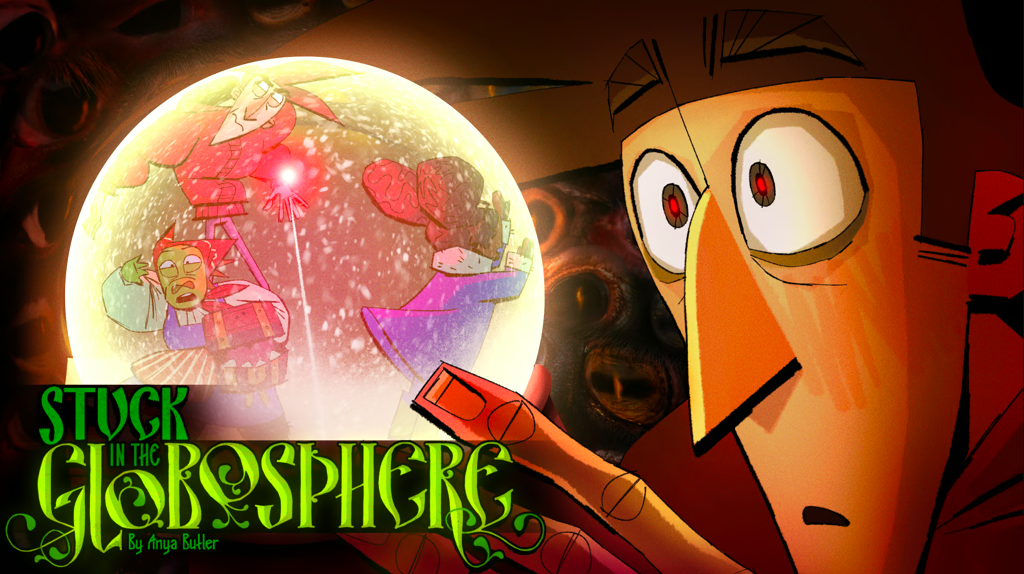
To celebrate the launch of her successful Kickstarter campaign, Comicon.com’s Tito W. James had the opportunity to chat again with Anya Butler (@meppity) about her new indie animated series: Stuck in the Globosphere.

Tito W. James: I love your art style for the show. The use of mixed-media actually reminded me of the original test pilot for Gravity Falls. What were your influences for creating the world of the Globosphere?
Anya Butler: Thank you!! I’ve always been a huge fan of mixed media and mixed-reality art, so it felt like a natural conclusion to incorporate this into my style for Stuck In The Globosphere.
Growing up, I was pretty sheltered and didn’t have access to TV networks like most 2000s kids. That being said, I did watch ITV Milkshake and CBBC, so I was blessed with British classics such as Charlie and Lola, Shaun the Sheep, Numberjacks, and In The Night Garden — all textural and media-varied shows. Aside from that, I mostly watched Soviet films on VHS (namely Cheburashka and Yuri Norstein films).
The visuals of The Globosphere are also heavily inspired by point-and-click puzzle games such as Mia’s Math Adventure and books like I Spy Treasure Hunt and Usborne’s The Great Search series. I also can’t ignore Professor Layton!
Another set of big visual inspirations is Russian folk art and decor. In particular, traditional Russian homes have a sort of “patchwork” feel to them – lots of clashing colors and textures that are reflective of a homemade, recycled feel. It’s got this sincerity and charm that perfectly lines up with not just my aesthetic sensibilities, but the story of The Globosphere itself. It even aligns with the nature of my upbringing in the English countryside and all the patchwork fields I was surrounded by.
Finally, Art Nouveau and Art Deco play a narrative role — without giving too much away, I have intentionally taken inspiration from the visual language of the two early 20th-century styles, with Deco representing industry and human endeavour, and Nouveau representing nature.

James: Animated shows with a long-running mystery are all the rage. Without giving away spoilers, how did you develop your mystery for your story? Did you start with a Twilight Zone-type plot twist, then reverse engineer the clues from there?
Butler: Ooh, good question. In all honesty, I can’t quite remember! I’ve had the core concept for nearly 14 years, and a lot has changed in that time, so it’s hard to pinpoint a true origin.
With that said, I’ve always had an overactive imagination and, as a young kid, would build elaborate worlds based on my upbringing in the English countryside. For example, we have this one large tree that creaks in the wind. I used to think it was because goblins lived inside the trunk and the creaking was them going up and down a staircase!
Effectively, a lot of the mystery started out as real questions I’d had over the years. How does this thing work? Why is this person like that? Where does this thing lead to? And, instead of relying on the truth or logic, I indulge in the weirder and wilder theories and make them the reality of The Globosphere. From there, I have all sorts of fun tying concepts together and finding a way to create the big, intricate puzzle that is The Globosphere.


James: The cost of producing an indie animated pilot is quite high. For the same amount of money, a small creative team could produce an indie graphic novel. I’m actually surprised art students aren’t going a comic book route when developing original characters and stories. Do you have any thoughts?
Butler: Funny you say that, I’ve actually seen a huge portion of my former classmates pivot to comics and graphic novels — some finding great success in the field! Maybe it’s because I live in LA, surrounded by artists, but I feel like comics are everywhere I look! To me, they are a form of storytelling that is easy to succeed with on social media — most social media offers a gallery format, so people can easily tell their stories and build a following.
It seems like a different story when it comes to younger people, like teenagers and Gen Alpha though: I believe a lot of young wannabe indie creators are taken by shows such as The Amazing Digital Circus and Hazbin Hotel, latching onto the idea of fame and popularity more than the storytelling core. These are people who don’t know much about money or the logistics of animated productions, but I admire their enthusiasm. If r/indieanimation is anything to go by, the kids want to make and consume YouTube content — comics don’t work in a YouTube format.
In my case, I am picking animation because it is what I interact with most. I love the mix of design, movement and sound all in one. I hardly read comics and I’ve not played video games since about 2013, so why would I make something if even I’m not the target audience?

James: Indie animated shows are notorious for making waves online and having passionate fan bases. Sometimes that enthusiasm crosses the line into toxic fandom. How do you maintain your artistic integrity in a world of instantaneous feedback?
Butler: I feel very lucky that, so far, Stuck In The Globosphere has received almost nothing but healthy support and positive interactions. However, toxicity is an inevitable fate all projects face, and it’s something I’m going to have to prepare myself for. I have a habit of being active in my comment sections, but as soon as people become demanding and crossing boundaries, I may have to alter this habit and take a step back. My responsibility is to focus on fostering a healthy environment by encouraging kind and good-faith discussion and leading by example, but if I need to step away to protect my mental health, that’s ok.
Unfortunately, a number of indie creators do not seem aware of their influence and spend too much time in their own comments sections — I wish to not repeat these mistakes and will step in only to have positive interactions and to dissuade poor behavior instead of enabling it.
The instantaneous feedback aspect has been the only tricky part so far. I wouldn’t consider myself particularly sensitive or defensive, but it has been a little frustrating receiving opinions from strangers based on information they do not have, such as:
- “This story is just a D&D campaign”
Beyond a group of ragtag individuals walking through the countryside, this is inaccurate. Magic doesn’t even exist in my world! - “Isn’t this just the plot of Amphibia?”
No, the similarity starts and ends at an isekai caused by an item in an antique shop – a common trope. - “Having a character with a Russian accent is inconsiderate”
No, I am a Russian citizen, and at its core, this story is about exploring the difficult relationship I have with my nationalities.
I have to accept that there is far too much information I cannot share yet that would impact people’s judgments of me and my story. I cannot blame people for having opinions based on the limited information they have. Even if they are woefully wrong, it’s not something I need to “correct” or address.


James: According to YouTube Culture and Trends Report, “… 61% of 14- to 24-year-old animation fans agree that they like watching animated series created by independent animators for YouTube as much as or more than series created by a major studio.” What are some things that can be done in indie animation that are harder to do on traditional networks?
Butler: It’s in the name! Independent animation means you do not have to deal with the oversight of profit-driven out-of-touch executives. There really are no limits in indie animation, and it means you can be truly experimental, sincere and provocative.
Sure, the budget suffers with going indie, but it’s a trade-off that I think is worth it in many cases. You do not have to create something super polished or even finished, I mean, look at the roaring success of Kiana Khan-Smith’s Pretty Pretty Please I Don’t Want To Be A Magical Girl! Traditional networks would never allow an animatic to be the finished product, and that’s a missed opportunity.
The final major thing that I believe indie holds over traditional networks is the intimacy and personality of it all. Fans can connect with creators, and creators can share whatever they want! They’re not sworn to secrecy; in fact, they often benefit from sharing works in progress and giving real-time updates — this can even financially support them if done through Patreon, etc.

James: We’re experiencing a Boom in indie animation! Other YouTube-first animated series like Dungeon Flippers and Far-Fetched, have also used Kickstarter to crowdfund episodes. What does it take to succeed and stand out in this space?
Butler: Standing out and convincing people to give you their time and money may seem hard but I actually don’t think that’s the case!!
The actual hard part is coming up with a good, compelling story in the first place.
From there, it’s all about finding your audience through marketing, and the most effective form of marketing is the pitch: a concise, but entertaining summary of your premise, the characters and the world they occupy. If you can’t convincingly pitch your story and intrigue people within 30 seconds, then you need to rethink your story and strategy.
Two months before my campaign launched, I pushed concept art, character introductions and pitch videos to my social media, growing my project Instagram from 0 to 16k followers in the process. This wasn’t a fluke or some kind of magic, though; I just made sure to consistently post material that communicated what was needed for people to give me a chance. Some clean, fun editing in CapCut and a good hook can work wonders!!
You do not need an existing following, nor do you need to be a professional; you just need to know the basics of marketing and reeling an audience in. That’s the beauty of indie — success is anyone’s game, as long as you put in the research and the work.
I’d like to thank Anya Butler for this in-depth interview.


