
Fire & Blood Files: The Prince Who Was Promised Explained
by Austin Gorton
The finale of HBO’s House of the Dragon is behind us, and one huge detail stuck out to us from the season finale. Who is The Prince Who Was Promised?
**Spoilers for House of the Dragon Season 3. Read at your own risk.**
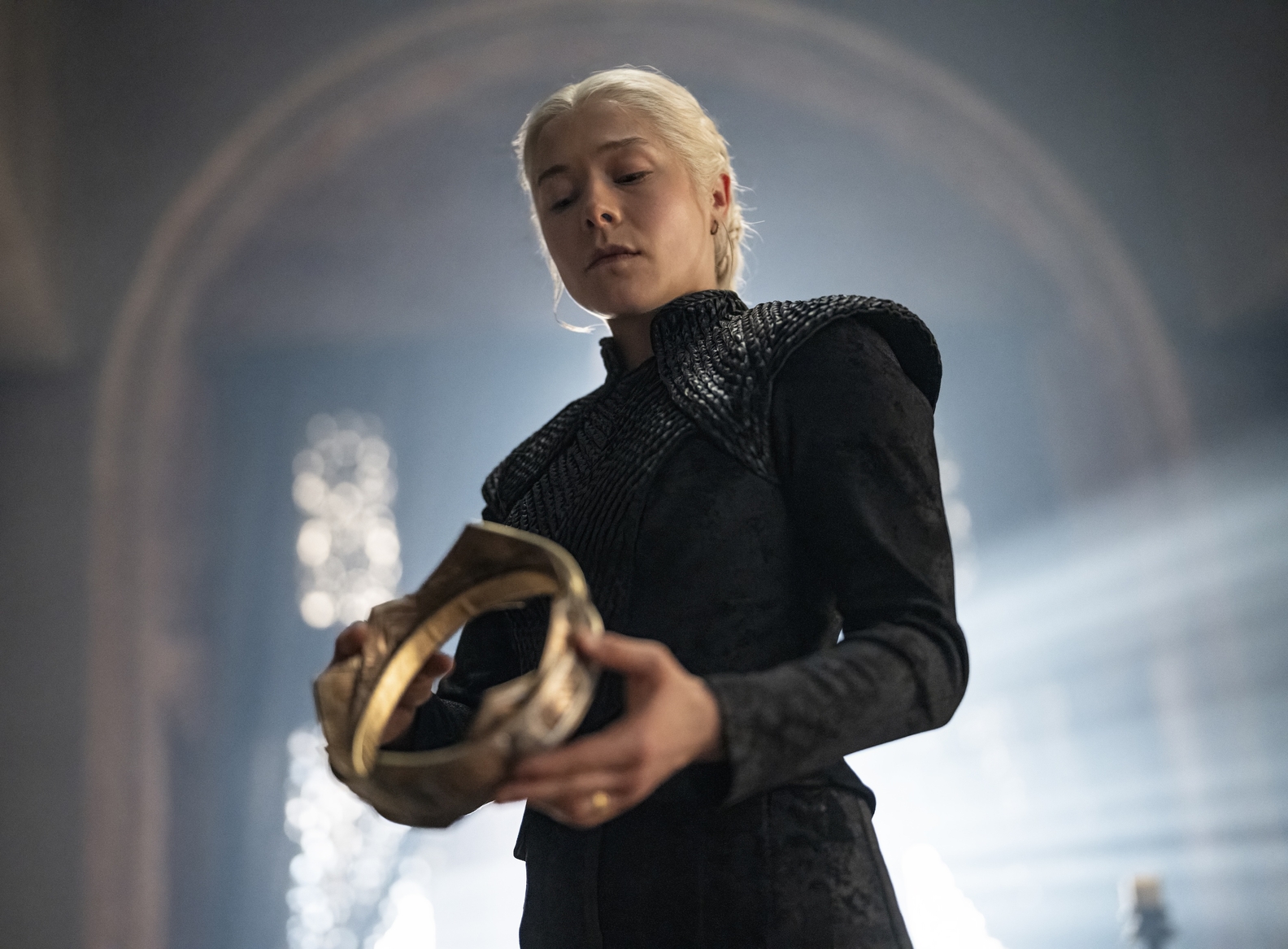
In “The Treasons of Tumbleton,” the final episode of House of the Dragon‘s third season, Rhaenyra (Emma D’Arcy) concludes her ill-advised attempt at shoring up the legitimacy of her rule by addressing a gathering of smallfolk outside the sept where she just got done killing their pope. She concludes her increasingly-insane sounding speech, in which she shares details of the prophetic dream of her ancestor, Aegon the Conqueror (first shared to her (and us) by her father Viserys (Paddy Considine) in the climax to the first episode of the series) with the declaration, “I am the shield of the people, I am Rhaenyra the Chosen, I am the Prince That Was Promised.”
That final title (which, notably, she delivered in High Valyrian, so no one listening even knew what she was saying) has particular significance in the broader “A Song of Ice and Fire” narrative, making it worth revisiting the origins of the Prince Who Was Promised prophecy and how Rhaenyra may or may not fit into it.

The term “The Prince Who Was Promised” first appears in A Clash of Kings, the second book (and in the second season of the Game of Thrones TV adaptation) in the A Song Of Ice And Fire series. When Daenerys (Emilia Clarke) visits the House of the Undying in Qarth in search of her dragons, she experiences a trippy vision in which she sees her oldest (and dead) brother Rhaegar talking to his wife about the destiny of their newborn son, proclaiming that “he is the prince that was promised, and his is the song of ice and fire” (the same words, it would later be revealed in House of the Dragon‘s fourth episode, that are inscribed on that Valyrian steel dagger).
The third novel, A Storm of Swords, expands on this further, revealing that the red priestess Melisandre (Carice Van Houten) knows of the prophecy (or at least a version of it), and believes that the Prince Who Was Promised will be the ancient warrior Azor Ahai reborn. At that point, she also believes that Stannis Baratheon (Stephen Dillane) is that figure.
More information comes in the fourth novel, A Feast For Crows, via Maester Aemon (Peter Vaughn), the ancient maester of the Night’s Watch (and brother to Egg of A Knight of the Seven Kingdoms fame). He believes that the Prince Who Was Promised will be heralded by a bleeding star, along with “smoke and salt,” echoing language also used by Melisandre. When he hears of Daenerys and her dragons, he becomes convinced that she is the Prince Who Was Promised, believing that, given the gender fluidity of both dragons (whom some believed changed sex over the course of their lifetimes) and the High Valyrian language, it wasn’t worth getting too crossed up by the gender dynamics of the word “prince.” (This is something Rhaenrya presumably buys into as well).
Daenerys fits the prophecy, having been literally born in the middle of a storm that sank the Targaryen fleet (salt) and figuratively when she emerged from her husband’s funeral pyre unscathed and with her newly-hatched dragons (smoke), an event which occurred under a red comet (the bleeding star).

Prior to his belief in Daenerys, Maester Aemon believed her brother Rhaegar (whose House of the Undying hallucinatory self introduced the whole thing in the first place) was the Prince Who Was Promised, with him having been born amidst the Tragedy of Summerhall, in which the Targaryen summer home was destroyed by fire (smoke) in an ill-advised attempt to trigger the rebirth of dragons, killing nearly everyone inside (leading to the “salt” in the tears of the mourners). Rhaegar himself seems to have believed himself to be the Prince, at least for a time, and then later believed it to be his son, Aegon (who was born while a comet was passing over King’s Landing).
It’s also possible that Rhaegar’s belief in the prophecy may have led to his kidnapping of/consensual affair with (depending on who you ask) Lyanna Stark, the event which kicked off Robert’s Rebellion, leading to Rhaegar’s death and the end of the Targaryen dynasty (events currently being dramatized in the Game of Thrones: The Mad King play in England).
Of course, George R. R. Martin has yet to confirm (or even further tease) any additional information regarding who may or may not the Prince Who Was Promised in his version of the story (the final season of Game of Thrones, which more or less abandoned references to the Prince Prophecy as it went along, seems to suggest the Prince Who Was Promised is either literally Arya (Maisie Williams), who slew the Night King (Vladimir Furdik), or some mishmash of Jon Snow (Kit Harrington) and Daenerys, who led the forces of men to victory in the Battle of Winterfell.
But House of the Dragon‘s contribution to the story of the prophecy back in its first season is something that came directly from Martin, and having the prophecy be born of a prophetic Targaryen dream would explain how so many in their line came to know of and be obsessed with it. So it wouldn’t be at all surprising if Martin writes that into a future novel (assuming there ever are any…).

So is Rhaenyra the Prince Who Was Promised?
Almost certainly not. Even without spoiling House of the Dragons based on Fire & Blood knowledge, it’s pretty clear she’s not the Prince, given that we’ve seen the defeat of the White Walkers and it came roughly two centuries after the events of this show. But what matters is Rhaenyra has chosen to believe it, as part of her moral justification for her increasingly-despotic actions. Because even if she is soup-boarding her half-sister, killing the High Septon, or ordering the sacking of Tumbleton, it’s all okay, because she’s a super special superhero prophesied to save the world.
What neither show watchers nor book readers know, however, is how she’s going to react when it becomes clear she’s not the super special superhero who saves the world, and has to come to terms with everything she did in the name of a destiny that isn’t hers…