
“An Idealist, A Dreamer And A Degenerate Slob”: Jesse Moynihan Chats About His New Graphic Novel ‘Forming’
by Tito W. James

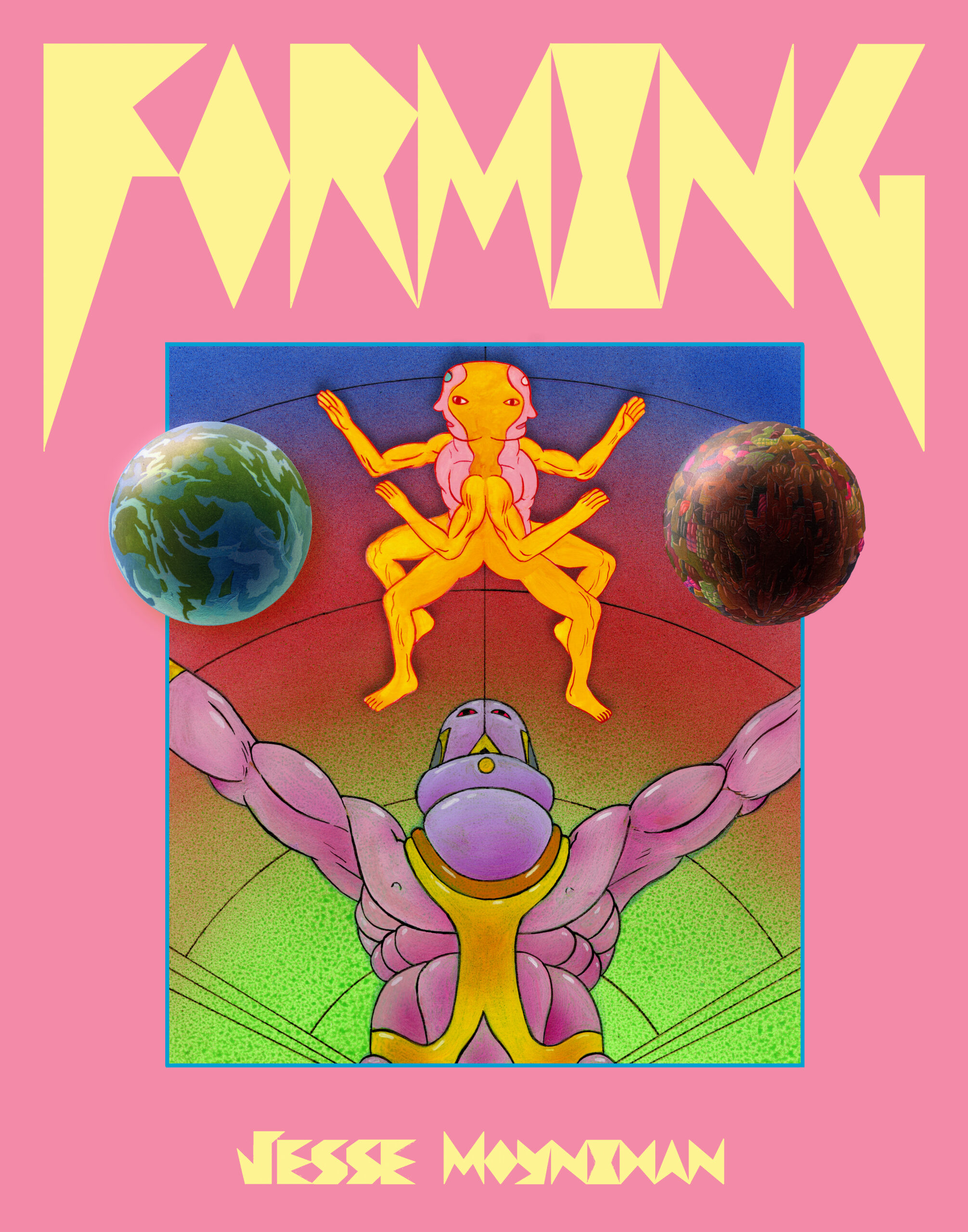
Jesse Moynihan is known for his work on psychedelic cartoons like Adventure Time, Midnight Gospel and Jesus 2. I had the opportunity to do an in-depth Q-and-A with Jesse about his new genre-defying graphic novel Forming. In Forming, Moynihan takes 50,000 years of socio-religious postulation and throws it in the blender to create one epic — and irreverent — battle royale between alien gods, Ancient Greek Titans, interplanetary assassin droids, and humanity itself.

Tito W. James: I’ve read through The Gnostic Gospels, The Secret History of the World, The Power of Myth, and I still feel like I’m getting only 80% of the content in Forming. How do you balance narrative clarity while also maintaining room for readers to have their own interpretation?
Jesse Moynihan: I tried as much as I could to forefront the personal drama and humor of the characters just above the esoteric spiritual ideas I was working through. I tried not to burden the reader with overexplaining anything, leaving it as breezy as possible. The goal of Forming was proposing an ongoing question rather than an answer. That left me free to have fun and not feel like I was writing a tied-down version of a Warhammer lore book or something.

James: Whether it’s Grant Morrison or Jodorowsky, many of the best comic creators have found themselves drawn to the arcane, esoteric, and mystical. What draws creative people to these areas of study and why is comics the place to explore them?
Jesse Moynihan: Since I was a high schooler, I’ve been trying to figure out a convincing answer to the question of existence. I remember in 10th grade my friend Steve told me he summoned a demon in his garage the summer before. My life is littered with moments like this: the experiences that make me think something else — some sort of system we don’t acknowledge as materialists is working through us either in proximity or from within or both. The easiest way to communicate these ideas is through comics. All you have to do is draw and write them down on paper. I remember being under hypnosis and encountering my “shadow”. The therapist asked me to draw him. That was the first time I was able to feel compassion for my shadow. Writing is cool, but I’m not a good prose writer. It’s easier to imagine and try to render something like that. And paper is cheap.

James: I recognize the names Angra Mainyu, Enoch, and Metatron. How much fidelity was there to the way these characters are portrayed in mythology— or was your goal just to create original characters with ancient-sounding names?
Jesse Moynihan: I looked for descriptions of characters from ancient religions to see if they would match up with the characters I was trying to portray. I tried to make the naming loosely meaningful if people wanted to look into it. Some of these accounts are pretty messy, like the nature of the Metatron is sort of all over the place depending on what you read. I thought about it like humanity’s collective, blurry memory. The exact details aren’t as important as the feeling that the story is rooted in something authentic and true.

James: With projects like Jesus 2 and Forming, I feel like you hit the bullseye in creating a graphic novel that’s equally accessible to readers of faith and non-believers. How are you able to explore spiritual ideas and stories without alienating or preaching to readers?
Jesse Moynihan: Sometimes I worry people will bounce off my stuff because of that. It definitely crosses my mind because in an ideal world everyone feels included when they read or see my work. At the same time, Forming definitely started because I felt I needed to make an unapologetically spiritual book based on things I was really feeling and the aspirations I had at the time to defeat the encroaching obnoxiousness of pop secular materialism. I could even feel it trying to crush my dreams through shows like Penn and Teller’s Bullshit, MythBusters, and later vampiric programs like Adam Ruins Everything. At the same time, I really don’t pretend to know anything, and hopefully that’s a way in for readers just looking for an entertaining yarn.

James: As a follow up to the previous question, Forming has a hilarious juxtaposition between the sacred and the profane. We’re seeing Gods and Titans with incredibly human vices and personalities. How do you balance the spiritual subject matter with heretical humor?
Jesse Moynihan: As a human being, I’m both an idealist, a dreamer and a degenerate slob. If it’s just me in my studio drawing with no editor, I’m making the most aspirational and base stuff I can think of. When I put it out into the world, I think I’m constantly bracing myself for possible bad faith interpretations of what I’m doing. Luckily so far, the hostile interpretations have been pretty minimal. I just keep waiting for the shit to hit the fan at some point.

James: Fifteen years ago, someone who believed in Big Foot just had a quirky personality. Nowadays people with funky belief systems can be legitimately dangerous. How can comic creators research the esoteric and occult without being duped by real cults and conspiracy theorists?
Jesse Moynihan: Social media psyops seemingly organized by people like Steve Bannon have absolutely tanked the conspiracy dialog. We’re living in a hypernormalized upside-down WWE world. World events are impossible to navigate and most conspiracies are at least 30% true in a post-Epstein reality. Meanwhile, the right-wing conspiracy theorists are in full occult satanic panic mode from what I can tell. How can I blame them when we see things like the pillars of Jachin and Boaz on Esptein’s island in his Turkish bath house? For me, Jachin and Boaz have inspirational symbolic meaning and really activate my world-building brain.
So what am I supposed to think about this? My friend John once said to me, “You can’t use my armies against me,” meaning that my convictions and interests will never work to undermine me as long as I stay mentally strong. I’m on my own team, so whatever the outside world is doing, I can go ahead and be curious and not worry if my areas of interest might be co-opted by internet-poisoned goons.
This has been the way for the entire history of human exploitation of belief. It seems like the internet is perhaps some sort of sub-Demiurge trying to confuse the fuck out of us. Everything is true and nothing is true. That makes people lash out in anger because they feel powerless and don’t know what else to do. It’s all mixed up. We should probably shut down the internet North Korea style. Maybe the dialog just isn’t worth it. Also maybe if you are a rich CEO influencer, going to Peter Thiel’s Dialog meetups isn’t worth it!

James: Forming reads like someone adapting a long-lost artifact that acts as the missing piece to world mythology. I’m very curious as to how this narrative was structured. Did you have a clear outline from the beginning? How did you keep track of the large cast of characters?
Jesse Moynihan: I spent several months to a year researching the story and world myths. I think I revised my master outline five or six times over the years. I had an outline of major story beats along a rough timeline that folded out of my notebook. But when I was thumbnailing pages, I allowed myself the freedom to change whatever I wanted because I knew this thing would take forever and I didn’t want to get bored doing it.

James:Forming is comic book making at a level of depth, complexity, and absurdity that’s quite rare. What practical advice would you give to a creative person who wants to add this multilayered level quality to their work?
Jesse Moynihan: I have my way of doing things, but I don’t know if it works for everyone. I really enjoy some media that’s pretty shallow, and they definitely aren’t using my methods for coming up with stories. For me, I’m trying to unpack my vulnerability and be in communication with my most primal self. Sometimes that primal self is petty, sometimes transcendent. When I write, I listen to loud repetitive music like Glenn Branca to try to forget the world I’m living in and just shoot for the most resonant images and concepts. I exploit my own human weakness for laughs, and I try to mine ideas that are emotionally hard to pull out. I’m usually trying to ask myself, ‘what else?’ when it comes to putting scenes together. If I’m just making up plots, it’s probably not good enough.

I’d like to thank Jesse Moynihan for taking the time to do this in-depth interview. The complete Forming collection will be available through Fantagraphics Books on October 6th.
