
The Weekly 2000 AD Prog 2497: Tharg Introduces Another Bumper 48-Pages Of Thrill Power
by Richard Bruton
Taking a look inside the UK’s greatest sci-fi comic, the Galaxy’s Greatest, fast approaching 50 years of brilliance — it’s the Weekly 2000 AD.

Another one of those bigger 2000 AD Progs this week. 48 pages, seven strips, the third bumper Prog of 2026, all building up to Prog 2500 and a load of new series coming your way. Inside, there’s another double dose of The Oubliette, as the Judge Dredd Mega Epic runs to its conclusion with episodes of both The Oubliette and The Finders, plus the continuation of Brink, the penultimate part of The Fall of Deadworld, and the conclusion of this series of Nightmare New York. In addition to all that, there’s one-off tales, with a Future Shock and another tale of Young Death.
Again, ignore the tease of a jumping-on point with Prog 2500 — there’s always a perfect time to jump onboard with 2000 AD, and that’s with the very first Prog you get your hands on. It worked for me. It can work for you. So, yes, just pick up the latest Prog and get into everything you can, knowing that anything that doesn’t work for you will be over soon, such is the churn of the weekly Prog.
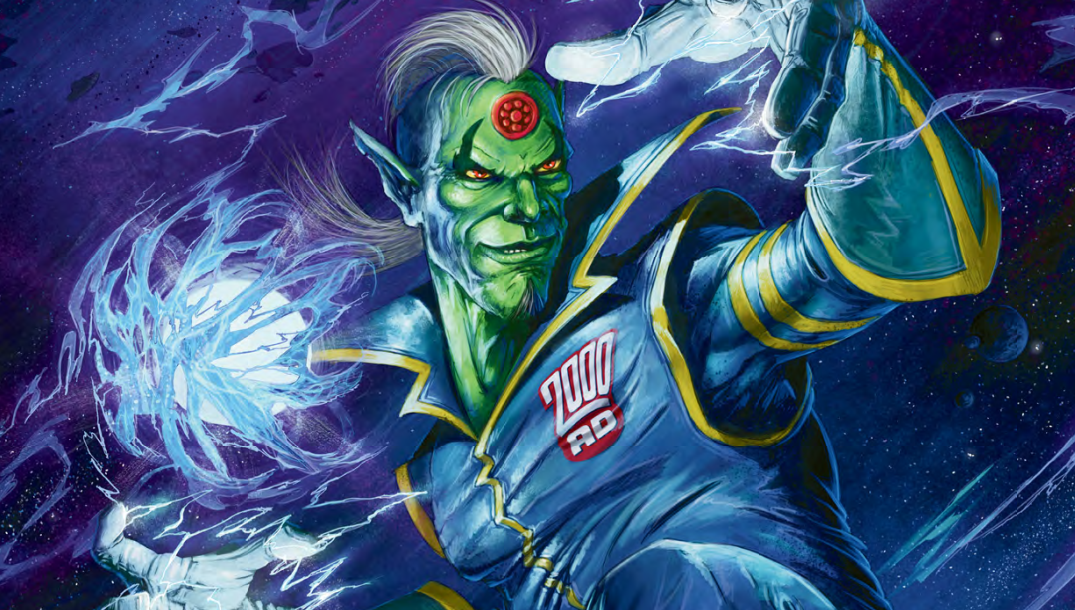
Okay, so that all over with, let’s get into this latest Prog, all behind a cover by Toby Willsmer …

2000 AD Prog 2497 is out in the UK on 26th August, and out in the USA on 9th September, the first time you’ve actually managed to experience the wonders of the weekly Prog as they’re meant to be experienced, weekly. Just be sure to ask your local comic shop to order it in for you.
Right, lots to get through, so you’ll forgive me for taking this one at a canter …

Judge Dredd: The Oubliette — Part 16 — By Ken Niemand and Dan Cornwell, Colours by Chris Blythe, letters by Annie Parkhouse
Again, double duties on the Oubliette this week, with both’The Oubliette’ itself and then ‘The Finders’, as everything races towards a conclusion in Prog 2499.
Dredd’s nearly at the end, nearly on his way out of the Oubliette, only Castallan the Judda left in his way, just as he’s been before, so many times, with the many bones of previous Dredds showing us just that. One last fall, one last death, only to come up against this at the end of last Prog, meaning he knows just who’s behind all this …

Thing is, it’s different this time; the Black Tower has fallen in Mega-City One, and Dredd has a way out — and no, I’m still not revealing who’s actually behind this, even though you got that in the final episode of The Black Tower in the Judge Dredd Megazine last week, and you get even more explanations here in this week’s Prog.
Let’s just say it all points back to the ‘Judge Child Quest’, although, as I’ve said before, the way Niemand writes it means that’s merely extra info — if you remember it, that works and adds more to the tale; if you don’t, you still get the tale told in such a way that it gives meaning to it all anyway. This is exactly the way you deal with rich continuity properly, making it clear and simple and pretty unnecessary.

Yes, ‘The Oubliette’ as a whole has been a fine, fine thing, rather simple in construction, sure, but that doesn’t mean it hasn’t been a pleasure watching Dredd fight and die again and again.
And a word for Cornwell’s art here as well, which just gets better and better, cementing his place in a modern list of damn good Dredd artists.

Brink Book 7: The Call Of The Void — Part 26 — By Dan Abnett and INJ Culbard, letters by Simon Bowland
Another series coming to its end now, with a double-length finale coming in Prog 2499. We’ve now spent half a year in the fine company of Bridge and the rest of HabSec, and it’s absolutely been worth every moment. It truly is the absolute best strip, and one that just gets better and better, a sci-fi noir drama police procedural just expertly done by Abnett and Culbard.
You know I absolutely love the series, have from the very first tale over a decade back now. I maintain that you should absolutely go out and get those collections and fall in love with it as much as I did.
Here, as it all comes to a head, we’ve got the ongoing crisis on the ship approaching the Mercury Event, as mystery and madness spreads on the one hand and the events back on LunaHab on the other, where Bridge and her colleagues are trying to get vital intelligence out Interhab Intelligence Agency (IAA) asset, Danny Reardon/Evan Leedon. It’s not proving all that easy. But then Bridge brings in her secret weapon …

This episode, five magnificent pages of Culbard and Abnett brilliance, pretty much all of it taking place in the interview room, the cramped confines letting Culbard go tight into faces, following the flow of Abnett’s dialogue.
Reardon gets some bad news and a reality check from Cutwell, another IAA asset embedded in HabSec yet whose loyalties seem (right now) to lie more with HabSec, particularly when it comes to containing Reardon.

And by the end of this one, we have Brink desperate to get in touch with Gita onboard the Mercury-bound ship, panic in her voice at what Reardon’s just given them.
It’s tight, tense, beautifully done work, effortlessly brilliant it seems, and all of it building perfectly to that finale in two Progs’ time. So, so good indeed.

The Fall Of Deadworld: Justice — Part 11 — By Kek-W and Dave Kendall, letters by Simon Bowland
The penultimate episode here, ahead of an extended finale next week, and it really does seem to be careering towards the end. Except it’s not quite THE end, not yet, not the one we definitely know is coming — after all, that is the whole point of The Fall of Deadworld, that we’re voyeuristically watching this world fall — but an end of sorts, and not one that bodes too well for young Jess Child, the heroine of this piece, one whose doomed little resistance is about to take more and more hits over the next two weeks.
First though, a moment of quiet and friendship for Jess and Arthur, as Jess looks through Sidney De’ath’s book, the one that tells your future, and the one where Jess has read of the Dark Judges, the Dark Sisters and then ones who control them, how they destroy worlds and then move on to the next …

But of course, this is Deadworld leading up to the fall, and there’s always something terrible and terrifying around the corner, waiting and ready to spoil any tiny moment of sweetness.
It’s Eunomia who’s out to spoil everything here, with no doubt her very own dastardly plans. After all, she’s been lurking in the background for a while now, and there’s no way she was going to end up on the side of the angels here. But we’ll get to more of that next time. Just don’t expect it to end well. In fact, don’t expect anything to end well, for anyone.
As it’s gone on, across the many series, Kendall’s art has shone through it all, an exercise in finding strange and grim beauty in this worst of times. And Kek-W’s story has grown on me as well, as we’ve gone deeper into it all and the end comes at us faster and faster. Fascinating to watch inevitability playing out so intriguingly well.

Nightmare New York — Book Two — Part 10 — Final Part — By Kek-W and David Roach, colours by Peter Doherty, letters by Annie Parkhouse
As with everything else ongoing here, Nightmare New York is rushing to its end. This time, young Lil’s got herself into more trouble with another old man with a passion for magic and selling souls to whatever devil or demon he thinks will gift him more power. Professor Praetorian’s plan to trade Lil and her powers to demonic forces appears to be proceeding apace, except he really shouldn’t have killed Selene, her rat friend, as that’s freed up the spirit inside her, allowing Lil access to her powers, finding out just how powerful she might be.
So, with all that, Lil just breaks free, dispatches Praetorian to a hell of his own making, and all is well, right? Well, not quite. Not yet anyway. There’s still one last twist of demonic proportions for Lil to navigate, one that ends the series on a rather large cliffhanger indeed. Nope, no spoilers, let’s just say it’s a big, big finale.

The two series of Nightmare New York have been artistic delights. First John M Burns, then David Roach, both gents giving us beautiful comic pages to look at indeed. And the story, all historical details and magical peril, has thoroughly entertained. And of course, there’s still that little fact that we know that young Lil here in 1845 grows up to be slightly older Lil, Lilian, but definitely not looking her age, in 1999, where she chats to Inspector Mucha of Kek-W and Roach’s Saphir series. Fascinating to see just how Kek-W and Roach spin this one out for the future.

Future Shocks: And Now The Fireworks — By James Peaty and Steve Yeowell, letters by Rob Steen
Nu-Britain, 2090, a fascist regime, all ‘forced repatriation of the false blood citizens’ and the like. A terror plot foiled by the Department of Homeland Stability, under threat themselves from the government, and a young agent on a mission to track down further connected terror threats. That’s where we get to after just the first page, Peaty doing a fine job indeed of laying out all the essential worldbuilding in just a few panels, vital to any Future Shock to truly work. And of course it’s a joy to see Yeowell’s artwork here in black and white and grey tones, looking crisp and sharp and detailed as well.

It twists and it turns, fairly predictably, it’s true, but it also does what it does with some style. Peaty gets us from setting up the fascist regime to the young agent uncovering something huge, to the endpoint and a forced regime change of the worst kind.
Just the mechanics of getting it all done in the short five pages is impressive, and Peaty’s storytelling to get us there is perfect, using so many tricks and shortcuts to make us, the reader, fill in the story. Excellent little Future Shock.

Young Death: Grave Consequences — By Kek-W and Sedat Oezgen, colours by John Charles, letters by Rob Steen
Another one of these standalone Judge Death tales, all of which tie into Kek-W’s saga of the Fall of Deadworld. Think of it as a prequel to the series, following Sidney De’ath’s journey from young psychopath to Judge psychopath to future Judge Death, the worst of the Dark Judges.
Each one of these might stand on its own, but collectively they build to present this picture of the man who would become Death, a biography of a superfiend. And although they all work extremely well on their own, together they really do add a lot to the mythos of the character. This time it’s Oezgen on art, capturing the essence of all De’ath and the Mortician’s little rendezvous.

Here, it’s De’ath meeting the Mortician, a fellow traveller in the darkness, and there’s almost a sensuality about their meeting, a courtship of sorts as they talk, gaining trust, allegiances made, and a first date spent unearthing De’ath’s father.
Yes, another fascinating little vignette giving us just that little more of the history of Judge Death, all of it building into a true biography of the making of a legendary character.

Judge Dredd: The Oubliette — Part 17 — The Finders — Part 6 — By Ken Niemand and Jake Lynch, Colours by Emily Roach, letters by Annie Parkhouse
Again, ending the Prog here with another episode of ‘The Oubliette’, only from the Finders perspective, joining Joe Fargo, an older, multiversal version of Dredd; PI Lana Locke, the Finder of Lost Things; Mister Jeremiah, a mystery man given to them by Professor Hobbes, and Judge Giant in the antechamber of the Oubliette, each facing their own personal demons in turn.

Two make it out the other side, the other two … lost. For good? Maybe. Time will tell. Truth be told, one of the lost is a major thing, but you’ve already seen how that happens over in the Megazine, haven’t you?
As for Joe and Lana, they’re out the other side, into the Oubliette, where a familiar figure comes into view.
The way Niemand’s worked these Finders episodes into the entire Oubliette saga has been possibly the best bit of the whole thing. It’s impressive to see this as the culmination of all the groundwork Niemand’s laid over the last few years, not least of all crafting a wonderful character arc for Joe Fargo, someone whose appearance came about, lest we forget, after a couple of deliberately multiversal tales bringing Dredd and the movie Dredds together. Who’d have thought that opening up of the Dredd multiverse could have led to something so important? Well, we didn’t. But Niemand did.
Meanwhile, artistically, The Finders has the distinct advantage of Jake Lynch’s style all over it. His angular characters, his page and panel constructions, his fluid and dynamic flow of the action, all just perfect, and all just an example of why he’s another of the small list of modern Dredd masters.
